Bearded Dragon
Lizards
The chill, cuddly lizard that changes color with its mood!
Written from Mike’s own two dragons, Dex and Cera.
On This Page▾
🤓 Did you know? Bearded dragons wave at each other as a sign of submission, basically saying 'Hey, you're the boss!'

🗓️ The first week
The numbers a new owner needs in the first week, each from the article it links to. Rows with no link come from the encyclopedia.
- Day one
- A new dragon is quarantined 3 to 6 months away from any reptile you already keep, on paper towel, with its own tools and a vet workup inside that window.Quarantine guide →
- Enclosure
- 4x2x2 ft, about 120 gallons, and that is the adult minimum, not an upgrade for later.Setup guide →
- Basking surface
- 95 to 110°F for adults, 105 to 115°F for juveniles, measured with an infrared thermometer aimed at the surface itself.Setup guide →
- Rest of the gradient
- Warm side air about 90°F, cool side 75 to 85°F, nights 65 to 75°F. Heat overnight only if the room falls below 65°F, with a ceramic heat emitter.Setup guide →
- UVB
- A linear T5 HO tube over about two-thirds of the enclosure, 12 to 18 inches from the basking surface, never behind glass. 10 to 14 hours a day, replaced every 6 to 12 months.Setup guide →
- Humidity
- 30 to 40%.Setup guide →
- Floor
- Paper towel, newspaper, or tile. No loose sand, calcium sand included.Setup guide →
- Diet ratio
- Juveniles roughly 80% insects and 20% greens. Adults flip to about 80% greens.Setup guide →
- Feeding schedule
- Hatchlings 2 to 3 times daily, 1 to 4 months twice daily, juveniles once daily, adults once daily or every other day with greens daily and insects a few times a week.Feeding guide →
- Calcium
- Gut-load the feeders, then dust with plain calcium: near-daily for juveniles, 2 to 3 times a week for adults, calcium with D3 a couple of times a week, a multivitamin once or twice a week.Feeding guide →
- Handling
- Wait 7 to 14 days before the first session. Scoop from below with all four feet supported. A black beard means the session is over.Handling guide →
- Vet
- An annual fecal exam with a sample less than 24 hours old, and a vet check before brumation season.Health guide →
- Budget
- $400 to $800 to set up, $50 to $108 a month, and an emergency fund of a few hundred dollars.Cost guide →
- Adult size
- 16 to 24 inches nose to tail tip, most adults 18 to 22.Growth guide →
- Lifespan
- 10 to 15 years in captivity.
- Shedding
- Raise humidity toward the high end during the shed, give rough surfaces to rub on, and never pull loose skin. A 30-minute chin-deep soak at cage temperature loosens retained shed.Shedding guide →
- Hygiene
- Wash hands with soap right after any contact, keep the dragon out of the kitchen, and never clean the enclosure in a kitchen sink or a bathtub people use.Hygiene guide →
- Power outage
- 65°F is the normal night low. Below 60°F for more than a day or two, add heat, move the animal, or call the sitter.Emergency plan →
🚨 Emergency card
Call the vet now if you see any of these.
- Tremors or muscle twitching
- Swelling in the jaw or limbs
- A juvenile refusing food for 2 to 3 days
- An adult refusing food for 1 to 2 weeks outside brumation, or any refusal with lethargy, abnormal stool, or a swollen abdomen
- No stool for five or more days
- A beard that stays dark for extended periods
- Difficulty moving or climbing
- Labored or open-mouth breathing
- Diarrhea, or stool that's runny or foul-smelling for more than 2 days
- Stargazing: the head held tilted up and back
- Any skin lesions or discoloration
- Swollen or bleeding gums, or cheesy material in the mouth
- A toe or the tail tip turning dark, dry, or hard
- Eyes swollen or closed for more than 2 days
- Blistered, blackened, or peeling skin
- Tissue protruding from the vent
A reptile vet, not a general clinic. Never dose an over-the-counter dewormer blind: get a fecal exam and treat what it finds.
📰 Where to go next
How Much Does a Bearded Dragon Really Cost?
$40 to $100 for the dragon, $400 to $800 for the setup around it, and the surgery bill correct husbandry prevents.
The Bearded Dragon Starter Shopping List (Buy Once, Cry Once)
Every item in the cart with a price range and the reason it is there.
Bearded Dragon Tank Setup: Temperature, UVB, and Everything Else
The full temperature table, UVB distance and replacement, humidity, and the substrate that will not impact.
Argentine Tegu Feeding: Schedule by Age, the Protein-to-Plant Split, and the Obesity Trap
Five meals a week as a hatchling to two as an adult, the 60/30/10 adult plate, the skull-sized portion, cooked eggs, and brumation versus a real refusal.
Bearded Dragon Safe Foods List: Staple, Occasional, and Never Foods
Staple greens, occasional foods, the daily salad, and the never-feed list.
How to Handle a Bearded Dragon Without Stressing It Out
Wait 7 to 14 days, scoop from below, and the signals that end a session.
Common Bearded Dragon Health Issues and What Causes Them
Metabolic bone disease, impaction, parasites, yellow fungus, atadenovirus, and the list that means the vet today.
Bearded Dragon Brumation: Triggers, the Routine, and When to Worry
How to tell brumation from illness, the pre-brumation vet check, and what a normal three months looks like.
Bearded Dragon Growth, Weight, and At-Home Health Checks
Weekly weigh-ins, the growth reference by age, and the 10 percent drop that means a vet.
Female Bearded Dragons: Eggs, Lay Boxes, and Egg Binding
Females lay without a male: the lay box, the digging window, and when it has become egg binding.
Bearded Dragon Enrichment: Climbing, Digging, and Safe Free-Roam
Climbing, the dig box, foraging, supervised free-roam, and the priority order.
🛒 What to buy
Prices and the reasoning behind each item are in How Much Does a Bearded Dragon Really Cost?.
❓ Frequently Asked Questions
How hot does the basking spot need to be?
95 to 110°F on the basking surface for adults, and 105 to 115°F for juveniles, measured with an infrared thermometer aimed at the actual surface rather than the air. That heat comes from a separate basking bulb, not the UVB tube, which supplies UV but little usable heat on its own.
Why has my bearded dragon stopped eating?
Often it's brumation, a shed, or, in females, a gravid cycle before laying, all normal. It becomes a concern when the enclosure's temperature isn't letting the dragon digest, or when refusal comes with lethargy, abnormal stool, or a swollen abdomen.
What is the most common health problem in pet bearded dragons?
Metabolic bone disease. It comes from too little calcium, inadequate or incorrect UVB, or a diet too high in phosphorus relative to calcium, and juveniles under two years old are hit hardest. Almost every case is preventable with correct lighting and supplementation.
📚 Encyclopedia
Bearded Dragon
Pogona vitticeps
Subscribe - it's free
New care guides straight to your inbox. No spam. 🐾
🖨️ Printable Guide
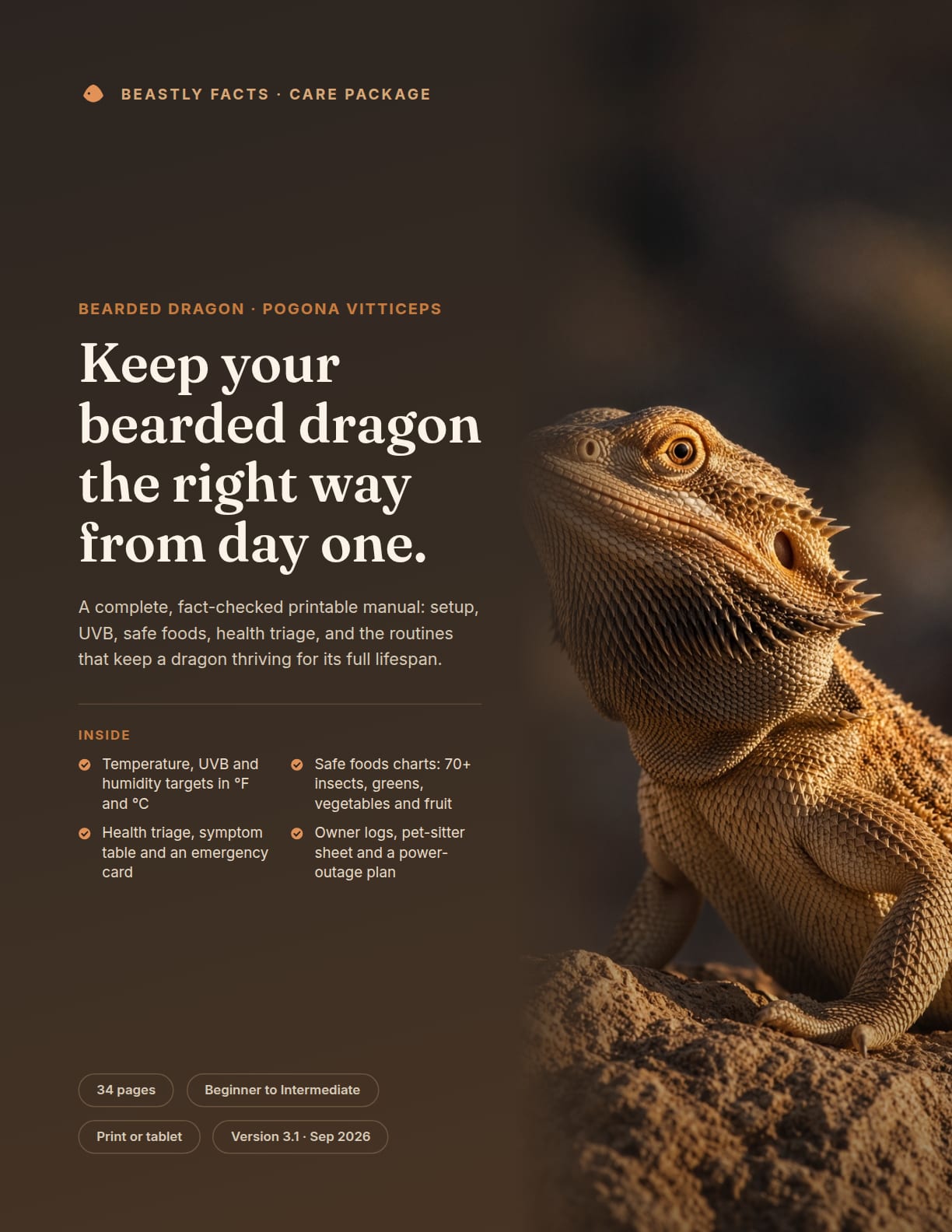
Bearded Dragon Care Package
35 pages · PDF · $8.99
📰 Deep Dive
🦎 How Much Does a Bearded Dragon Really Cost?
🦎 How to Handle a Bearded Dragon Without Stressing It Out
🦎 Common Bearded Dragon Health Issues and What Causes Them
🦎 Bearded Dragon Tank Setup: Temperature, UVB, and Everything Else
🦎 Bearded Dragon Feeding: Schedule, Diet, and Why They Stop Eating
🦎 Bearded Dragon Enrichment: Climbing, Digging, and Safe Free-Roam
🦎 Bioactive Setups for Bearded Dragons
🦎 The Bearded Dragon Starter Shopping List (Buy Once, Cry Once)
🥬 Bearded Dragon Safe Foods List: Staple, Occasional, and Never Foods
🦎 Bearded Dragon Brumation: Triggers, the Routine, and When to Worry
🦎 Female Bearded Dragons: Eggs, Lay Boxes, and Egg Binding
🦎 Bearded Dragon Growth, Weight, and At-Home Health Checks
🦎 10 Surprising Bearded Dragon Facts
🩺 Health and More
💡 T5 vs Compact UVB: Which One Won't Fail Your Reptile
🔌 Reptile Emergency Plan: Power Outages, Travel, and Pet Sitters
💧 Reading Reptile Stool, Urates, and Hydration: A Daily Health Check
🧼 Salmonella and Reptile Hygiene: The Rules That Actually Matter
🌡️ Reptile Heating and Thermostats: Preventing Burns
🧫 Reptile Quarantine: Why New Snakes and Lizards Need Months, Not Weeks
🏡 Outdoor Reptile Housing: Pens, Predators, and What Actually Kills Them
🦎 Understanding Reptile Shedding (Ecdysis)
🦎 Five Reptiles That Actually Make Sense for Beginners
🦎 Uromastyx vs. Bearded Dragon: Which Desert Lizard Fits Your Setup
🦎 Bearded Dragon vs. Leopard Gecko: Which Beginner Reptile Should You Get
📖 Short Story
There's a whole fiction series about a bearded dragon:
Chronicles of Dex: The Sun, the Glass, and the Cricket That Got Away
🤩 Fun Facts
🦎 Mood Ring Lizards
Bearded dragons can change color based on their mood and body temperature! They darken when cold or stressed, and lighten up when warm and happy. Their 'beard' puffs out and turns black when they're showing off.
🦎 The Wave of Peace
Bearded dragons wave one arm as a submissive gesture to other dragons. It's their version of 'no threat here!' and a polite greeting in dragon language.
🦎 Temperature-Switch Dragons
Bearded dragons have a clever built-in trick: while genetics set their sex at conception, incubating eggs above 32°C (about 90°F) can turn genetic males into fully functional females. It's nature's smart way to balance populations in hot climates!