UVB Lighting: Why It Matters More Than You Think
On This Page▾

For decades the hobby drew a hard line: desert lizards need UVB, everything else does not. Research since, largely driven by Frances Baines' UV Tool and by field measurement of what animals actually experience, has moved that line a long way.
The more useful reframing is that this is not a reptile question at all. The same deficiency shows up as the most common bone disease in reptile practice, as an emergency syndrome in African grey parrots, and as spinal and jaw deformity in captive frogs. Three very different animals, one lighting decision.
What UVB Actually Does
UVB is ultraviolet light in the 290 to 320 nm band, and its job is chemical rather than visual. It lets an animal synthesise vitamin D3 in its own skin. D3 is what makes dietary calcium usable.
Break that chain and the body does not simply run short of calcium. It starts taking calcium out of the skeleton to keep blood levels stable, which is why the resulting disease is properly called nutritional secondary hyperparathyroidism rather than just a calcium deficiency. The bones are being spent to protect the bloodstream.
Two things follow that are worth holding on to:
- Calcium in the bowl is not enough on its own. Without D3 the animal cannot use it.
- The damage is structural and largely permanent. Bone that has been resorbed does not come back neatly.
Reptiles: The Most Common Bone Disease in Practice
The Merck Veterinary Manual is blunt about how routine this is:
Secondary nutritional hyperparathyroidism is the most common bone disease encountered in reptile practice. It is caused by poor diet (low calcium:phosphorus ratio, vitamin D3 deficiency) or poor husbandry (lack of UVB light, inadequate thermal provision).
Note that thermal provision sits in that list alongside lighting. A reptile too cool to digest properly cannot make use of calcium it has eaten, so a UVB fixture over a cold enclosure only solves part of the problem.
Merck's own illustration of the disease is a green iguana, captioned with the swollen fibrous long bones and maxilla that characterize it, and described in three words that are hard to argue with: this is a disease of mismanagement. The green iguana is a particularly good example because it is a large diurnal herbivore with a high calcium demand, sold as a six-inch hatchling, and the green iguana care guide covers just how far that animal outgrows its setup.
What it looks like in practice: a soft or swollen lower jaw, bowed limbs, lumpy long bones, tremors, and difficulty lifting the body clear of the floor. By the time a jaw is visibly rubbery, a lot has already happened.
Ferguson Zones
Rather than a single recommendation, researchers place species into Ferguson Zones based on the UV exposure they seek out in the wild. Matching the zone matters more than picking the strongest bulb.
- Zone 1 Crepuscular and shade dwellers (crested geckos, leopard geckos). UVI 0.6 to 1.4, from low-output UVB
- Zone 2 Partial sun (corn snakes, ball pythons). Low to moderate
- Zone 3 Open shade and general basking (bearded dragons, blue-tongue skinks, fire skinks). UVI 1.1 to 3.0, from moderate UVB
- Zone 4 Intense baskers (ackie monitors, tegus, uromastyx). UVI 2.9 to 7.4 and up, from high-output UVB
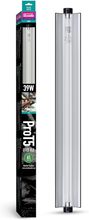
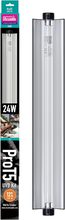
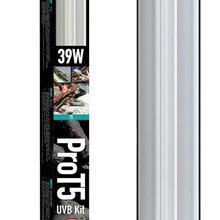
The zone describes the animal, and the bulb plus its mounting distance describes what you deliver. Those are two different things, which is why the same bulb can be right for one enclosure and wrong for another.
Birds: The Part Almost Nobody Sets Up
Ask most keepers whether parrots need UVB and you will get a shrug. The veterinary literature is considerably less relaxed. Merck, on calcium and D3 imbalance in pet birds:
The effects of a calcium-deficient diet are often compounded by inadequate exposure to unfiltered sunlight in birds housed indoors, resulting in vitamin D3 deficiency as well.
The word doing the work there is unfiltered. A cage by a sunny window is not sunlight in any sense the bird can use, because the glass has removed the wavelength that matters.
It gets more specific. Merck singles out one species twice over: young African grey parrots may show hypocalcemia as osteodystrophy, with curvature and deformation of the long bones and vertebrae, and greys are separately prone to an acute hypocalcemia syndrome tied to both low calcium and low vitamin D3. The clinical signs are not subtle: weakness, ataxia, tremors, depression, seizures and pathological fractures.
In breeding birds the same deficiency produces thin-shelled eggs, reduced hatchability, embryonic death, and can end in egg binding or cloacal prolapse.
This is why the African grey parrot care guide carries a UVB line at all, and why it is worth taking seriously for any indoor bird on a seed-leaning diet. Seed diets are the other half of the problem: sunflower and safflower seeds are both low in calcium and high in fat, so the diet and the lighting fail in the same direction at the same time.
Birds see in four color channels rather than our three, and the fourth reaches into the ultraviolet. Plumage that looks plain to us can carry UV-reflective patterning that other birds read clearly, and in several species it plays a part in mate choice. So UV light is not only a vitamin pathway for birds, it is part of how they see each other. A bird under lighting with no UV component is, in a real sense, looking at a duller world than it evolved for.
Amphibians: Less Certain, Still Consequential
Amphibians are the honest gap in the picture. Merck says so plainly:
Although the benefits of ultraviolet light are not well understood in amphibians, it is likely that diurnal species use ultraviolet B (UVB) light (280-320 nm) for calcium metabolism and for color rendition.
Uncertain mechanism, certain outcome: metabolic bone disease is frequently observed in captive amphibians, arising from dietary calcium and D3 deficiency, inappropriate UVB provision, and the calcium to phosphorus ratio of the water itself. It presents as mandibular deformity, long bone fracture, scoliosis, and eventually tetany and bloating.
Three practical differences from reptile husbandry are worth knowing:
- Bulb life is shorter. Merck specifies replacing amphibian UVB bulbs every 6 to 8 months, against the 12 months usually quoted for reptiles.
- Heat is the enemy. Fluorescent or LED sources are specified precisely to avoid heat output, with lighting within 18 inches of the animals.
- There is a boost protocol. For species that do poorly under continuous light, Merck describes high UVB for short periods, 20 minutes weekly until lesions resolve, then every 3 to 4 weeks.
There is also a genuine over-supplementation risk here that runs the other way: excessive vitamin A has been hypothesised to interfere with vitamin D metabolism and contribute to MBD, so more of everything is not the answer.
Tortoises and Turtles
Tortoises sit at the demanding end. They are long-lived, grow continuously, and carry a shell that is bone. A young tortoise short on UVB grows a soft, deformed shell, and that damage is permanent. Worth keeping separate from pyramiding, the raised, cone-shaped scutes that often get blamed on lighting: that is a different deformity with a different evidence base, pointing at humidity during growth and growth rate rather than UVB. Our sulcata tortoise health issues guide covers the studies.
Both the Russian tortoise and sulcata tortoise guides carry a strong UVB requirement for that reason, and both benefit from the one option that beats any bulb: unfiltered natural sunlight outdoors, in weather that suits the species.
The Mistakes That Actually Cause Problems
Most UVB failures are not a keeper deciding to skip it. They are one of these:
- Glass or plastic between bulb and animal. Both attenuate UVB heavily. A mesh lid costs you some output; a glass lid costs you most of it.
- Distance. UV falls off sharply with distance, so a fixture correct at 12 inches may deliver almost nothing at 20. Manufacturer distance ratings are not suggestions.
- Running a bulb past its life. A UVB bulb keeps producing visible light long after useful UV output has faded. It looks fine and it is not.
- No gradient. The animal must be able to move away. A single UV level across the whole enclosure removes its ability to regulate exposure.
- Coil bulbs in place of linear tubes. Compact bulbs concentrate output in a small area and have been associated with eye and skin irritation.
- Assuming a sunny window works. It does not. See point 1.
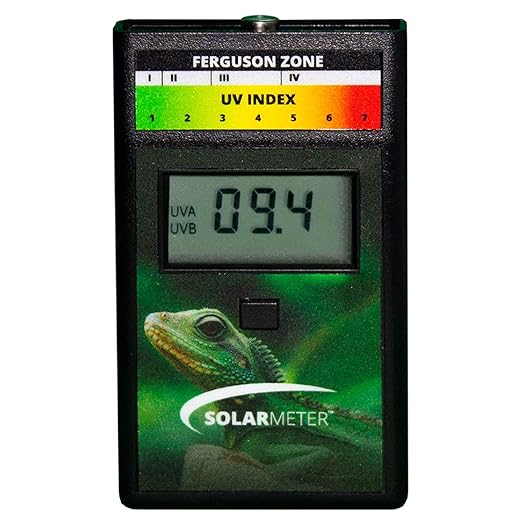
If you want to stop guessing, a UV index meter measures what is actually reaching the basking site rather than what the box claims. It is the most expensive item in any reptile kit and it is genuinely optional, but it is the only way to know rather than assume.
The Short Version
Light is not decoration. For a great many animals it is part of the metabolism, and the deficiency it causes is one of the most common and most preventable diseases in exotic pet medicine.
- Match the Ferguson Zone, not the biggest number on the box
- Use linear T5 HO fixtures over coils
- Replace on schedule, 12 months for reptiles and 6 to 8 for amphibians
- Keep glass out of the path, and mesh distance within spec
- Provide a gradient so the animal chooses its own dose
- Remember that birds count too, especially indoor greys on seed
The bearded dragon is the species where this matters most, and why skipping UVB is deadly for bearded dragons is the case study.
Sources & Further Reading
Last reviewed 5 Aug 2026 · 4 sources
- Merck Veterinary Manual: Nutritional, Metabolic and Endocrine Diseases of Reptiles
- Merck Veterinary Manual: Nutritional Diseases of Pet Birds
- Merck Veterinary Manual: Environment and Husbandry for Amphibians
- Merck Veterinary Manual: Noninfectious Disorders of Amphibians
- Baines FM et al. (2016). How much UV-B does my reptile need? The UV-Tool, a guide to the selection of UV lighting for reptiles and amphibians in captivity. Journal of Zoo and Aquarium Research 4(1):42-63.
❓ Frequently Asked Questions
Do nocturnal reptiles really need UVB if they're never active in daylight?
Current research says yes, at a low level. Even nocturnal and crepuscular species receive incidental UV exposure at dawn and dusk in the wild, and low-output UVB (Zone 1) is now commonly recommended for species previously thought not to need it at all.
Do pet birds need UVB?
Indoor birds are at real risk without it. The Merck Veterinary Manual notes that a calcium-deficient seed diet is often compounded by inadequate exposure to unfiltered sunlight in birds housed indoors, producing vitamin D3 deficiency on top of the dietary problem. African grey parrots are specifically prone to an acute hypocalcemia syndrome tied to both low calcium and low vitamin D3, which can present as weakness, tremors and seizures.
How do I know what Ferguson Zone my reptile needs?
It's based on the species' natural basking behavior in the wild. Shade-dwellers and crepuscular species sit in Zone 1 or 2 (low UV), while open baskers like bearded dragons and intense sun-seekers like ackie monitors sit in Zone 3 or 4 (moderate to high UV). Species-specific care guides typically state the appropriate zone directly.
How often do UVB bulbs actually need replacing?
Every 12 months for most linear T5 HO bulbs used with reptiles, even if the visible light still looks bright, because UV output degrades well before brightness noticeably drops. Amphibian guidance is shorter: Merck specifies every 6 to 8 months or per the manufacturer.
Does glass block UVB?
Yes, and this catches people out constantly. Ordinary glass and most plastics attenuate UVB heavily, so a bulb mounted above a glass lid, or a window described as a sunny spot, delivers far less than it appears to. Merck states the point directly for amphibians and it applies just as much to a reptile under a glass top.
Can I provide too much UVB?
Yes. Without a gradient allowing the animal to move toward or away from the light, overexposure is possible and can cause harm. A gradient that lets the animal self-regulate is as important as the bulb strength itself.
Is a compact UVB bulb as good as a linear T5 HO?
Compact coil and dome UVB bulbs generally produce a less even gradient and have been associated with eye and skin irritation in some cases. Linear T5 HO fixtures from reputable brands are the current standard recommended by most reptile lighting researchers.
🛒 Recommended Gear
As an Amazon Associate, we earn from qualifying purchases through the links above - at no extra cost to you.
Written by Michael Ryan
Mike keeps two rescued bearded dragons, Dex and Cera, and writes the care guides on BeastlyFacts from his own research and mistakes. He is not a veterinarian.
More about Michael Ryan →Comments
No comments yet - be the first!