Bearded Dragon Feeding: Schedule, Diet, and Why They Stop Eating
On This Page▾

A bearded dragon's diet changes as it grows up, and not only in amount: what belongs on the plate shifts too. Here's how that shift works, and how to read a dragon that's gone off food.
Feeding Schedule by Age
- Hatchlings (under about 1 month): 2 to 3 times daily, on flightless fruit flies and gut-loaded pinhead crickets.
- 1 to 4 months: Twice daily, insects plus vegetables introduced.
- Juveniles (roughly 4 to 18 months): Insects once or twice daily, plus a fresh salad every day (every other day at the least), so the greens habit is in place before the insects taper off.
- Adults (18+ months): A salad daily and insects a few times a week, since growth has stopped and metabolism has slowed.
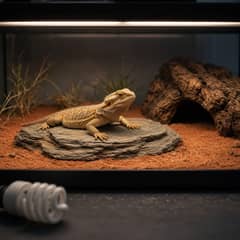
As an ectotherm, a dragon can only digest its food when it's warm enough. Feed only when the basking surface is in range.
What Bearded Dragons Eat
The ratio flips with age: juveniles eat roughly 80% insects and 20% greens, and adults move to about 80% greens and 20% insects. That isn't an arbitrary husbandry rule, since wild bearded dragons make the same shift as they grow.
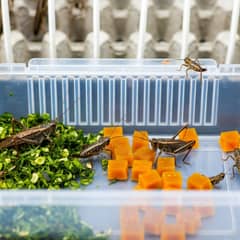
Insects: calcium-dusted crickets, dubia roaches, black soldier fly larvae, and silkworms as regular staples. Hornworms are occasional: mostly water, good for hydration or tempting a picky eater, weak as a staple. Mealworms and superworms are an occasional food from about a month old, never daily. Superworms in particular are high in fat, and both have hard exoskeletons that can wear the teeth when they're fed often, which is why they stay occasional. Waxworms are treat-only. Insects should be no larger than the space between the dragon's eyes to avoid choking, impaction, and tooth damage.
Gut-loading and dusting matter as much as the insect choice itself. Gut-load feeder insects on a calcium-rich diet for a day or two before offering them, then dust with plain calcium powder at nearly every feeding, juveniles and adults alike, with calcium plus D3 2 to 3 times a week and a multivitamin once a week. Dusting doesn't replace gut-loading, because a cricket is mostly a container for whatever it ate last: a dragon needs both. UVB lighting is essential too, because without it a dragon can't use the calcium it's getting.
Serving insects: offer as many as the dragon eats in 10 to 15 minutes, then take out whatever is left. Crickets left in overnight can bite a sleeping dragon. Feeding tongs or a smooth-sided dish keep insects from hiding in the substrate, and a few loose ones give the dragon a chase. Buy captive-bred feeders from a pet store or an online breeder.
Vegetables and greens should make up the majority of plant matter: collard greens, mustard greens, turnip greens, dandelion greens, watercress, bell peppers, green beans, and squash are good staples. Carrots are occasional: a pinch for color and variety, not a daily base. Feed spinach, Swiss chard, and beet greens sparingly, because they contain oxalates that bind calcium, and rotate in cabbage and kale carefully too. Skip iceberg lettuce: it isn't toxic, just nutritionally empty. Celery is mostly water as well, so it is fine now and then for hydration and useless as a staple. Fruit is a minor treat: aim for 5% of the diet or less, since it's high in sugar, and never let it pass 10%.
Foods to Avoid
Avocado contains persin, a compound with documented toxicity in birds and a range of mammals and no established safety margin in reptiles. Also keep off the menu: rhubarb (especially the leaves), onion, garlic, leeks, chives, and any insects caught outside, which can carry pesticides. Fireflies in particular are potentially lethal even in small amounts. Dog food, cat food, raw meat, rabbit food, and eggs are all wrong for this species even though they sometimes get suggested online, since none of them is nutritionally balanced for it. Citrus causes digestive irritation.
Why Bearded Dragons Stop Eating
- Brumation. A seasonal dormancy most captive dragons can enter, typically starting between 1 and 3 years old, commonly lasting 1 to 3 months and most often about 2. Appetite often spikes first, then drops until the dragon mostly rests in its hide.
- Shedding. Makes dragons itchy and uncomfortable, commonly paired with a temporary appetite drop and more lethargy around the shed.
- Gravidity. Female dragons can produce infertile egg clutches without a male present. Many eat voraciously during early follicle development, then go off food substantially in the 1 to 2 weeks before laying.
- Stress. A new environment, an enclosure that's too small, cohabitation with another dragon, or overhandling can suppress appetite.
- A basking temperature that's too low. A dragon needs correct heat to produce stomach acid and digestive enzymes. Too cold, and appetite wanes while digestion slows or stalls, which can also contribute to impaction.
- Impaction. A blockage from oversized insects, loose substrate ingestion, or slowed cold-temperature digestion, often paired with reduced or absent stool and straining.
- Illness, parasites, or metabolic bone disease. Usually accompanied by other symptoms like lethargy, abnormal stool, or visible weakness or deformity.
- Picky phases. Dragons can simply go off a food they're bored with. Worth ruling out before assuming illness.
When to Worry
An adult that skips food for a day or two is normal. An adult refusing food for 1 to 2 weeks outside brumation, a shed or a gravid cycle is the point to call a vet. Babies and juveniles have far less room because they're growing so fast, so don't let one go more than about 2 to 3 days without food.
During confirmed brumation, consult a vet if it runs longer than 4 months, the dragon loses 10% or more of its starting body weight, or appetite doesn't come back once it's up and moving around consistently. Regardless of day count, seek care for lethargy, stopped or abnormal stool, a swollen abdomen, visible straining, sunken eyes, unexplained weight loss, hind-limb weakness, or a persistent black-beard stress display. After brumation ends, appetite should return within 2 to 3 weeks. If it doesn't, that's worth a vet visit too.
Match the Plate to the Age
Feeding a bearded dragon well means keeping up with it: more insects while it grows, more greens once it stops. Under good heat and UVB, a dragon on the right diet for its age eats steadily, which makes any change in appetite worth noticing.
Sources & Further Reading
Last reviewed 3 Sep 2026 · 6 sources
- VCA Hospitals: Bearded Dragons, Feeding
- NC State Veterinary Hospital: How to Feed Your Bearded Dragon
- Whyte Ridge Veterinary Hospital: Bearded Dragon Care Info
- Texas Avian & Exotic Hospital: Why Isn't My Bearded Dragon Eating? Common Causes of Appetite Loss
- Avocado (Persea spp) Toxicosis in Animals, Merck Veterinary Manual
- Firefly Toxicosis in Lizards, Journal of Chemical Ecology 25:1981-1986 (Knight and colleagues, 1999)
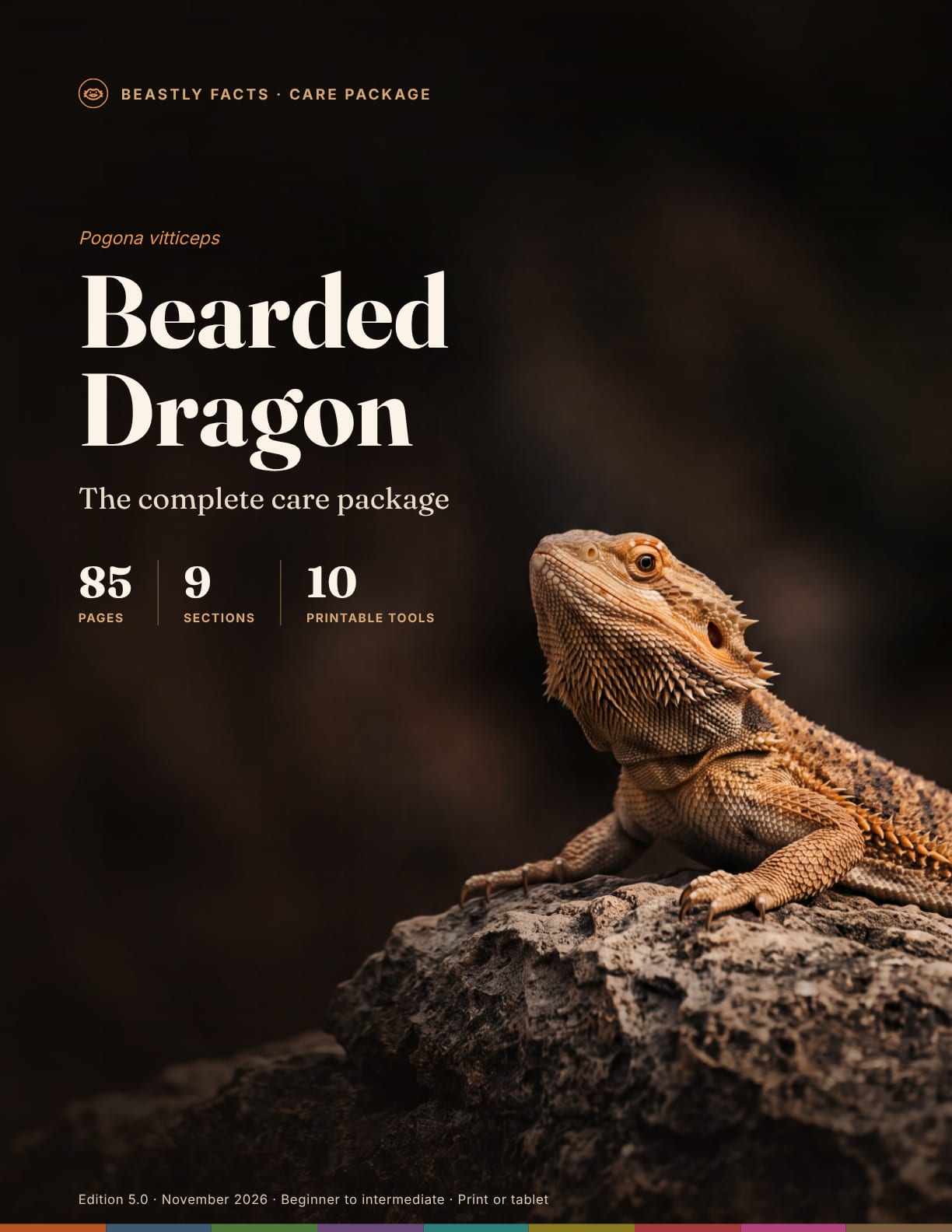
The Bearded Dragon Care Package puts the feeding section, an owner log and a pet-sitter sheet on paper, in a 85-page PDF you can keep by the enclosure, $8.99. Includes the Universal Pet Kit free: a routine chart and feeding log you can fill in.
Frequently Asked Questions
How often should I feed my bearded dragon?
It depends heavily on age. Hatchlings eat 2 to 3 times a day, mostly insects, dropping to twice daily from about a month old, then insects once or twice daily with a daily salad as juveniles, and greens daily with insects a few times a week as adults.
What's the right ratio of insects to vegetables?
It flips as the dragon grows up. Juveniles eat mostly insects with vegetables introduced alongside, and adults flip toward mostly plant matter with insects offered just a few times a week. More bugs when young and more greens as an adult is the same shift wild bearded dragons make as they grow.
Do I need to gut-load and dust feeder insects?
Both, and they do different jobs. Feeding the insects well beforehand fixes the nutrition inside the bug; the powder coating adds calcium on the outside, with a D3 version 2 to 3 times a week. Neither one counts for much without working UVB overhead, since a dragon that can't make D3 can't put that calcium into its bones.
Why has my bearded dragon stopped eating?
Often it's brumation, a shed, or in females the run-up to laying eggs. All of those are normal. It becomes a concern when the enclosure's temperature isn't letting the dragon digest, or when refusal comes with lethargy, abnormal stool, or a swollen abdomen.
How long can a bearded dragon go without eating?
Skipping food for a day or two is normal for an adult. Call a vet once an adult has refused food for 1 to 2 weeks with no brumation, shed or egg cycle to explain it. Babies and juveniles can't wait anywhere near as long: 2 to 3 days at most.
What foods are dangerous for bearded dragons?
Avocado, rhubarb, onion and garlic, and any wild-caught insects, especially fireflies, which are toxic. Dog food, cat food, and rabbit food are wrong for them too, even though they sometimes get suggested online: none of them is balanced for this species.
More on the Bearded Dragon


Recommended Gear
As an Amazon Associate I earn from qualifying purchases through the links above, at no extra cost to you.

Written by Michael Ryan
Written from Mike’s own two dragons, Dex and Cera.
Mike keeps two rescued bearded dragons, Dex and Cera, and writes the care guides on BeastlyFacts from his own research and mistakes. He is not a veterinarian.
More about Michael Ryan →You May Also Like
Subscribe - it's free
An occasional email when something new is worth your time. No spam.
Deep Dive
Health and More