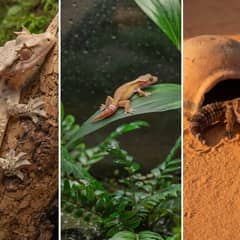
African Fat-Tailed Gecko Enrichment: Damp Hides, Warm Ground, Live Prey
On This Page▾

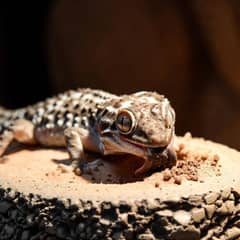
African fat-tailed geckos spend their days asleep under rocks, surface debris and abandoned burrows in the West African savanna, and their nights hunting insects on the ground. Good enrichment hands a pet fat-tail the same pattern: a damp retreat to sleep in, a choice of warm ground, earth to dig and prey to stalk. Correct heat, humidity and a properly sized enclosure (36x18 inches of floor is the minimum) come first, and no amount of enrichment makes up for them.
Wild fat-tails hide by day, hunt on the ground at night and live alone. Give yours a humid hide that stays damp all the time, hides at the warm and cool ends with a warm end that reaches the top of its range, low cover and ground to dig, and evening meals it has to hunt. Add a laying box for any female, keep one gecko per enclosure, and leave new objects for last.
A Night in the Savanna
The African fat-tailed gecko lives across West Africa in rocky woodlands and savannas, arid to semi-humid grassland with rock crevices and burrows. It is nocturnal. By day it sleeps hidden beneath rocks and surface debris or in an abandoned burrow, and at night it comes out to hunt insects on the ground.
It is a ground gecko with no sticky toe pads, so it climbs low rocks but cannot walk up walls. It is territorial and probably solitary in the wild, rarely seen in groups. The fat it stores in its tail carries it through times when food is scarce.
The fat-tail's range runs across West Africa from Senegal to northern Cameroon.
Source: Animal Diversity Web
A Damp Hide to Sleep In
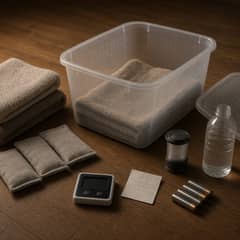
Fat-tails need a persistently damp retreat as a standing feature, not a shedding aid set up now and then. A gecko cave packed with damp sphagnum moss stays humid inside while the rest of the enclosure runs drier. Re-dampen the lining every day and replace it every week: a humid hide that has dried out is only a hide.
Keep the moisture in the hide. Raising humidity across the whole enclosure to make up for a dry hide risks respiratory infection.
Cover at Every Temperature
Give it three hides at minimum: warm, cool and humid. The point is that the gecko can be concealed and at its chosen temperature at the same time, without trading one for the other. Heat choice sits at the top of the list because when 16 leopard geckos, the fat-tail's closest studied relative, were given five types of enrichment, they spent the most time with heat and food.
Make sure the warm hide reaches the top of the warm-side range. Fat-tail females pick hotter ground than their cousin: given a temperature gradient in a nest-site study, gravid fat-tails chose sites averaging about 90°F (32.4°C), while leopard geckos in the same study chose about 84°F (28.7°C). A warm hide that sits just below the range leaves the gecko short of the spot it would choose.
Ground to Dig, Low Cover to Use
The fat-tail is a ground species that shelters under rocks and in burrows, so floor area is where the enclosure budget goes. Once quarantine on paper towel is over, give it a deep patch of diggable substrate, at least 4 inches, and low cover across the floor: cork flats, stacked slate set firmly on the tank floor, and low rocks and branches. Skip tall climbing furniture, which a fat-tail barely uses.
Meals Worth Hunting
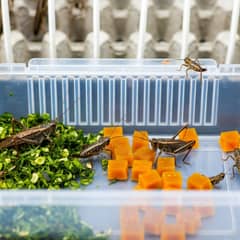
A fat-tail hunts insects on the ground at night, so a meal works best as a hunt. Offer prey from soft-tipped tongs, let a few insects loose for a short supervised hunt inside the enclosure, and vary when and where prey appears. All of these beat a static bowl. A fat-tail stalking prey often raises its tail and waves it slowly.
Feed in the evening. Fat-tails are nocturnal, and food offered in daylight gets a duller response from an animal that should be asleep.
A Laying Box for Females
Every adult female needs a laying box. Like other female reptiles, a fat-tail can form eggs with no male present, so she needs somewhere to dig and lay. Lack of a suitable nesting site is one of the recognized causes of egg-binding. A covered box of moist substrate deep enough to dig into, set in a quiet spot out of direct heat, gives her that site.
How to Tell It Is Working
A fat-tail in a setup that suits it uses what you built: it spends the day in its hides, moving between the warm and humid ones, and comes out in the evening to hunt. Its tail stays thick.
Reduced appetite, fewer droppings, lethargy and sunken eyes point to illness, and that is a question for a vet. Stress or rough handling can make a fat-tail drop its tail, so a gecko that drops one needs its setup and handling looked at.
One Gecko Per Enclosure
Keep one per enclosure. Both sexes are territorial. Males fight over space and females, and two males must never be housed together. Female groups and one male with females are kept by breeders, but only as carefully monitored groups with room to separate, and a pair produces eggs the keeper then has to incubate or discard. A single gecko loses nothing: in the wild this species is solitary, and none of the enrichment above depends on a tankmate.
A Layout It Knows, With One Thing New
Skip mirrors. In that leopard gecko study, a mirror was the only one of the five types that did not improve the geckos' welfare; heat, food, scents and new objects all did.
New objects are worth offering once everything else is in place, one at a time. A study of leopard geckos and crested geckos compared reactions to novel objects with fecal stress-hormone levels. Geckos that touched a new object sooner and explored it longer had lower baseline levels, and no object feature (color, shape or smell) was preferred across animals. Which object a given gecko takes to is individual, so try one, watch, and leave the rest of the layout alone.
Priority Order
Heat, humidity and floor space come before everything on this list.
- Three hides, warm, cool and humid, with the warm end reaching the top of the range and the humid hide kept damp
- Evening meals that are a hunt
- Ground to dig and low cover across the floor
- A laying box for any female
- One new object at a time, once the rest is in place, and never a mirror
Hides First, Then the Hunt
A fat-tailed gecko spends its day hidden, so its hides do most of the enrichment work. Keep the humid one damp and the warm one hot enough, and the gecko never has to trade cover for comfort. After that, make the evening meal a hunt and leave new objects for last.
Sources & Further Reading
Last reviewed 8 Sep 2026 · 6 sources
- Bashaw MJ et al. (2016). Does enrichment improve reptile welfare? Leopard geckos respond to five types of environmental enrichment. Applied Animal Behaviour Science
- Fernández-Lázaro G et al. (2023). Reaction to Novel Objects and Fecal Glucocorticoid Metabolite Levels in Two Species of Nocturnal Geckos. Animals
- Bragg WK, Fawcett JD, Bragg TB, Viets BE (2000). Nest-site selection in two eublepharid gecko species with temperature-dependent sex determination and one with genotypic sex determination. Biological Journal of the Linnean Society
- Animal Diversity Web (University of Michigan): Hemitheconyx caudicinctus
- VCA Animal Hospitals: Reptiles, Dystocia
- Tree of Life Exotic Pet Medical Center: African Fat-Tailed Gecko Care
Frequently Asked Questions
How does an African fat-tailed gecko live in the wild?
It lives in the rocky woodlands and savannas of West Africa, from Senegal to northern Cameroon. It sleeps by day under rocks, surface debris or an abandoned burrow and comes out at night to hunt insects on the ground, and it lives alone.
How is a fat-tail different from a leopard gecko for enrichment purposes?
Mainly in humidity. Fat-tails need noticeably more moisture than leopard geckos, though they come from arid to semi-humid West African savanna, so the humid hide is a permanent requirement instead of an optional extra. Everything else transfers closely.
Is the three-hide system enrichment or just husbandry?
Both. A warm hide, a cool hide and a humid hide let a gecko choose its temperature and humidity while staying concealed, and making that choice is itself natural behavior.
What is the best feeding enrichment for this species?
Anything that turns a meal into a hunt: prey offered from tongs, a few insects loose for a short supervised chase, and meals that move in time and place. Fat-tails are nocturnal, so an evening meal matches their activity window and gets a better response than one offered by day.
Do fat-tailed geckos need climbing structure?
Some, but it comes second. They are terrestrial, and floor space plus a working hide setup does more for them than height. Low branches, cork flats and stacked slate give somewhere to rest off the ground without turning the enclosure into a climbing wall.
How do I know the enrichment is working?
The gecko uses what you built: it spends the day in its hides, comes out to hunt in the evening and keeps its tail thick. Reduced appetite, fewer droppings, lethargy or sunken eyes point to illness, which is a question for a vet.
More on the African Fat-Tailed Gecko
Recommended Gear
As an Amazon Associate I earn from qualifying purchases through the links above, at no extra cost to you.

Written by Michael Ryan
Mike keeps two rescued bearded dragons, Dex and Cera, and writes the care guides on BeastlyFacts from his own research and mistakes. He is not a veterinarian.
More about Michael Ryan →You May Also Like
Subscribe - it's free
An occasional email when something new is worth your time. No spam.
Deep Dive
Health and More