Degu Enrichment: Burrows, Dust Baths and a Busy Day
On This Page▾

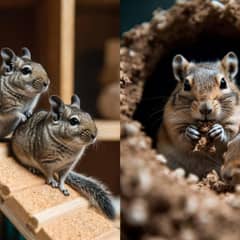
Wild degus live in the scrubland and lower Andean slopes of central Chile, a dry country of shrubs and open ground. They dig extensive communal burrow systems and live in small family groups, where related females share a nest and raise their young together. Unlike most rodents they are active by day, busiest in the morning and evening. They forage above ground on leaves, bark and seeds, hoard food, gnaw constantly, call to each other, and share dust wallows that the group marks with its own scent.
Give a pet degu what that life is built around: company, somewhere to dig, a shared dust bath, food to search for, things to gnaw and climb, a big wheel and time out with you. Degus use all of it during the day.
Company
Keep at least two. Degus groom each other and enjoy sleeping side by side, and a single degu can develop repetitive behaviors, depression or fur chewing. A same-sex pair or small group is the simplest setup, introduced slowly and on neutral ground. Give the group one nest box big enough for all of them and a hide each.
Somewhere to Dig
Wild degus dig burrows to sleep and hide in through the night, and a pet needs a way to dig too.
- Choose a cage with a high, solid base.
- Fill it with a deep layer of hay, shredded paper and dust-free bedding.
- Add a separate deep box filled with plain potting soil, with no fertilizer or other additives, for tunneling, if there is room.
- Bury a few pellets or a treat in the dig box, so digging has a reward.
- Add tubes and tunnels, such as ceramic or metal tubes at least about 2.5 inches across, for burrowing and hiding.
A Shared Dust Bath
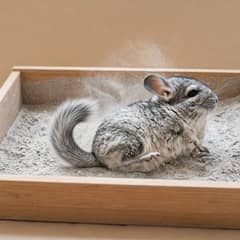
Dust bathing is an important social behavior for wild degus, who mark their favorite wallows with scent. Offer the bath to the group together:
- Fill a shallow, heavy bowl or a bath house with chinchilla bathing dust or chinchilla sand.
- Set it in the cage two or three times a week, for about 20 minutes.
- Let every degu in the group use it.
- Take it out afterward, since sand left in all the time can dry the skin.
Food to Find
Wild degus spend much of the day foraging, and scatter feeding brings that back.
- Scatter the day's pellets through the hay instead of using a bowl.
- Hide a few pellets in a wooden foraging puzzle.
- Stuff cardboard tubes and paper bags with hay and a little dried forage.
- Tuck hay into a hanging rack at a different level each day.
Keep every treat sugar-free and fruit-free, since degus develop diabetes easily. Degus hoard, so check their stores at every clean and take out anything going moldy.
Something to Gnaw
A degu's incisors and molars never stop growing, so gnawing is a daily need. Keep a mix in the cage:
- Branches of safe wood, such as pear, apple or beech, never cedar
- Wooden, rope and cardboard toys
- Mineral and lava chew blocks
- Timothy hay chews, occasionally
Skip plastic toys and hides, which degus chew apart.
Climbing and Jumping
Fit wood bridges, platforms and branches at several heights in a tall cage, so the degus can climb, jump and choose where to rest. Move a few pieces every couple of weeks so the routes stay new.
A Wheel
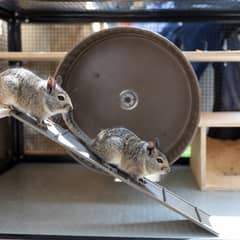
A solid wheel is close to essential for a caged degu. Use a solid-surface exercise wheel at least 12 inches across, large enough that the degu runs with a flat back. Wire or mesh wheels catch feet and tails.
Time Out of the Cage
Half an hour or more a day out of the cage is ideal, in a large exercise pen or a secure room:
- Protect or remove every electrical wire.
- Take out house plants.
- Close the doors and block gaps behind furniture.
- Add cardboard boxes, tunnels and a dig tray to explore.
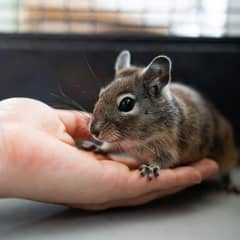
- Sit on the floor and let the degus come to you.
A Cool, Daytime Room
Degus are awake when you are, so a busy room in the day is fine, as long as it stays cool. Keep the cage around 68°F, out of direct sun, and remember that a degu lying flat on its stomach may be overheating.
Building a Chilean Hillside Indoors
A degu's day is digging, foraging, gnawing and company. Give it a group to live with, a deep layer to tunnel in, a shared dust bath and food to search for, and most of its enrichment runs itself while you are home to watch.
Sources & Further Reading
Last reviewed 15 Nov 2026 · 6 sources
- Animal Diversity Web: Octodon degus
- Octodon degus laboratory colony management principles and methods for behavioral analysis. Frontiers in Aging Neuroscience
- RSPCA: Degu Behaviour; Degu Environment
- PDSA: The Ideal Environment for Degus; Your Degu's Diet
- LafeberVet: Basic Information Sheet, Degu
- Ardiles et al. (2013). Octodon degus: A Model in Comparative Biology and Biomedicine. Cold Spring Harbor Protocols
Frequently Asked Questions
Do degus need a companion?
Yes. Wild degus live in small family groups that groom each other and sleep side by side. Keep a same-sex pair or small group, and never a degu alone unless a vet advises it.
How deep should a degu's bedding be?
Deep enough to dig and burrow in. Use a cage with a high solid base and fill it with a deep layer of hay, shredded paper and dust-free bedding, or add a separate dig box.
How often should degus have a dust bath?
Two or three times a week, for about 20 minutes, in a shallow, heavy bowl of chinchilla sand or dust. Offer it to the group together, then take it out.
What size wheel does a degu need?
At least 12 inches across, with a solid running surface. If the degu's back arches as it runs, the wheel is too small.
How much time out of the cage do degus need?
Half an hour or more a day in a large exercise pen or a secure room, with wires protected and house plants removed.
Are degus awake during the day?
Yes. Degus are mainly diurnal, most active in the morning and evening, so the enrichment you provide gets used while you are around to watch.
More on the Degu

Recommended Gear
As an Amazon Associate I earn from qualifying purchases through the links above, at no extra cost to you.

Written by Michael Ryan
Mike keeps two rescued bearded dragons, Dex and Cera, and writes the care guides on BeastlyFacts from his own research and mistakes. He is not a veterinarian.
More about Michael Ryan →You May Also Like

Subscribe - it's free
An occasional email when something new is worth your time. No spam.
Health and More