Leopard Gecko Enrichment: What the Research Actually Supports
On This Page▾

Most enrichment advice for reptiles is extrapolated from general principles. Leopard geckos are unusual in having real studies behind some of it, and the findings are specific enough to change what's worth prioritizing.
The three-hide system, warm dry, cool dry, and moist, along with correct belly heat, is the foundation everything else sits on. Toys do not compensate for a missing hide or the wrong temperature, no matter how enriched the rest of the setup looks.
What the Research Says
Bashaw et al. (2016), published in Applied Animal Behaviour Science, tested leopard gecko engagement with five types of environmental enrichment. Thermal and feeding enrichment produced the strongest responses. Mirror-based visual enrichment was the weakest, geckos largely didn't engage with it in a meaningful way.
A more recent study, Rickman et al. (2025), found that geckos in enriched housing showed improved welfare indicators compared to standard sparse setups, and when given a choice in preference tests, they consistently chose naturalistic, enriched conditions over barren ones.
Additional work on feeding presentation specifically has found that offering small insects in a more naturalistic way, rather than a single static bowl, is associated with sustained activity increases, another point in favor of prioritizing feeding enrichment over novelty items.
The practical translation is straightforward: prioritize functional enrichment, thermal choice, a maintained moist hide, and hunting opportunities, well ahead of decorative novelty objects.
Hide Enrichment Is the Baseline, Not an Extra
Three hides, minimum: a warm dry hide over the belly-heat zone, a cool dry hide, and a moist hide with damp media. This isn't just husbandry checkbox material, it's the mechanism that lets a gecko actually exercise choice, moving between microclimates while staying hidden, which is itself a real behavioral option and not a forced compromise between safety and temperature. That choice only exists if the gradient under the hides is right, and the leopard gecko temperature guide has the surface and ambient numbers.
Keep hides snug and cave-like, never oversized and open. The moist hide runs meaningfully more humid than the rest of the tank, often cited around 70 to 80% inside the hide itself, while overall enclosure humidity stays much lower, commonly around 30 to 40%. Raising the whole enclosure to that higher number instead of using a dedicated moist hide is the wrong approach, and it raises respiratory infection risk. Maintain and replace the damp media so it stays damp, not swampy and not bone dry.
Feeding and Hunting Enrichment
This is the highest-value enrichment after thermal setup, according to the research above. Tong-feeding, short supervised insect hunts inside the enclosure, a rolling treat dispenser that sheds insects as it is nudged, and simple timed-release prey containers all give a gecko something closer to natural hunting behavior than a bowl of static food. Evening feeding matches this crepuscular species' natural activity window.
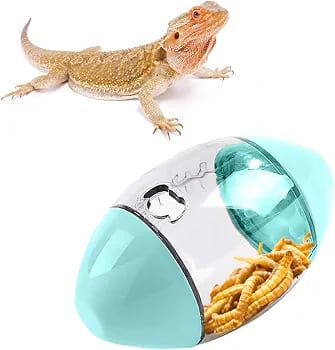
Keep prey no larger than the space between the gecko's eyes, and don't leave feeder insects unsupervised in the enclosure long-term. Never use wild-caught insects or fireflies.
Climbing, Cover, and Dig Options
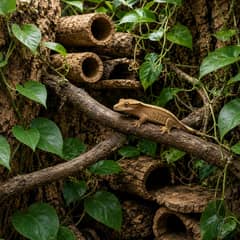
Low sturdy branches, cork flats or tubes, and stacked slate give a gecko somewhere to climb and rest off the ground, along with visual cover that still allows movement through the space. Height matters less here than it does for arboreal species, floor space and a properly working hide setup do more for this species than a tall build.
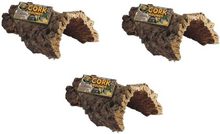
A dig box can satisfy digging behavior, which shows up especially in some females, without converting the whole floor to loose substrate. Paper towel or tile stays the safest primary substrate for beginners; sand and soil-style mixes are an advanced option for healthy adults only, never calcium sand.
Occasional novelty, a new piece of cork, a mild rearrangement, has some value but is genuinely secondary to everything above. It's a nice-to-have, not where the research points as a priority.
Priority Order
- Correct belly heat plus all three hides, including a genuinely maintained moist hide
- Feeding and hunting presentation
- Low climbing structure and visual cover
- A dig opportunity
- Light novelty rotation, last on the list for a reason
What Not to Do
A one-hide setup isn't enrichment with a gap, it's a missing foundation. Skipping the moist hide, or raising overall humidity instead of using one, both work against this species instead of for it. Calcium sand marketed as an enrichment substrate carries a real impaction risk. Lifting a gecko by the tail during "play," or treating a shed cycle as handling time, both cause real harm, not enrichment. And don't assume a wheel or a toy substitutes for hides and hunting opportunities, the research above is fairly direct about which of those actually moves the needle.
Sources & Further Reading
Last reviewed 31 Aug 2026 · 3 sources
- Bashaw MJ, et al. (2016). Does enrichment improve reptile welfare? Leopard geckos (Eublepharis macularius) respond to five types of environmental enrichment. Applied Animal Behaviour Science, 184, 150-160
- Rickman EL, et al. (2025). The impact of enriched housing on the behaviour and welfare of captive leopard geckos, summarized by the University of Lincoln
- RSPCA: How to care for a leopard gecko
❓ Frequently Asked Questions
What does the research say about leopard gecko enrichment?
Bashaw et al. (2016) found leopard geckos engaged with several types of enrichment, but thermal and feeding enrichment produced the strongest responses, while mirrors and other visual enrichment were the weakest. Rickman et al. (2025) found enriched housing improved welfare indicators compared to standard sparse setups, and geckos preferred naturalistic, enriched conditions when given a choice in preference tests.
Is the three-hide system enrichment, or is it just husbandry?
Both. A warm dry hide, a cool dry hide, and a moist hide are the baseline that lets a gecko choose its thermal and humidity microclimate while staying hidden, which is itself a form of enrichment (behavioral choice), not just a checklist item. Toys and novelty items don't make up for a missing hide or the wrong temperature.
What's the most effective enrichment for a leopard gecko?
Thermal choice and feeding or hunting presentation, in that order, according to the available research. Tong-feeding, short supervised insect hunts inside the enclosure, and evening feeding timed to match their crepuscular activity all outperform passive novelty items like mirrors.
Do leopard geckos need climbing structure?
Some, but it's secondary to hides and feeding. Low sturdy branches, cork flats or tubes, and stacked slate give a gecko somewhere to rest off the ground, but floor space and a working hide setup matter more than height for this species.
Should I give my leopard gecko a dig box?
It can satisfy natural digging behavior, especially for some females, without converting the whole enclosure floor to loose substrate. Paper towel or tile stays the safest primary floor for beginners, with a separate dig box added if you want to offer it.
Do leopard geckos benefit from mirrors or other visual enrichment?
Not much, according to Bashaw et al. (2016), mirror-based visual enrichment was the weakest-performing type tested. It's not harmful, but it's a low priority compared to thermal and feeding enrichment.
📰 More on the Leopard Gecko
🛒 Recommended Gear
As an Amazon Associate, we earn from qualifying purchases through the links above - at no extra cost to you.
Written by Michael Ryan
Mike keeps two rescued bearded dragons, Dex and Cera, and writes the care guides on BeastlyFacts from his own research and mistakes. He is not a veterinarian.
More about Michael Ryan →Comments
No comments yet - be the first!