Jackson's Chameleon Enrichment: A Mountain Animal in a Warm House
On This Page▾

The enrichment problem with this species is usually a thermometer.
Jackson's chameleons come from cool, humid montane forest, and most captive ones are kept too warm. Before any enrichment item helps, the enclosure has to stop being a problem, because a chronically overheated chameleon has no behavior left to enrich.
What the Research Says
Nothing on Trioceros jacksonii. The borrow is from the veiled chameleon, the nearest studied relative.
Ballen, Shine and Olsson reared hatchling veiled chameleons alone or in groups of four using a split-clutch design. Two months later the isolation-reared animals were more submissive, darker and duller, and worse at a foraging task. Different genus, same family, and the honest reading is the same one: early life shapes a chameleon more than the hobby assumes, and it says nothing about housing adults together.
Jackson's chameleons give birth to live young instead of laying eggs, which is unusual among chameleons and is a montane adaptation. Carrying developing young at altitude beats leaving eggs in cold ground.
Temperature, Which Decides Everything Else
Listing this first because it is the one that decides everything else. Montane species. They need a cooler ambient range than the chameleons most care sheets are written around, plus a genuine night-time drop, and a house sitting at a comfortable human temperature all year is already too warm for many of them.
Check the numbers with an actual thermometer rather than the room's feel. Chronic overheating in this species presents as a chameleon that has simply stopped doing things, which is easy to file as personality.
Planting Density
The core enrichment item once the temperature is right. Dense live planting in a 24x24x48 screen enclosure, layered so the animal can cross the cage at several heights without being visible from the room.
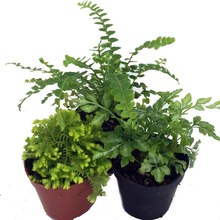

The test is the same as for veiled chameleons: if you can always spot your chameleon immediately, it is too sparse. Live plants also hold the humidity this species needs and catch the water it drinks.
Water That Moves
They drink droplets running off leaves and largely ignore standing bowls. An automatic misting system makes that reliable, with drying cycles between mistings, never permanent saturation.

Montane humidity is high and cyclical. Constant wet in a cool enclosure is how respiratory infections start. Drippers, misters and foggers each solve a different part of that cycle, and the chameleon hydration guide sorts out when each is the right answer.
Branches at Varied Diameter
Chameleon feet grip in opposed bundles and want something to close around. Mix thin flexible stems with thicker branches, run them diagonally, and give more than one route between basking, feeding and resting positions so movement involves a choice.
Prey Released, Not Presented
Given the foraging deficit in the veiled chameleon study, this is worth doing properly. Release insects into the planting so they have to be found and shot at. Vary where and when they appear. Keep a cup for tracking intake and dusting, and do not let it be the only way food ever arrives.
Quiet
Worth listing as an enrichment item. Low traffic, visual barriers on two or three sides, and minimal handling. Many animals in the trade are wild-caught and arrive already stressed, and for those the first months are quarantine and a vet. A new decoration is not the priority.
Priority Order
- Correct montane temperatures, with a real night drop
- Humidity with proper drying cycles
- Planting dense enough to disappear into
- Reliable moving water to drink
- Branches at varied diameter and angle
- Prey released to be hunted
- Low disturbance and visual barriers
What Not to Do
Do not keep a montane animal at veiled chameleon temperatures, which is the failure this guide is built around. Do not house adults together, since the quieter species hides the stress rather than avoiding it. Do not rely on a standing water bowl. Do not keep the enclosure saturated around the clock in a cool cage. And do not treat handling as stimulation for an animal that mostly endures it.
Sources & Further Reading
3 sources
- Borrowed evidence. No enrichment study exists for this species. The finding below is from veiled chameleons, the nearest studied relative, and is covered in full in our Veiled Chameleon enrichment guide.
- Ballen C, Shine R and Olsson M (2014). Effects of early social isolation on the behaviour and performance of juvenile lizards, Chamaeleo calyptratus. Animal Behaviour
- Chameleons. Handbook of Exotic Pet Medicine
- Burghardt GM (2013). Environmental enrichment and cognitive complexity in reptiles and amphibians
❓ Frequently Asked Questions
Is there enrichment research on Jackson's chameleons?
No. Nothing has been published on Trioceros jacksonii. The nearest evidence is the veiled chameleon isolation study, which found that hatchlings reared alone for two months grew into more submissive, duller, worse-foraging animals. Different genus, same family, so it is a reasonable borrow.
What makes Jackson's chameleons different from veiled chameleons?
Altitude. They come from cool, humid montane forest in East Africa, so they need noticeably lower temperatures and a real night-time drop. A room temperature that suits a veiled chameleon can be lethal to a Jackson's over time.
What is the most important enrichment item for this species?
Getting the temperature down. That sounds like husbandry rather than enrichment, and for a montane animal being kept too warm it is the change that unlocks every other behavior. A chronically overheated chameleon does not climb, hunt or display much of anything.
Do they need a misting system?
In practice, yes. They drink moving droplets off leaves, need high humidity with drying cycles between mistings, and the humidity requirement is higher than for most chameleons kept in the hobby. Hand spraying enough times a day is difficult to sustain.
Can Jackson's chameleons be kept together?
No, not as adults. They are less openly aggressive than veiled chameleons, which makes the stress harder to spot rather than absent. Solo housing is correct, and a subordinate chameleon in a shared enclosure declines quietly.
Are wild-caught Jackson's chameleons common?
Historically yes, and it matters here. Wild-caught animals arrive with parasite loads and transport stress, and a stressed imported chameleon needs quarantine, veterinary attention and quiet far more than it needs enrichment objects.
📰 More on the Jackson's Chameleon
📘 Jackson's Chameleon care guide
🦎 How Much Does a Jackson's Chameleon Really Cost?
🦎 How to Handle a Jackson's Chameleon
🦎 Common Jackson's Chameleon Health Issues
🦎 Jackson's Chameleon Enclosure Setup: Considerably Cooler Than the Veiled Chameleon
🦎 Jackson's Chameleon Feeding: Three Insects Every Other Day, and the Supplement That Causes Edema
🛒 Recommended Gear
As an Amazon Associate, we earn from qualifying purchases through the links above - at no extra cost to you.
Written by Michael Ryan
Mike keeps two rescued bearded dragons, Dex and Cera, and writes the care guides on BeastlyFacts from his own research and mistakes. He is not a veterinarian.
More about Michael Ryan →Comments
No comments yet - be the first!