Guinea Pig Feeding: Schedule, Diet, and Why They Stop Eating
On This Page▾

A guinea pig's gut depends on food moving through it almost constantly, so a skipped meal matters more here than it does for most pets.
Feeding Schedule
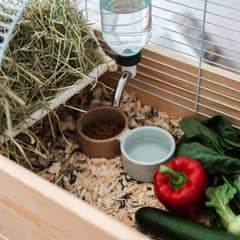
Guinea pigs are near-constant grazers, so continuous access matters more than counting meals. Fresh grass hay, timothy, orchard, or oat/meadow, should be unlimited at every life stage, kept in a hay rack that never runs empty. It makes up roughly 80% of the diet. A measured daily portion of guinea-pig-specific fortified pellets goes on top, typically in the morning, and measuring the pellets each day makes a drop in appetite obvious at once. Fresh vegetables go in every day, at any time of day, with anything uneaten pulled after 30 minutes to a couple of hours to avoid spoilage. Treats, fruit included, should stay under about 10% of the daily diet.
| Daily Component | Amount |
|---|---|
| Grass hay (timothy or orchard) | Unlimited, roughly 80% of the diet |
| Plain, vitamin-C-fortified guinea pig pellets | About 1 to 2 tablespoons per guinea pig, measured |
| Fresh vegetables, mostly leafy greens | About 1 to 2 cups per guinea pig |
Babies start nibbling hay, pellets, and vegetables within hours of birth even while still nursing, and are typically fully weaned by 2 to 4 weeks old. Juveniles under about 6 months do best with alfalfa hay added alongside the grass hay, since the extra protein and calcium support growth. Adults stick to grass hay as the staple, because alfalfa carries too much calcium and protein for an adult. Pregnant and nursing guinea pigs benefit from alfalfa, and a growing, pregnant, nursing or ill one needs more vitamin C than a healthy adult, roughly 30 to 40 mg a day against 20 to 25.
What Guinea Pigs Eat
Grass hay is the staple, fed unlimited. It supplies the long-strand fiber that keeps digestion moving and the abrasive chewing that wears down ever-growing teeth. On top of that goes a daily measured portion of commercial pellets made for guinea pigs. Rabbit and other rodent pellets contain no added vitamin C, since those animals make their own. Choose plain pellets, because ones with nuts, seeds or dried fruit are too high in fat. Look for stabilized vitamin C on the label, and use pellets within about 90 days of manufacture, since the vitamin degrades with light, air and time. That means buying a small bag more often than seems necessary.
Fresh vegetables go in daily, rotated among varieties: bell pepper, ripe tomato, romaine lettuce, broccoli, cauliflower, carrot, celery, spinach, kale, dandelion greens, parsley, cilantro and cucumber are all commonly used. Altogether, 1 to 2 cups of fresh produce per guinea pig a day is the usual range. Kale, spinach and parsley are high in vitamin C but also in calcium, which feeds bladder stones, so they rotate through the week rather than going in every day. Iceberg lettuce has almost no nutritional value, so it is left out. A new vegetable goes in on its own and in a small amount, so a change in appetite or droppings can be traced to it.
Vitamin C Every Day
Guinea pigs cannot make their own vitamin C, so every day needs a source. Fresh vitamin-C-rich vegetables are the daily one, fortified pellets add to it, and a direct supplement in drop or tablet form is the backup. The need scales with body weight: 10 to 25 mg per kilogram a day for a healthy adult and 30 mg per kilogram or more for a growing, pregnant, nursing or ill one. That works out to about 20 to 25 mg a day for a typical adult and 30 to 40 mg for a growing or pregnant one. Bell pepper is a good daily choice, high in vitamin C and low in sugar, and it carries more vitamin C by weight than an orange. About 1 to 2 tablespoons of chopped pepper a day is enough for most guinea pigs, and it is a better daily source than pellets, whose vitamin C fades in the months after they are made. The supplement is the backup: use it on a day the fresh vegetables fall short or the pellets are past their date, at the dose on the label, and ask the vet for the dose for a growing, pregnant or ill guinea pig.
Never dose vitamin C through the water bottle. It oxidizes quickly, and a picky drinker may drink less if the water tastes different. A diet that falls short shows up as scurvy within a few weeks.
Fruit is an occasional treat: small amounts of orange, kiwi, apple or pear are fine. Fresh water needs to be available at all times.
Foods to Avoid
Toxic: avocado (linked to heart muscle damage), chocolate, onions, garlic, chives and leeks (they can cause hemolysis, with symptoms sometimes taking 3 to 5 days to appear), rhubarb (high oxalic acid, linked to bladder stones), raw potato and unripe tomato or their plant leaves, mushrooms, and fruit pits or seeds.
Skip high-starch or high-fat treats too. Nuts, seeds, peanut butter, corn, bread and pasta are not toxic, but guinea pigs will pick them over hay and pellets, causing nutrient gaps and obesity. As strict herbivores, guinea pigs eat no meat, eggs or dairy.
Why Guinea Pigs Stop Eating
- Dental disease. The most common cause. Guinea pig teeth grow continuously, and uneven wear creates sharp points or misalignment that make chewing painful, often invisible to an owner without a vet exam.
- GI stasis. Gut motility slows or stops, usually from inadequate fiber, dehydration, pain, or stress. It is both a cause and an effect of not eating, and an emergency.
- Illness or pain elsewhere. Respiratory infections, urinary tract issues or bladder stones, arthritis, or injury commonly suppress appetite as a secondary sign.
- Environmental stress. A new home, cage move, new cage mates, or loud noise can put a nervous animal off its food. A bonded companion helps, and the same-day rule below still applies.
- Dietary neophobia. Guinea pigs set their food preferences early in life and do not adapt well to sudden changes, so a new hay type or pellet brand can get turned down for being unfamiliar. Introduce new foods gradually.
- Pregnancy toxemia. A risk in overweight or late-term pregnant sows, presenting with appetite loss and potentially fatal without prompt treatment.
- Vitamin C deficiency. Decreased appetite is one of the earliest signs, appearing within 2 to 3 weeks of a deficient diet, alongside foot inflammation, weight loss, and a rough coat.
Weighing and Body Condition
A gram scale is the most useful tool a guinea pig owner can have. Weigh each guinea pig once a week at the same time of day and write the number down, because the trend over several weeks says more than any single reading. Adult boars normally weigh 900 to 1,200 g (2 to 2.6 lb) and sows 700 to 900 g (1.5 to 2 lb), and each animal's own steady figure is the one that counts.
A steady fall is a reason to call a vet, since dental disease is one common cause. A steady climb usually comes from too much food and too little exercise, so check the pellet and fruit portions and add supervised floor time. Guinea pigs are shaped like a rounded brick, so the scale is not the whole test: look down at the animal from above, and sides that bulge outward point to excess weight. Have a vet rule out a tumor or a pregnancy before changing the diet for weight loss, and make any change gradually.
When to Worry
A guinea pig that skips meals is never normal, because its digestion depends on constant food, so the safe window is short. Call a vet the same day a guinea pig stops eating or its droppings fall off, and treat more than 12 hours without food as an emergency. Once GI stasis sets in, it can become life-threatening within 24 to 48 hours. With prompt treatment, many guinea pigs start improving within 24 to 72 hours.
Signs that warrant a same-day call: reduced or absent droppings, or droppings turning small or dry, lethargy, a hunched or tense posture, audible teeth grinding, a bloated or firm abdomen, reduced water intake, and labored breathing. Any noticeable drop in eating is reason to contact an exotics-experienced vet promptly.
The Morning Check
Look at the pellet bowl and the droppings every morning before topping anything up. An empty bowl and plenty of droppings make a normal day, and anything less starts the clock.
Sources & Further Reading
Last reviewed 3 Oct 2026 · 5 sources
- VCA Hospitals: Guinea Pigs, Feeding
- PetMD: GI Stasis in Guinea Pigs
- NC State Veterinary Hospital: Caring for Your Pet Guinea Pig
- Merck Veterinary Manual: Housing and Nutrition of Guinea Pigs, for the 1 to 2 cups of produce a day, the per-kilogram vitamin C figures, and the vegetables high in vitamin C
- Lafeber: Is My Guinea Pig Fat?, for weekly weighing, the adult weight ranges and the view from above
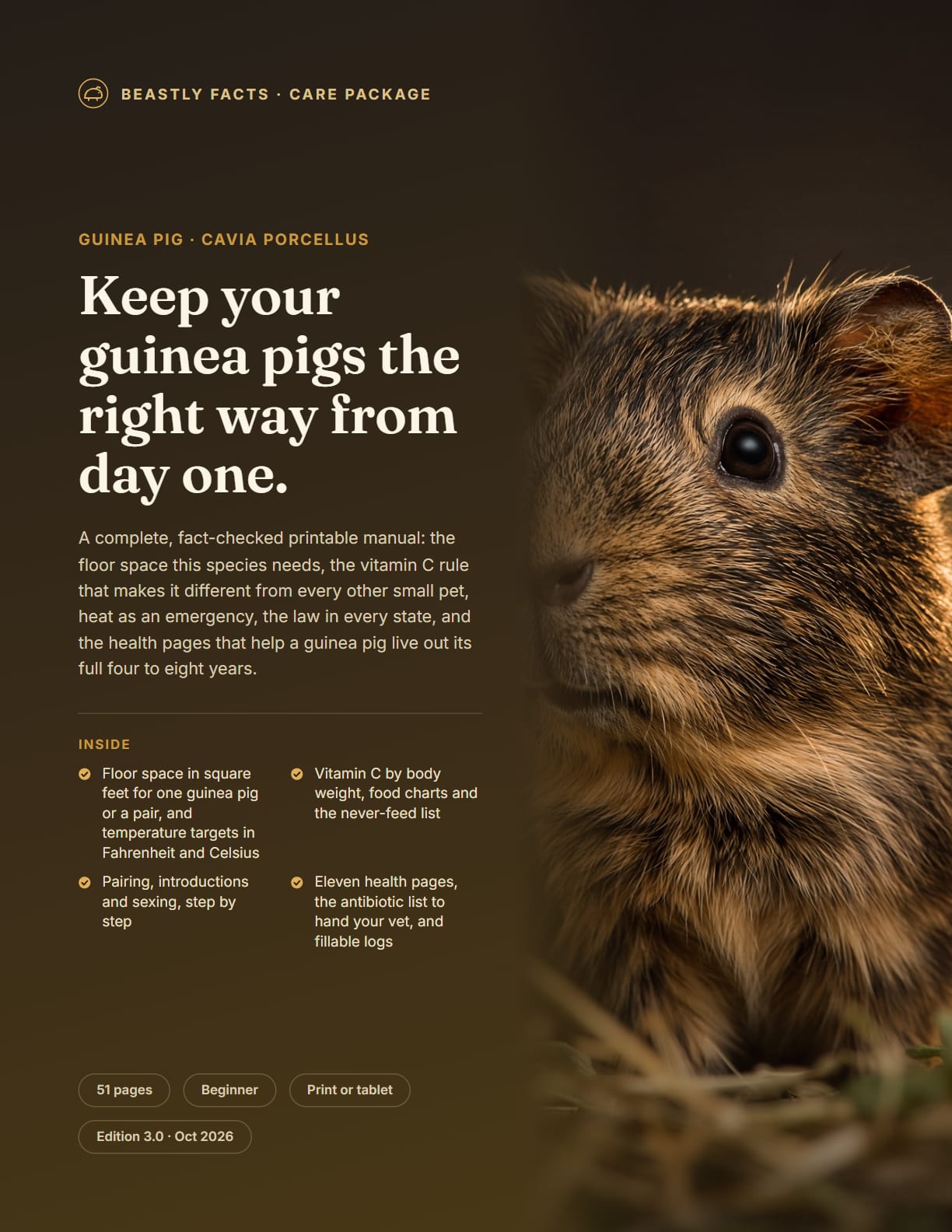
The Guinea Pig Care Package puts the feeding section, an owner log and a pet-sitter sheet on paper, in a 51-page PDF you can keep by the cage, $8.99. Includes the Universal Pet Kit free: a routine chart and feeding log you can fill in.
Frequently Asked Questions
How much hay does a guinea pig need?
As much as it will eat, around the clock. A rack that is empty at any point in the day is a rack that needs filling more often.
Do guinea pigs need vitamin C every single day?
Yes. A guinea pig cannot make or store it, so a diet that falls short shows up as scurvy within 2 to 3 weeks. Fresh pellets and a tablespoon or two of chopped bell pepper a day cover most adults.
Can adult guinea pigs eat alfalfa hay?
Not as a staple. It is for guinea pigs under about 6 months and pregnant or nursing sows, and for an ill adult only on a vet's advice.
Why has my guinea pig stopped eating?
Most often its teeth, since overgrown back molars hurt and do not show. A vet visit is the way to find out, and it is a same-day call whatever the cause.
How long can a guinea pig safely go without eating?
Not long. Call the vet the same day it stops eating, and treat more than 12 hours without food as an emergency, since GI stasis can kill within 24 to 48 hours.
What foods are dangerous for guinea pigs?
Avocado, chocolate, the onion family, rhubarb, raw potato, unripe tomato, mushrooms and fruit pits. Meat, eggs and dairy are off the menu too.

Recommended Gear
As an Amazon Associate I earn from qualifying purchases through the links above, at no extra cost to you.

Written by Michael Ryan
Mike grew up with guinea pigs.
Mike keeps two rescued bearded dragons, Dex and Cera, and writes the care guides on BeastlyFacts from his own research and mistakes. He is not a veterinarian.
More about Michael Ryan →You May Also Like

Subscribe - it's free
An occasional email when something new is worth your time. No spam.
Health and More