Guinea Pig
Small Mammals
The vocal, social little veggie lover that needs a friend!
Mike grew up with guinea pigs.
On This Page▾
🤓 Did you know? Guinea pigs have over 11 different vocalizations. They 'wheek' when excited about food and 'purr' when content (similar to cats but much louder)!

🗓️ The first week
The numbers a new owner needs in the first week, each from the article it links to. Rows with no link come from the encyclopedia.
- Enclosure
- 7.5 square feet minimum for one, 10.5 for a pair (and a pair is the recommended minimum), more for a larger group. Solid floor, never wire.Setup guide →
- Temperature
- 65 to 79°F. Heatstroke becomes a real risk above 80°F, so the gap between the comfortable ceiling and the danger line is a single degree.Setup guide →
- Bedding
- Paper-based bedding, kiln-dried pine, or fleece liners. Never cedar, raw pine, or sawdust.Setup guide →
- Company
- Pairs or small groups, not solitary. Guinea pigs housed alone tend to become withdrawn or depressed.Setup guide →
- Diet
- Grass hay unlimited, roughly 80% of the diet. About 1/8 cup (about 2 tablespoons) of vitamin-C-fortified pellets per guinea pig, and roughly 1 cup of fresh leafy greens.Setup guide →
- Vitamin C
- 10 to 25 mg/kg a day for a healthy adult, 30 mg/kg or more if growing, pregnant, lactating, or ill, roughly 20 to 25 mg a day for a typical adult. A quarter of a medium bell pepper covers it.Vitamin C guide →
- Not eating
- Call a vet at 8 to 12 hours without eating or producing droppings. Once GI stasis sets in, it can become life-threatening within 24 to 48 hours.Feeding guide →
- Handling
- Approach from the side, never above. One hand under the chest behind the front legs, the other supporting the hindquarters. Stay low, a fall can be fatal.Handling guide →
- Budget
- $10 to $60 from a shelter, around $50 at a pet store. $100 to $250 to set up. $33 to $70 a month for one, $60 to $135 for a pair.Cost guide →
- Adult size
- 8 to 12 inches, 1.5 to 2.6 lbs.
- Lifespan
- 4 to 8 years.
- Nails
- A trim roughly every 6 to 8 weeks, with styptic powder within reach before you start, a flashlight held behind dark nails to find the quick.Grooming guide →
- Vet trips
- Don't withhold food the way you would for a dog or cat, guinea pigs and rabbits can't vomit and don't need a long pre-op fast. Bring the cage mate along when the visit allows it.Vet trips guide →
🚨 Emergency card
Call the vet now if you see any of these.
- Refusal to eat
- Drooling
- Labored breathing
- Diarrhea
- Lethargy
- A hunched posture
A cavy-savvy exotic vet, found before you need one. Guinea pigs hide illness well, so an annual wellness exam matters even when everything looks fine.
📰 Where to go next
How Much Does a Guinea Pig Really Cost?
$10 to $60 for the animal, $100 to $250 to set up, and why the budget really needs to plan for two.
Guinea Pig Housing and Diet: Why Vitamin C Is Non-Negotiable
The 7.5 to 10.5 square foot minimum, temperature, bedding, and why vitamin C makes this diet different from a rabbit's or hamster's.
Guinea Pig Scurvy: Why Vitamin C Isn't Optional
What scurvy actually looks like by stage, why fortified pellets alone aren't enough, and the real daily numbers.
Guinea Pig Feeding: Schedule, Diet, and Why They Stop Eating
Schedule, life-stage differences, safe and toxic foods, and the honest range of reasons a guinea pig stops eating.
How to Handle a Guinea Pig Without Scaring It
The correct two-handed pickup, why staying low matters, and the stress signs that mean the session is over.
Common Guinea Pig Health Issues (And Why Vitamin C Matters So Much)
Respiratory infection, dental disease, GI stasis, bladder stones, and ovarian cysts, with what to watch for and when to call.
Guinea Pig Enrichment: Hideouts, Foraging, and Floor Time
Hideouts, foraging enrichment that replaces up to 80% of a wild guinea pig's day, and supervised floor time.
🛒 What to buy
Prices and the reasoning behind each item are in How Much Does a Guinea Pig Really Cost?.
❓ Frequently Asked Questions
How much space does a guinea pig need?
About 7.5 square feet, roughly 30 by 36 inches, for one, and 10.5 for a pair, with more for a larger group. Bigger is always better: guinea pigs are active and use the room.
How long can a guinea pig safely go without eating?
Not long. Sources say call a vet after 8 to 12 hours with no eating and no droppings, since guinea pig digestion depends on constant food throughput. Once GI stasis sets in, it can become life-threatening inside 24 to 48 hours.
Why is vitamin C such a big deal for guinea pigs specifically?
Guinea pigs, like humans, can't produce their own vitamin C, which makes deficiency a species-specific concern. It weakens the immune system, slows wound healing, and disrupts normal bone and tooth development, and it's almost entirely preventable through diet.
📚 Encyclopedia
Guinea Pig
Cavia porcellus
Subscribe - it's free
New care guides straight to your inbox. No spam. 🐾
🖨️ Printable Guide
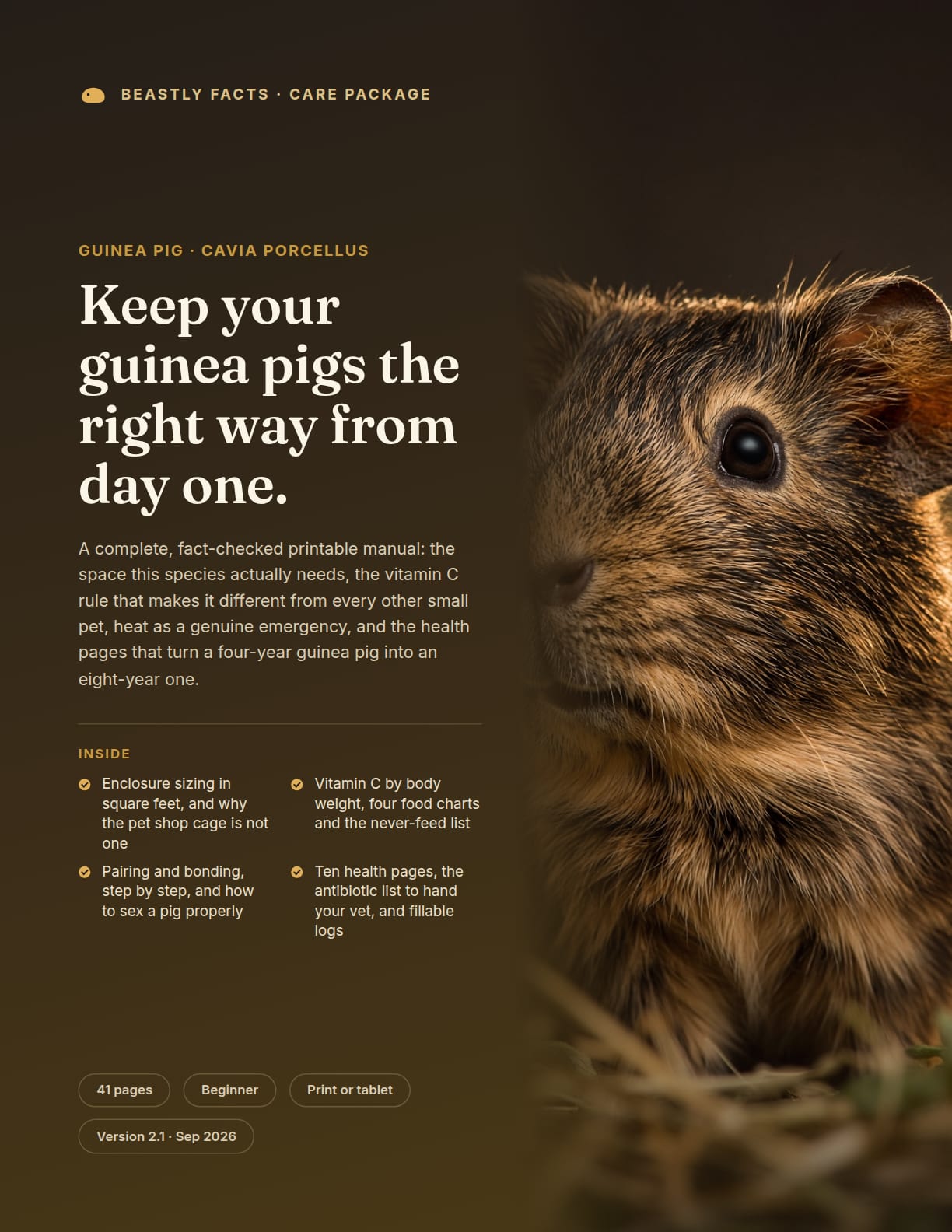
Guinea Pig Care Package
41 pages · PDF · $8.99
⚖️ Legal Guide
📰 Deep Dive
🐹 How Much Does a Guinea Pig Really Cost?
🐹 How to Handle a Guinea Pig Without Scaring It
🐹 Common Guinea Pig Health Issues (And Why Vitamin C Matters So Much)
🐹 Guinea Pig Housing and Diet: Why Vitamin C Is Non-Negotiable
🐹 Guinea Pig Feeding: Schedule, Diet, and Why They Stop Eating
🐹 Guinea Pig Enrichment: Hideouts, Foraging, and Floor Time
🩺 Health and More
💊 Antibiotic-Associated Enterotoxemia: The Small Mammal Danger Most Vets Don't Warn You About
🌡️ Heat Stress and Cold in Small Mammals: Temperature Ranges and Emergency Signs
🩺 Getting a Small Mammal to the Vet: Carriers, Car Travel, and Anesthesia
✂️ Grooming, Nails, and Molting in Small Mammals
🔑 Four Pets With One Rule Each Worth Knowing First
🐹 Gerbil vs. Guinea Pig: Which Small Pet Actually Fits Your Space
🤩 Fun Facts
🐹 Guinea Pigs Are Social
Guinea pigs are highly social and should ideally be kept in pairs or small groups. A lone guinea pig can become lonely, anxious, and even depressed.
🐹 The Vitamin C Shortage
Guinea pigs 'popcorn,' leaping straight up and twisting mid-air, when they're overjoyed. Like humans, they can't produce their own Vitamin C, so their diet needs a daily dose of fresh veggies or they risk getting scurvy!