Ball Python
Snakes
The gentle noodle that curls into a perfect ball when shy!
On This Page▾
🤓 Did you know? Ball pythons can go 3 to 6 months without eating (though they shouldn't have to). When scared, they curl into a tight ball to protect their head, hence the name!

🗓️ The first week
The numbers a new owner needs in the first week, each from the article it links to. Rows with no link come from the encyclopedia.
- Legal check
- Broadly legal; the invasive-constrictor rules were written to exclude it. Illegal in Hawaii and New York City, a permit in New Jersey and Delaware, a permitted breeder in Minnesota, and city ordinances vary.Legal guide →
- Enclosure
- 4x2x2 feet for an adult, at least as long as the snake, in PVC, which holds humidity far better than glass. A hatchling up to about 300 grams does well in a 10-gallon, a juvenile under 3 feet in 36x18x18. One snake per enclosure.Setup guide →
- Temperatures
- Warm side 88 to 92°F with air nowhere above 95°F, cool side 75 to 80°F, nights 72 to 75°F. Every heat source on a thermostat, no hot rocks.Setup guide →
- Thermostat probe
- On the floor of the warm hide under foil tape, the surface the snake lies on, never up in the air near the fixture.Heating guide →
- Humidity
- 55 to 65%, raised to 70 to 80% during a shed, on a digital hygrometer. Too dry means bad sheds and respiratory infection; too wet without ventilation means scale rot.Setup guide →
- Substrate
- Cypress mulch or coconut coir 3 to 4 inches deep. No aspen, which molds at this humidity, and never pine or cedar.Setup guide →
- Hides and water
- At least two snug hides, warm and cool, touching the body at several points, and a heavy bowl big enough to soak in.Setup guide →
- Cover
- Cork tubes and flats, leaf litter, and plant cover across the whole floor, so the snake can be out of its box without being exposed. A braced branch gets used.Enrichment guide →
- Feeding schedule
- Hatchlings every 5-7 days, juveniles at 6-18 months every 7-10, adults every 10-14, on prey the width of the snake's thickest point, fed inside the enclosure: a separate feeding tub adds stress and refusals.Feeding guide →
- Thawing
- In the refrigerator, or sealed in a bag in cool to lukewarm water. Never on the counter, never a microwave, and never fed cold.Feeding guide →
- Not eating
- A healthy adult goes 3-6 months without eating, with a seasonal dip from roughly October through March. Worry only with rapid weight loss, lethargy, mucus at the mouth, or wheezing.Feeding guide →
- Handling
- Nothing for the first one to two weeks or until it eats regularly. Then 2 to 3 sessions a week of 15 to 30 minutes, 48 to 72 hours after a meal, never during a shed.Handling guide →
- Weight checks
- Weigh monthly while growing. A rounded loaf in cross-section is right; a triangle with a ridge down the spine is underweight.Body condition guide →
- Budget
- $40 to $100 for a wild-type, $300 to $800 for the setup, then $200 to $500 a year.Cost guide →
- Adult size
- 3 to 5 feet, females significantly larger.
- Lifespan
- 20 to 30 years, up to 48 recorded in captivity.
- Quarantine
- 3 to 6 months, with a fecal exam before assuming it is healthy. Mites show within weeks; inclusion body disease can sit silent for months to years.Quarantine guide →
- Power outage
- 72-75°F is the cold floor. Below it for more than a day or two is the classic winter trigger for respiratory infection.Emergency plan →
🚨 Emergency card
Call the vet now if you see any of these.
- Any wheezing, open-mouth breathing, or visible mucus, this one is urgent
- Belly scale discoloration that's spreading or blistering
- Signs of mouth rot
- A prolapse (keep the area moist and get to a vet as soon as possible)
- Visible mites
A reptile-experienced vet, found before you need one. Respiratory infection needs vet-prescribed antibiotics, not a wait-and-see approach, and left untreated it can progress to pneumonia and become fatal.
📰 Where to go next
How Much Does a Ball Python Really Cost?
$40 to $100 for a standard snake, $300 to $800 for the setup, and what the first year and a sick visit really cost.
Ball Python Tank Setup: Humidity Is the Detail That Makes or Breaks It
The 4x2x2 standard, the temperature gradient, why PVC beats glass, and the humidity range that decides how this goes.
Ball Python Feeding: Everything You Need to Know
Schedule by age, prey size and type, how to thaw and warm a rodent properly, and the honest list of reasons one stops eating.
How to Handle a Ball Python: Timing Matters More Than Technique
The settling-in weeks, the two timing rules around feeding and shed, how to support the body, and the stress signs.
Common Ball Python Health Issues and What Causes Them
Respiratory infection, scale rot, mouth rot, mites, parasites, retained shed, thermal burns, IBD, prolapse, and the list that means the vet today.
Ball Python Enrichment: What 35 Snakes in a Study Actually Showed
What a 35-snake housing study actually found, cover across the whole floor, climbing structure, and a priority order.
Is It Legal to Own a Ball Python? State-by-State Guide
Why the federal python ban never touched this species, the two places it is banned outright, and the states that want a permit.
🛒 What to buy
Prices and the reasoning behind each item are in How Much Does a Ball Python Really Cost?.
❓ Frequently Asked Questions
What humidity level does a ball python need?
Ambient 55 to 65%, raised to 70 to 80% while the snake is in shed. Dry air gives bad sheds and raises respiratory infection risk; too wet without ventilation goes the other way, toward scale rot.
Is it normal for a ball python to refuse food?
Yes. Ball pythons are famous for hunger strikes, and a snake in good body condition that turns down a meal or two isn't automatically an emergency. With temperature, humidity, and everything else checking out, offering again in a couple of weeks is often reasonable.
How long should I wait to handle after feeding?
48 to 72 hours. Picking a snake up on a full stomach is one of the most common ways keepers cause a regurgitation, and that is hard on the digestive system and slow to recover from.
📚 Encyclopedia
Ball Python
Python regius
Subscribe - it's free
New care guides straight to your inbox. No spam. 🐾
🖨️ Printable Guide
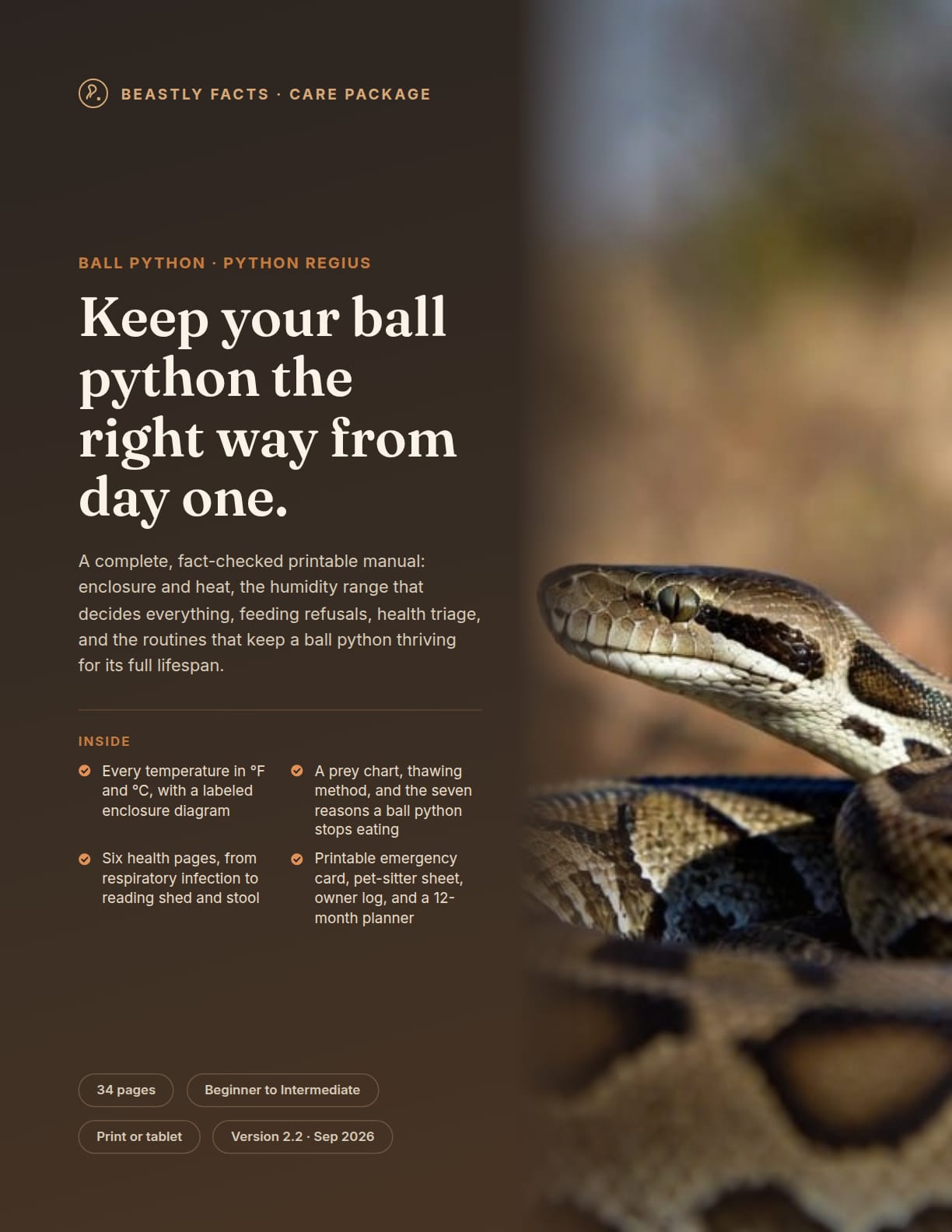
Ball Python Care Package
35 pages · PDF · $8.99
⚖️ Legal Guide
📰 Deep Dive
🐍 How Much Does a Ball Python Really Cost?
🐍 How to Handle a Ball Python: Timing Matters More Than Technique
🐍 Common Ball Python Health Issues and What Causes Them
🐍 Ball Python Tank Setup: Humidity Is the Detail That Makes or Breaks It
🐍 Ball Python Feeding: Everything You Need to Know
🐍 Ball Python Enrichment: What 35 Snakes in a Study Actually Showed
🩺 Health and More
🐍 Brumation in Pet Snakes: How to Safely Cool Down Ball Pythons and Corn Snakes
🔌 Reptile Emergency Plan: Power Outages, Travel, and Pet Sitters
💧 Reading Reptile Stool, Urates, and Hydration: A Daily Health Check
🧼 Salmonella and Reptile Hygiene: The Rules That Actually Matter
🌡️ Reptile Heating and Thermostats: Preventing Burns
🧫 Reptile Quarantine: Why New Snakes and Lizards Need Months, Not Weeks
🐍 Sexing, Growth, and Body Condition in Pet Snakes
🐍 How Snakes Actually Shed, and Why Humidity Is Not the Engine
🦎 Understanding Reptile Shedding (Ecdysis)
🦎 Five Reptiles That Actually Make Sense for Beginners
🐍 Ball Python vs. Corn Snake: Which Beginner Snake Fits You Better
🐍 Ball Python vs. Boa Constrictor: Which Snake Actually Fits Your Space
🤩 Fun Facts
🐍 Months Without Eating
Ball pythons can go months without eating when they're in breeding season, and that's totally normal. It's a natural fasting behavior, not a sign of illness.