Ember Tetra Enrichment: Bright Orange, Built to Vanish
On This Page▾

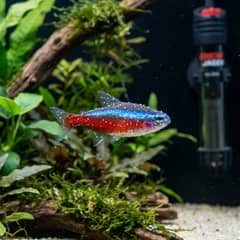
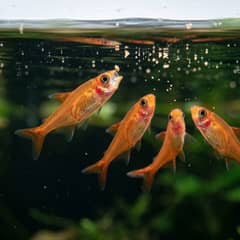
An ember tetra is a bright orange fish about 0.8 inch long, and seen from above, in its own river, it is hard to spot at all.
Ember tetras live as a school in clear, well-lit water beside dense plants, where predators hunt close by. Enrichment means giving them that setup: a school of 10 or more, heavy planting with floating plants and leaf litter, calm tankmates, and daily small live or frozen food.
How They Live in the Wild
The ember tetra comes from the Araguaia River basin in central Brazil, and the type specimens came from the Rio das Mortes. The species is presumed to live in minor tributaries, backwaters and oxbow lakes, with soft, weakly acidic water, rather than in the main channels. Very little has been written about its habitat.
A field account from near Aruanã, on the Araguaia in Goiás, describes clear water with little overhead cover, so a lot of light reached it. Stands of Eichhornia, Cabomba, Ludwigia and flooded grasses lined the site, and the middle of the channel was mostly open, with leaf litter over clay, sand and fine gravel. In summer, the author was told, the water there all but vanishes.
From the bank, the orange fish were difficult to see. When cloud covered the sun, their dark backs blended into the dim water. The school shifted its position every few minutes, and the reason turned up soon after: pike cichlids were creeping through the tall Eichhornia.
That picture is the brief for the tank. A group that keeps moving, close to dense cover, with open water to move through.
Brazilians near the Araguaia call ember tetras foguinhos, which means "little fires." The word is the diminutive of fogo, the Portuguese for fire.
Source: Practical Fishkeeping; Wiktionary
The School: Ten or More
The recommended purchase is a minimum of 8 to 10, so the target is 10 or more of this one species.
The closest research is on a different fish. A home aquarium study on neon tetras and three other species found that the neons were less aggressive and darted less in larger groups, and that groups of 10 shoaled the most. That result belongs to neons, not embers, but it fits the field account, where the school's whole defense was moving together.
A full school also shows off the difference between the sexes. Adult males are the slimmer, more intensely colored fish, especially in spawning condition, and females are rounder-bodied, most clearly when seen from above.
Dense Plants, Floating Plants, Leaf Litter
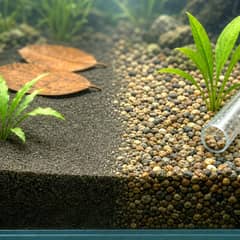
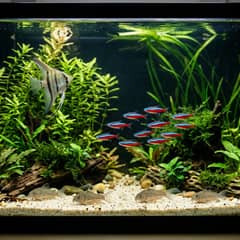
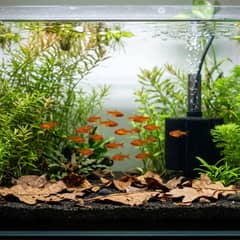
Ember tetras should be kept in a heavily planted tank, ideally over a dark substrate, and they tend to show brighter color in planted tanks with a dark substrate and background. Plant thickly along the back and sides, the way the stands lined the field site, and leave the middle open for the school to cross.
Floating plants are a useful addition, and so are driftwood branches. The wild fish lived in bright, clear water, so a well-lit tank is not wrong. What the school relied on was cover close at hand.
Leaf litter is optional, and it does more than decorate: as the leaves decompose, they feed the growth of microbe colonies in the tank. Catappa leaves are a common choice, and the biofilm they grow is food for any fry.
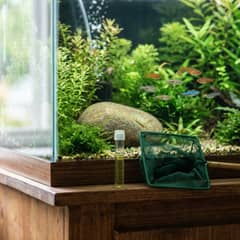
The water behind all of it is soft and acidic: pH 5.0 to 7.0, 1 to 10 dGH, and 75 to 82°F with gentle filtration. GH and pH are separate measurements, so test the tap water for both before buying fish. A school of 10 needs a 10-gallon tank on an 18 x 12 inch footprint, which leaves room for the dense planting and open water the shoal moves between.
Clear Water or Tannin-Stained?
Leaves and wood stain water the color of tea, and whether an ember tank should look like that comes down to what the stain does for the fish. Neither answer has been tested on embers.
The case for clear water is the river. The one first-hand account of a wild ember site found clear water with plenty of light reaching it. The basin matches: the Araguaia is the main tributary of the Tocantins, which is classed as a clearwater river, low in sediment and dissolved solids, with visibility deeper than 13 feet. That classifies the basin rather than every backwater, and the field visit took no water readings.
The case for tannins is chemistry. The tannins and other chemicals released by decaying leaves are thought beneficial for embers, though no evidence comes with that view. The nearest test used zebrafish: dissolved organic carbon from the Rio Negro, a blackwater river, almost completely protected them from losing sodium and chloride when they were held at pH 4.0 in very soft water. Zebrafish are not tetras, and pH 4.0 is a full point below the bottom of the ember's range.
Both sides keep the water soft and acidic to neutral, and light leaf litter fits either one. A clear tank matches the only wild site anyone has described; a lightly stained one has no known downside for the fish.
Calm Tankmates
Embers are very peaceful and will not compete well with boisterous or much larger fish, so the calm of the whole tank depends on what shares it.
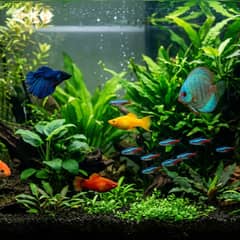
A school of embers moving in the open does a job for other fish. They are an ideal dither fish for Apistogramma and other dwarf cichlids, whose confidence rises when small fish swim unbothered above them, and embers are relatively outgoing in a large group, so the bigger the school the better they play the part. Beyond dwarf cichlids, good companions are similar-sized, peaceful fish. A betta or dwarf gourami is a judgment call: some turn territorial, and the embers lose, though a calm one can make a striking centerpiece above the school.
Feeding as Enrichment
In the wild, ember tetras are probably micropredators of tiny invertebrates and zooplankton. Small live and frozen foods are the closest a tank comes to that diet, and they give the school something to chase.
Offer small live or frozen food daily, such as baby brine shrimp, moina or grindal worms, alongside a dried staple sized for the fish: micro-pellets or flake crushed fine. Their mouths are small, so the food has to be tiny and slow-sinking.
Priority Order
- A school of 10 or more ember tetras, one species
- Heavy planting at the back and sides over a dark substrate, open water in the middle
- Floating plants
- Soft, acidic water at 75 to 82°F with gentle filtration
- Peaceful, similar-sized tankmates, or dwarf cichlids
- Daily small live or frozen food alongside a tiny dried staple
- Leaf litter, in clear or lightly stained water
What Not to Do
Do not buy five because the tank looks small. Do not leave the tank bare and open. Do not run the heater above 82°F. Do not add boisterous or much larger fish that will outcompete a school this small. Do not push the pH below 5.0 for a darker, blackwater look: that is under the bottom of the ember's range. Do not skip a 30-day quarantine for new fish.
In the Araguaia, an ember's safety was the school around it and the plants beside it. A tank that supplies both covers most of what this fish needs.
Sources & Further Reading
Last reviewed 1 Nov 2026 · 4 sources
- Finding ember tetras in Brazil (Tai Strietman). Practical Fishkeeping
- Hyphessobrycon amandae. Seriously Fish
- Composition and flux of dissolved and particulate carbon and nitrogen in the lower Tocantins River (Neu, Araújo, Guedes, Ward, Ribeiro, Richey and Krusche, 2023). JGR Biogeosciences
- Dissolved organic carbon from the upper Rio Negro protects zebrafish (Danio rerio) against ionoregulatory disturbances caused by low pH exposure (Duarte, Smith, Val and Wood, 2016). Scientific Reports
Frequently Asked Questions
How many ember tetras should be kept together?
Ten or more. The recommended purchase is a minimum of 8 to 10 ember tetras, and in the closest research, a group-size study on neon tetras, groups of 10 shoaled the most.
What tank do ember tetras need to behave naturally?
A 10-gallon tank with an 18 x 12 inch footprint for a school of 10, heavily planted over a dark substrate, with floating plants, gentle filtration and soft water at 75 to 82°F.
What should ember tetras eat for enrichment?
Daily small live or frozen foods such as baby brine shrimp and moina, alongside micro-pellets or finely crushed flake. Ember tetras are about 0.8 inch long with small mouths, so food has to be tiny and slow-sinking.
Why are ember tetras called little fires?
In the Araguaia River basin of central Brazil, local people call them foguinhos, from fogo, the Portuguese for fire. The name fits a fish that is bright orange at close range yet hard to see from above in its own river.
Can ember tetras live with Apistogramma?
Yes, and they help. Embers are an ideal dither fish for Apistogramma and other dwarf cichlids, and a school of 10 or more swimming in the open is what gives the cichlids confidence.
Do ember tetras need blackwater?
No. The one field account of a wild ember site found clear water, in a river system classed as clearwater. Tannins from decaying leaves are thought beneficial but have not been tested on embers, so light staining from leaf litter is optional.
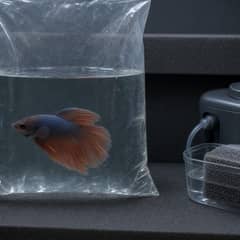
Can an ember tetra school live with a betta?
Sometimes. Some bettas and dwarf gouramis turn territorial, and a school of tiny, peaceful embers cannot hold its own against one. A calm individual can work as a centerpiece above the school.
More on the Ember Tetra
Recommended Gear
As an Amazon Associate I earn from qualifying purchases through the links above, at no extra cost to you.

Written by Michael Ryan
Mike keeps two rescued bearded dragons, Dex and Cera, and writes the care guides on BeastlyFacts from his own research and mistakes. He is not a veterinarian.
More about Michael Ryan →You May Also Like

Subscribe - it's free
An occasional email when something new is worth your time. No spam.
Deep Dive
Health and More