Fire Skink
Lepidothyris fernandi
On This Page▾
🌍 Overview
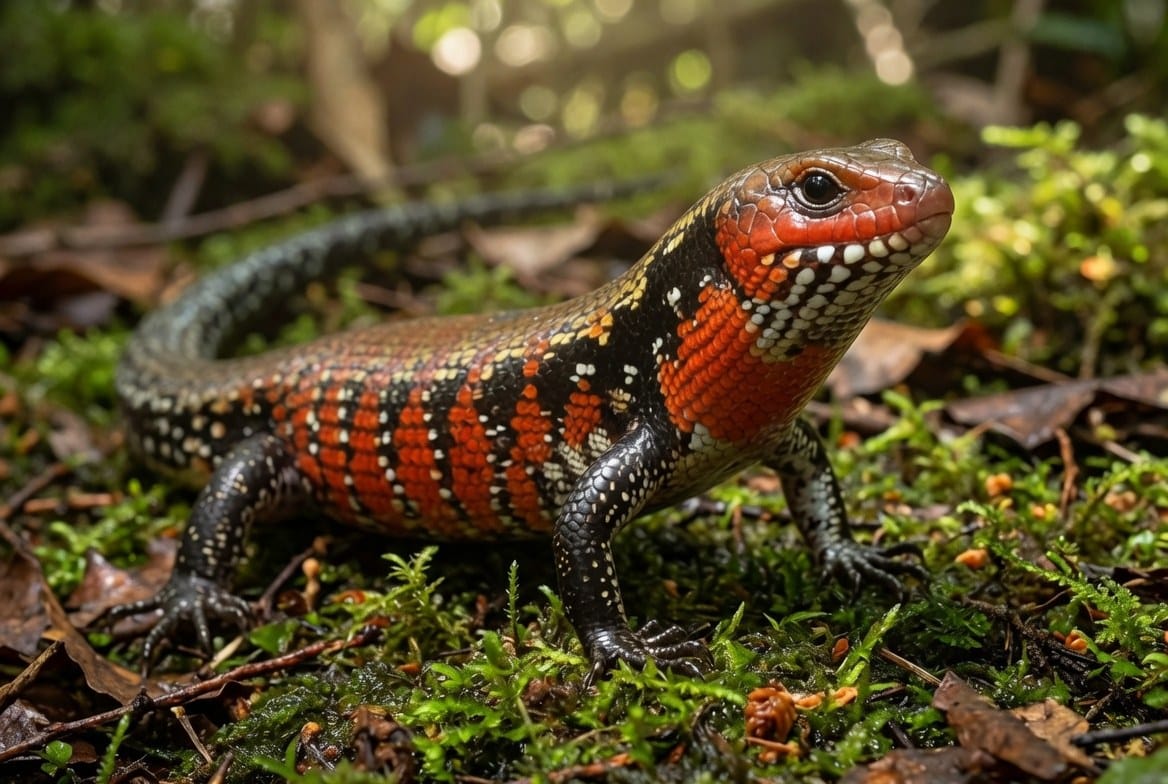
The fire skink is a West African forest lizard with some of the most striking coloring of any commonly kept reptile: brilliant red flanks broken by black and silver barring, a gold and bronze back, and a black-and-white banded throat. It spends most of its life underground or under leaf litter, which is the part new keepers underestimate. A fire skink in a shallow setup will look permanently stressed and hide in a corner; the same animal in deep, moist substrate will burrow, tunnel and then come out to bask and hunt in the open. They are secretive rather than shy, and most become confident enough to feed from tongs.
📋 Quick Facts
Native Range
West and Central Africa, from Guinea east to Uganda and Angola
Natural Habitat
Tropical forest floor and forest edge, in leaf litter and self-dug burrows
Adult Size
12-15 inches (30-38 cm) including tail
Wild Diet
Insects, worms, snails, and occasional fruit or small vertebrates
Wild Lifespan
Not documented in the wild; 15 to 20 years commonly reported in captivity
Conservation Status
Not evaluated (IUCN)
📜 History
Edward Burton described the fire skink in 1836 as Tiliqua fernandi, from a specimen taken on Fernando Po, the island off West Africa now called Bioko. It then spent nearly two centuries being shuffled between genera: Lygosoma, then Lepidothyris under Cope in 1892, then Riopa under Loveridge in 1936, then Mochlus under Mittleman in 1952, which is why old care sheets and new ones rarely agree on the name. A 2009 review led by Philipp Wagner went further and split what keepers had treated as one animal into three species, restricting the true fire skink to tropical West Africa and the western edge of Central Africa. Most animals in the trade are still wild collected and shipped out through Ghana and Togo.
⚖️ Compare
Fire Skink
Human
Adult Size
12-15 inches (30-38 cm) including tail
5-6 feet (150-185 cm); ~135-200 lbs
Wild Lifespan
Not documented in the wild; 15 to 20 years commonly reported in captivity
~73 years (global average)
Wild Diet
Insects, worms, snails, and occasional fruit or small vertebrates
Omnivorous - eats just about anything
Native Range
West and Central Africa, from Guinea east to Uganda and Angola
Global - originated in Africa roughly 300,000 years ago
Natural Habitat
Tropical forest floor and forest edge, in leaf litter and self-dug burrows
Everywhere from arctic tundra to tropical megacities
Conservation Status
Not evaluated (IUCN)
Least Concern (8+ billion and counting)
🧠 Test Yourself
What's the Fire Skink's native range?
📖 Care Guide
Fire Skink Care Guide
Dressed in red and gold, and determined to stay underground!
Subscribe - it's free
New animal facts and care guides straight to your inbox. No spam. 🐾
📰 Deep Dive
🦎 How Much Does a Fire Skink Really Cost?
🦎 How to Handle a Fire Skink (This Isn't the Blue-Tongued Skink)
🦎 Common Fire Skink Health Issues
🦎 Fire Skink Enclosure Setup: Deep, Moist Substrate Above Everything Else
🦎 Fire Skink Feeding: Five Minutes of Insects in the Leaf Litter, Twice a Week as an Adult
🦎 Fire Skink Enrichment: The Study Where Skinks Stopped Hiding
🩺 Health and More
🎭 Three Pets That Are a Bigger Deal Than They Look
🔌 Reptile Emergency Plan: Power Outages, Travel, and Pet Sitters
💧 Reading Reptile Stool, Urates, and Hydration: A Daily Health Check
🧼 Salmonella and Reptile Hygiene: The Rules That Actually Matter
🌡️ Reptile Heating and Thermostats: Preventing Burns
🧫 Reptile Quarantine: Why New Snakes and Lizards Need Months, Not Weeks
🤓 Did You Know?
Fire skinks are one of the most brightly colored lizards in the hobby and one of the most rarely seen in their own enclosure. Give one a shallow scattering of substrate and it will vanish; give it the 4 to 6 inches it can actually tunnel through and it will build a burrow system, come out to bask, and behave like a completely different animal.
Explore More