How to Handle a Red-Footed Tortoise
On This Page▾

Red-footed tortoises are food-motivated and often more personable than drier-climate tortoises, but the same general handling caution applies here as with any tortoise: this is an observation pet, not a lap pet.
What to Expect
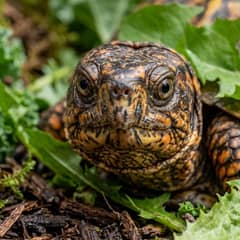
Many keepers describe red-footed tortoises as more food-motivated and personable than a Russian or sulcata tortoise, readily approaching for a meal and appearing to recognize their keeper over time. That food-motivated reputation is genuine, but it doesn't change the basic rule for tortoises generally: frequent, purposeless handling causes real stress. Treat physical interaction as occasional and purposeful, feeding time, a health check, moving the tortoise for cleaning, and never routine.
General Handling Caution: Shell and Limb Injury Risk
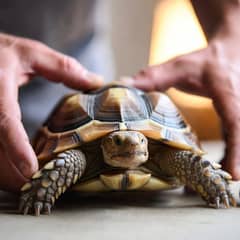
This applies to any tortoise, and it's worth taking seriously with a species that can reach a substantial adult size. Shell trauma from being dropped is one of the most commonly documented causes of shell injury in pet tortoises, alongside dog bites and blunt trauma from other animals, according to veterinary guidance on managing tortoise shell injuries. The shell's dermal bone is sensitive tissue, a fracture causes real pain, and healing is slow even with treatment, basic granulation can take around 12 weeks and full bone regeneration can run one to two years. When you do pick a red-footed tortoise up, keep it low to the ground, support the shell fully from underneath with both hands, and never flip it onto its back. Adults can weigh up to 20 pounds, well short of a sulcata's bulk, but heavy enough that a drop is a real, not theoretical, risk.
Male red-footed tortoises make a clucking sound during courtship, genuinely similar to a chicken, one of the more unexpected behaviors documented in a group of animals most people assume are silent.
Growth and the Decades-Long Housing Commitment
Hatchlings emerge at just 1.5 to 2 inches and 35 to 50 grams, small enough to sit in a spoon. Growth from there is steady, never explosive: roughly 3 to 4 inches by the first birthday, 7 to 9 inches and several pounds by age 2, and 9 to 11 inches by age 5, according to a growth chart compiled by Hepper. Most individuals reach close to full adult size, 11 to 16 inches, within 5 to 10 years, continuing to fill out gradually for a while after that. Combined with a lifespan commonly cited at 50 to 70 years or more, sometimes reportedly approaching 90, that means the enclosure you build should be sized for the adult this tortoise will become, not the hatchling in front of you today.
Substrate and Why It Matters Here
This is a species that spends much of its time rooting through substrate, pushing through leaf litter, and digging shallow scrapes to rest in, and you'll be observing and interacting with it in that environment constantly. A red-footed tortoise comes from humid tropical forest and forest edge, unlike the arid steppe a Russian tortoise calls home or the desert fringe a sulcata does, and a dry, sandy, arid-style substrate is a genuine mismatch for it. Beyond the direct health risk, the wrong substrate flattens out the natural digging and foraging behavior that makes this tortoise rewarding to watch in the first place.
How This Compares to Russian and Sulcata Tortoises
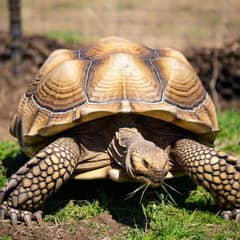
Handling difficulty here sits exactly where size does, between the Russian tortoise and the sulcata. A Russian tortoise stays light enough that a fall is dangerous but rarely catastrophic, the smaller-scale version of the same caution in the Russian tortoise handling guide. A sulcata becomes genuinely too heavy to lift within its first several years, a transition the sulcata tortoise handling guide covers. A red-footed tortoise stays liftable with two hands for its entire life, but its adult weight, up to 20 pounds, still demands the same low-to-the-ground, two-handed support that matters for any tortoise.
The Red-Footed Tortoise encyclopedia profile carries the full species overview.
Sources & Further Reading
❓ Frequently Asked Questions
Are red-footed tortoises easy to handle?
Many keepers find them more food-motivated and personable than drier-climate tortoises, readily approaching for a meal and recognizing their keeper over time. That said, this is still fundamentally an observation pet, not one built for frequent picking up.
Is it safe to pick up a red-footed tortoise?
Yes, with care. Keep it low to the ground and support the shell from underneath with both hands, since a fall risks a genuine shell fracture. Adults can weigh up to 20 pounds, heavy enough that dropping one is a real, not theoretical, risk.
How does a 50-plus year lifespan affect housing planning?
Fastest early, then tapering. Hatchlings emerge at 1.5 to 2 inches and reach roughly 3 to 4 inches by the first birthday, 7 to 9 inches by age 2, and 9 to 11 inches by age 5. Plan the enclosure around adult size from the start rather than upgrading repeatedly as a hatchling grows.
Why does substrate matter so much for a red-footed tortoise?
This species roots and forages through substrate constantly, and it comes from humid tropical forest, not arid steppe or desert. A dry, sandy, arid-style substrate undermines both its health and the natural digging and foraging behavior that makes this tortoise engaging to watch.
How does handling a red-footed tortoise compare to a Russian or sulcata tortoise?
It sits between them in every practical sense. A Russian tortoise stays light enough that dropping it is less catastrophic, though still a real risk. A sulcata becomes too heavy to lift within a few years. A red-footed tortoise stays liftable with two hands for its whole life, but adult weight still demands real care.
📰 More on the Red Footed Tortoise
📘 Red Footed Tortoise care guide
🐢 How Much Does a Red-Footed Tortoise Really Cost?
🐢 Common Red-Footed Tortoise Health Issues and What Causes Them
🐢 Red-Footed Tortoise Enclosure Setup: A Humid Tropical Setup, Not a Desert One
🐢 Red-Footed Tortoise Feeding: Diet, Schedule, and Why Protein Isn't Optional
🐢 Red-Footed Tortoise Enrichment: Enriched Tortoises Are More Optimistic
Written by Michael Ryan
Mike keeps two rescued bearded dragons, Dex and Cera, and writes the care guides on BeastlyFacts from his own research and mistakes. He is not a veterinarian.
More about Michael Ryan →Comments
No comments yet - be the first!