Milk Snake Tank Setup: Corn Snake Basics, Plus a Few Species-Specific Twists
On This Page▾

Milk snake care closely mirrors the corn snake's, familiar territory if you've kept one before, with a couple of details specific to this species worth getting right.
Enclosure Size
Most milk snakes stay at or under 48 inches long, which puts the minimum adult enclosure at 48 inches long by 24 inches wide by 24 inches tall. Within that ceiling, a Pueblan reaches 28 to 36 inches, an Eastern 36 to 45, and a Honduran or Sinaloan 40 to 48. A secure, genuinely escape-proof lid matters more with this species than some others, milk snakes are accomplished escape artists.
Temperature
Basking surface 85 to 90°F, cool side 75 to 80°F, nighttime 70 to 75°F. A halogen flood bulb positioned over a basking stone is the commonly recommended heat source for this species, generally preferred over ceramic, colored, or red bulbs. A thermostat-controlled heat mat can supplement the warm hide if needed, though it is the supplement and not the main heater. Where the probe sits decides what that thermostat is actually holding.

Not every care sheet agrees on how to heat a milk snake. Some general reptile care sheets suggest a ceramic heat emitter instead, a genuine point of disagreement in the hobby, though halogen basking bulbs positioned over a basking stone remain the more specialist-endorsed choice for this species.
Humidity
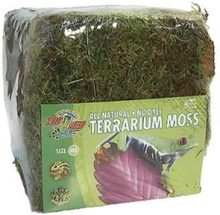
40 to 60%, monitored with a digital probe hygrometer. Provide a dedicated humid hide with moist Sphagnum moss for moist hide, this is what actually prevents retained shed, and mist as needed to maintain the range.
Substrate
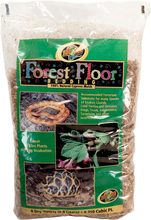
Aspen or cypress mulch substrate both work well and support natural burrowing. Avoid substrate that stays constantly wet, this is a direct path to scale rot, and skip cedar and pine entirely, both are toxic to reptiles.
Lighting
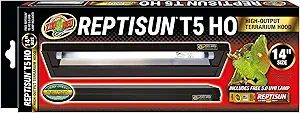
Not strictly required, but low-level UVB offers real benefit according to current husbandry guidance. A low-output option like Optional low-level UVB (5%) works well, run on a standard 12-hour photoperiod.
Diet Basics
Milk snakes eat frozen/thawed rodents: juveniles every 7 to 10 days, adults every 10 to 14. Size the prey at no more than 1.5 times the snake's width at its widest point, or roughly 10% of its body weight. Frozen and thawed is both safer for the snake and generally considered the more humane choice than live. Keep a water bowl large enough for the snake to curl up in and soak, topped up with fresh water.
The Non-Obvious Requirement: Never Cohabitate
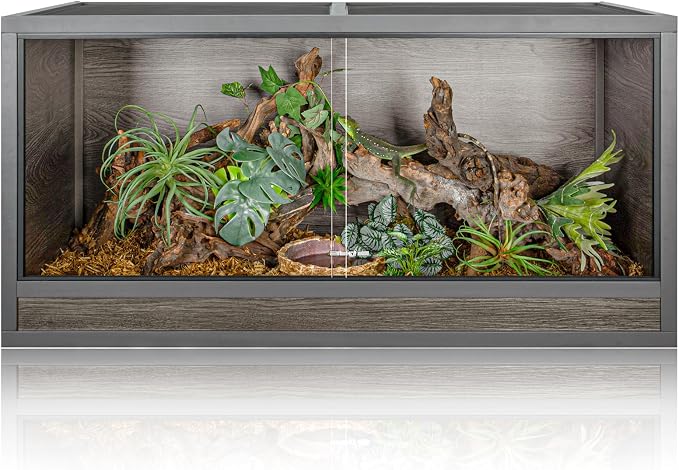
This belongs in the setup conversation as much as the handling one. Milk snakes are cannibalistic, and this is a firm, no-exceptions rule, one snake per enclosure, always. It is one of the few places this setup diverges from a corn snake's. A wood or PVC vivarium is generally a better choice than glass for this species, both hold heat and humidity more effectively, which matters given how much this species' health depends on getting that balance right.
Sources & Further Reading
Last reviewed 14 Sep 2026 · 1 source
❓ Frequently Asked Questions
What size enclosure does a milk snake need?
Most milk snakes top out at 48 inches, which sets the adult minimum at 48 by 24 by 24 inches. Subspecies vary within that: Pueblans run 28 to 36 inches, Easterns 36 to 45, and Hondurans and Sinaloans 40 to 48.
What temperature does a milk snake enclosure need?
Basking surface 85 to 90°F, cool side 75 to 80°F, nights 70 to 75°F. The usual heat source here is a halogen flood bulb over a basking stone, with a thermostat-controlled mat as a supplement rather than the main heater.
What humidity does a milk snake need?
40 to 60%, monitored with a digital probe hygrometer. A dedicated humid hide with moist sphagnum moss is what prevents retained shed, mist as needed to stay in range.
How often does a milk snake eat?
Juveniles every 7 to 10 days, adults every 10 to 14. Two ways to size the rodent, either of which works: no wider than 1.5 times the snake at its thickest, or about a tenth of what the snake weighs.
What substrate is safe for a milk snake?
Aspen bedding or cypress mulch both work well and support natural burrowing. Avoid substrate that stays constantly wet, and skip cedar and pine entirely, both are toxic to reptiles.
Can two milk snakes share an enclosure?
No. Milk snakes are cannibalistic, so it's one snake per enclosure with no exceptions.
📰 More on the Milk Snake
📘 Milk Snake care guide
🐍 How Much Does a Milk Snake Really Cost?
🐍 How to Handle a Milk Snake (And the Coral Snake Look-Alike Question)
🐍 Common Milk Snake Health Issues
🐍 Milk Snake Feeding: Prey at 1.5 Times the Body Width, and Why Hatchlings Eat Snakes
🐍 Milk Snake Enrichment: A Shy Snake Needs More Cover, Not Less Space
🛒 Recommended Gear
As an Amazon Associate, we earn from qualifying purchases through the links above - at no extra cost to you.
Written by Michael Ryan
Mike keeps two rescued bearded dragons, Dex and Cera, and writes the care guides on BeastlyFacts from his own research and mistakes. He is not a veterinarian.
More about Michael Ryan →Comments
No comments yet - be the first!