Gerbil Enrichment: Deep Bedding Alone Does Not Stop the Digging
On This Page▾

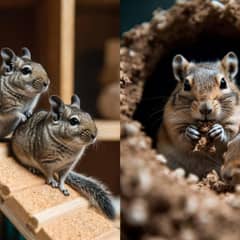
A Mongolian gerbil is a small burrowing rodent of the Central Asian steppe, and nearly everything it does for fun is something it would do to survive there. The digging matters most, and deep bedding only meets half of that need.
Give a gerbil a tunnel that leads to a dark chamber, buried in 8 to 12 inches of bedding. Gerbils raised with that structure show far less stereotypic corner digging, the repetitive digging at one spot of the glass that goes nowhere. Gerbils given sand or bedding alone still dig at the glass, and a bigger tank does not change it.
How a Wild Gerbil Lives
Wild Mongolian gerbils live on dry steppe and semi-desert. A family group is one adult male, one or two adult females and their young, and it rarely passes 20 animals. The family shares the work: defending and marking the territory, keeping up the nests, hoarding food and raising the pups.
Home is a burrow dug in soft soil, often near plants. It has one nest and one or two storerooms, the tunnels are about an inch and a half across, and it reaches 18 to 24 inches below the surface. In September and October every member of the family gathers food into a shared winter store.
A pet gerbil wants the same things: a burrow, a family, food to carry and something to gnaw.
A wild gerbil's tunnel is only about an inch and a half wide, close to the width of a cardboard paper towel tube.
Build a Burrow, Not Just a Bedding Layer
Digging is aimed at producing a burrow. In a tank where digging can never produce one, the behavior runs without finishing, and the result is a gerbil scrabbling at the same corner day after day.
- Bury tunnel sections or a tube about 2 inches wide and at least 8 inches long in the bedding.
- Run the tube into an enclosed, dark chamber: a wooden nest box or a partly buried hideout.
- Leave the tube mouth open at the surface.
- Choose opaque materials. Gerbils prefer dark burrows and dig less compulsively with them than with see-through ones.
- Use pressed plant fiber, cardboard or wood, never plastic, which gets chewed into sharp edges.
The connection between tunnel and chamber is the part that works. A chamber without a tube does not do the job, and neither does a tube that leads nowhere. Cardboard tubes make a fine first version. Gerbils destroy them quickly, so keep a rigid option as the permanent one.
Depth, Still
A burrow does not replace bedding depth. A shallow layer with a tunnel sitting on top is not a burrow either.
Fill the tank with 8 to 12 inches of bedding: paper bedding mixed with hay so tunnels hold their shape. This is the most common corner cut in gerbil keeping and the cheapest to fix.
Keep a Pair
Gerbils are family animals. Keep a same-sex pair or small group, ideally littermates or animals introduced young. Introducing unfamiliar adults is difficult and can end in serious fighting. Keeping one gerbil does not make the setup simpler. It makes it poorer.
Chewing and Shredding
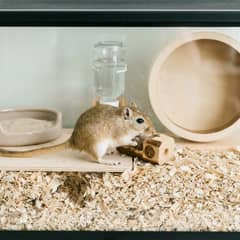
Gerbil incisors grow for life, and a gerbil with nothing to chew will chew the tank furniture.
- Natural chew sticks and apple or willow branches
- Paper towel tubes and cardboard boxes
- Plain paper and hay to shred
Shredding is nest building as much as chewing, so give the material generously. Keep cotton and fluffy nesting fiber out of the tank. They tangle around legs.
Foraging and Hoarding
- Scatter the daily pellets across the bedding in place of using a bowl.
- Push a few pellets into the bedding and into cardboard tubes.
- Hand-feed a sunflower seed or pumpkin seed to each gerbil as a treat.
- Let them carry food off and cache it. Check the caches daily for fresh food that will spoil.
A Sand Bath
A sand bath is for coat condition, and gerbils clearly enjoy it. It is a separate thing from somewhere to dig, and it does not stand in for a burrow.
Offer dust-free bathing sand in a heavy glass or ceramic bowl for short sessions. Left in permanently, it ends up scattered and soiled.
Space to Run
Gerbils are active and use the floor area and any solid levels they are given. Add a wheel with a solid running surface, since an open-rung wheel risks tail and limb injury. Skip mesh shelves, which damage feet.
Space is worth having for its own sake. It is not the fix for corner digging.
How to Tell It Is Working
- The gerbils dig tunnels that stay open and use them.
- They sleep together in the dark chamber or a nest they built.
- Corner digging at the glass is brief or absent.
- Cardboard disappears and gets rebuilt into nest.
- The pair grooms each other and forages side by side.
A gerbil that digs at one corner for long stretches every day is telling you the burrow is missing or is not dark enough.
One Change at a Time
Gerbils recognize home, and each other, by scent.
- Add one new item at a time. A strong-smelling new hut can start a quarrel.
- Keep the nest and some old, clean bedding at every full clean.
- Rearrange the surface if you like, but leave the buried burrow where it is.
Priority Order
- A tunnel connected to a dark chamber, buried in the bedding
- Bedding 8 to 12 inches deep that holds its shape
- A same-sex pair or small group
- Constant chewing and shredding material
- Scattered food to forage and hoard
- A sand bath, offered in sessions
- Floor area, solid levels and a solid-surface wheel
- Rearranging and novelty, last and one item at a time
Somewhere for the Digging to Go
A gerbil digs to make a home, and enrichment for this species means letting that work succeed. Bury a tunnel that ends in the dark, cover it deep, and let a bonded pair take over the building. Chewing, hoarding and bathing fill the rest of a gerbil's day once the burrow is in place.
Sources & Further Reading
Last reviewed 16 Nov 2026 · 6 sources
- Wiedenmayer C (1997). Causation of the ontogenetic development of stereotypic digging in gerbils. Animal Behaviour
- Waiblinger E and König B (2004). Refinement of gerbil housing and husbandry in the laboratory. Animal Welfare
- NC3Rs: Housing and Husbandry, Gerbil
- Animal Diversity Web: Meriones unguiculatus
- Gromov V (2026). Russian Journal of Theriology 25(1): 44-54 (PDF, downloads)
- Wood Green: Make Your Gerbil Feel at Home
Frequently Asked Questions
What is stereotypic corner digging?
Repetitive digging at one fixed spot, usually a tank corner, that goes on and on without getting anywhere. It is a recognized welfare sign, and it is extremely common in pet gerbils.
What exactly counts as a burrow for a gerbil?
A tunnel with a dark chamber at the end of it. Loose sand or bedding to dig in is far less effective without that structure.
Doesn't a bigger tank fix stereotypic digging?
No. Tank size does not change the behavior, because the gerbil is missing somewhere for the digging to lead.
Can corner digging be fixed once it has started?
It is much easier to prevent than to reverse. Adding a proper burrow to an established digger is still worth doing, and you should expect gradual improvement.
Should gerbils be kept alone?
No. Keep a same-sex pair or small group, ideally littermates. A gerbil on its own has lost the main feature of its natural life.
Should the burrow tube be clear so I can watch?
No. Gerbils choose dark, opaque burrows over transparent ones and dig less compulsively with them.
More on the Gerbil



Recommended Gear
As an Amazon Associate I earn from qualifying purchases through the links above, at no extra cost to you.

Written by Michael Ryan
Mike keeps two rescued bearded dragons, Dex and Cera, and writes the care guides on BeastlyFacts from his own research and mistakes. He is not a veterinarian.
More about Michael Ryan →You May Also Like



Subscribe - it's free
An occasional email when something new is worth your time. No spam.
Health and More