African Grey Enrichment: Foraging Is the One With Real Evidence
On This Page▾

A wild African grey spends its day flying to food, working it open and keeping watch with its flock. A grey with a full bowl is done eating in minutes. Foraging is the one kind of enrichment that has been tested in this species, so it is where to start. This guide covers both pet greys, the Congo and the smaller Timneh.
Feather-plucking greys fed through pipe feeders instead of a bowl foraged longer, and their feathers improved within a month. Young Amazon parrots given foraging work from weaning were kept from developing feather picking. Move part of the food out of the bowl first. Everything else comes after.
A Day in the African Forest
Wild greys live in the moist lowland forests of central and West Africa, and at forest edges, clearings and mangroves. They roost in large, noisy flocks, often in trees over water, and call loudly in the morning and the evening. During the day the flock splits into smaller groups that fly long distances to feed. They eat mostly nuts and fruit, the oil palm above all, with leaves, bark, flowers and insects on the side. They feed on the ground too, coming down in waves so the whole flock is never down at once, and they stay alert to every movement while they eat. Young greys stay with their family for years.
Each part of that day points to something a pet grey needs: food to work for, a reason to move, company, and a quiet, safe place to rest.
Move the Food Out of the Bowl
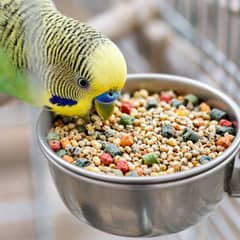
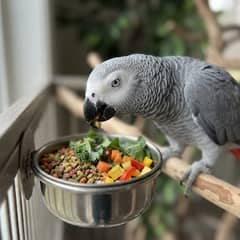
Deliver as much of the day's food as the bird will reliably work for through extra-large wooden foraging toys and foraging boxes, and put less in the dish as the bird learns.
Start easy. A bird that has always eaten from a bowl does not know that food can be inside a device, so the first stage is food sitting in plain view on top of a foraging toy. Make it harder as the bird gets better at it, and weigh the bird while you do. Rotate the toys and the hiding places, because a puzzle that has been solved and left up for a month no longer occupies the bird.
The evidence comes from a controlled study of feather-plucking greys. Birds fed through pipe feeders for a month foraged longer than birds fed from a bowl, and their feathers improved. Each extra hour spent foraging roughly tripled a bird's odds of better plumage. In young Amazon parrots, foraging work and a more complex cage both prevented and reduced feather picking, and the birds chose foraging over plastic toys. Preventing plucking in young birds is a stronger result than treating it in an established adult, and plucking has medical causes as well as behavioral ones.
Perches and a Reason to Move
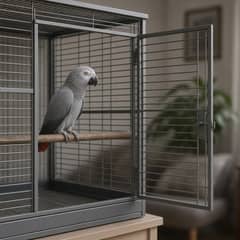
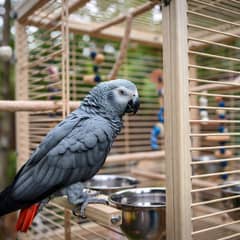
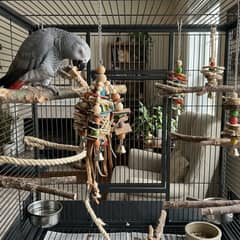
A cage furnished with identical dowels loads the same points of the foot all day and gives the bird no reason to move. Fit natural branch perches of varied diameter at different heights and distances, so crossing the cage takes a route, not one hop. Wild greys feed partly on the ground, so scatter part of the day's pellets on a tray on the cage floor or a play stand as well.
Things to Shred
For a parrot, shredding is closer to foraging than to play, and material that survives the week has failed at its job. Give the grey soft wood, palm, paper and untreated natural fiber to dismantle, with food hidden inside some of it, so the bird has to take it apart to eat.
Company and Time Out
Wild greys live in flocks and stay with their families for years, and a pet grey looks to its people the same way. Give it three to four hours of supervised time out of the cage every day, in a room checked for hazards, and spread the household's attention so the bird does not fixate on one person.
Training for Cooperative Care
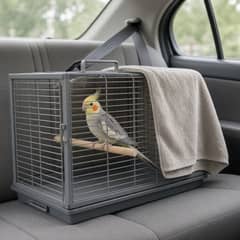
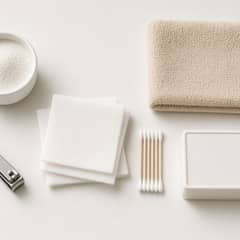
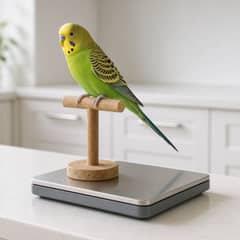
Short positive reinforcement sessions have taught parrots to step onto a scale, walk into a carrier and accept a towel and a syringe on cue. A bird that steps onto a scale gets weighed, and weight is usually the first thing to change when a parrot is becoming unwell. A clicker and target stick is the whole equipment list. Keep sessions short and daily, and end them while the bird is still interested. Training is part of a good routine, but foraging is still the one with direct evidence against plucking in greys.
Bathing
Offer a bath every morning, so the feathers dry before night: a shallow dish of lukewarm water, a plant mister or a shower perch. For a grey that will not bathe on its own, give a gentle spritz once or twice a week. Regular bathing also keeps the grey's powder down from coating the room.
How to Tell It Is Working
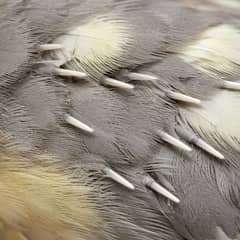
A grey with enough to do works at its foraging toys, shreds, preens, talks and whistles, and moves around the whole cage. The warning signs are feather plucking, screaming beyond its normal calls, and pacing or repeating the same movement. The same signs can mean illness, so have an avian vet check a grey that shows them before you change only its routine.
One Change at a Time
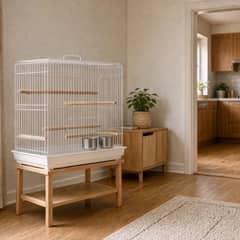
Keep the perches, dishes and cage where they are, so home stays familiar. Add one new foraging device or toy at a time and watch how the bird takes it, since a grey can be wary of anything new in its space. Bring back a toy that has been out of rotation for a few weeks, which a grey often treats as new.
Priority Order
- Move part of the food into foraging devices, and put less in the bowl as the bird learns.
- Give it three to four hours a day out of the cage with you.
- Fit perches of varied diameter and material.
- Give it soft wood, palm and paper to shred, and rotate them.
- Run short daily training sessions aimed at cooperative care.
- Offer a bath every morning.
- Add new objects last.
Start With the Food
If only one thing changes this week, take part of the day's food out of the bowl and put it inside a foraging toy. Add the perches and shredding next, and weigh the bird as you go.
Sources & Further Reading
Last reviewed 24 Sep 2026 · 6 sources
- Lumeij JT and Hommers CJ. Foraging enrichment as treatment for pterotillomania. Applied Animal Behaviour Science
- van Zeeland et al. Efficacy of foraging enrichments to increase foraging time in Grey parrots. Applied Animal Behaviour Science
- Meehan CL, Millam JR and Mench JA (2003). Foraging opportunity and increased physical complexity both prevent and reduce psychogenic feather picking by young Amazon parrots. Applied Animal Behaviour Science
- Positive reinforcement training facilitates the voluntary participation of laboratory macaws with veterinary procedures. Journal of Avian Medicine and Surgery
- VCA Animal Hospitals: Bathing Birds
- Animal Diversity Web: Psittacus erithacus (grey parrot), University of Michigan Museum of Zoology
Frequently Asked Questions
Does foraging enrichment stop feather plucking?
It has the strongest evidence of anything in this field. In a controlled study, feather-plucking greys fed through pipe feeders foraged longer and their feathers improved within a month, and in young Amazon parrots foraging work both prevented and reduced feather picking. Plucking can also be medical, so a vet check comes first.
Why is a food bowl a problem?
Because it removes the activity the bird is built around. In conventional captive settings, food offered in a bowl results in foraging times of well under an hour a day, leaving most of the waking day unoccupied. Abnormal repetitive behaviors, including repetitive mouth movements and feather destruction, fill that gap.
How much of the diet should be delivered through foraging?
As much as the bird will reliably work for while still eating enough. Start by moving part of the ration into foraging devices and watch intake, then increase difficulty as the bird gets competent. A bird that gives up and loses weight has been asked for too much too fast.
Do perches matter or is that just husbandry?
Both. A cage of identical dowels puts the same pressure on the same points of the foot all day and gives the bird no reason to move between locations. Varied diameters and natural materials are a foot health intervention and a choice intervention at once.
Will enrichment fix an established plucker?
It can help and it has been studied as a treatment, but plucking has medical causes too, and a bird that has started should be seen by an avian vet before anyone assumes it is behavioral. Enrichment is part of the answer, not a substitute for a diagnosis.
Is an African grey a reasonable first parrot?
For most people, no. This is a long-lived, highly intelligent species with a documented vulnerability to feather-damaging behavior when under-occupied, and the enrichment workload is a daily commitment rather than a one-time purchase.
More on the African Grey Parrot
Recommended Gear
As an Amazon Associate I earn from qualifying purchases through the links above, at no extra cost to you.

Written by Michael Ryan
Mike keeps two rescued bearded dragons, Dex and Cera, and writes the care guides on BeastlyFacts from his own research and mistakes. He is not a veterinarian.
More about Michael Ryan →You May Also Like

Subscribe - it's free
An occasional email when something new is worth your time. No spam.
Deep Dive
Health and More