Sulcata Tortoise Enrichment: A Hundred Pound Grazer in a Back Garden
On This Page▾

The sulcata gets sold as a hatchling that fits in a hand and grows into the third largest tortoise in the world.
Tortoise cognition research is a good deal more interesting than the animals' reputation suggests: touchscreen tasks, knowledge transfer between contexts, anticipation of scheduled food, and measurable cognitive bias. Then a sulcata adds a hundred pounds and a burrowing habit, and the enrichment question becomes a land question.
What the Research Says
Nothing on Centrochelys sulcata. The borrow is from red-footed tortoises, the nearest studied tortoise.
Red-footed tortoises have learned touchscreen tasks and transferred that knowledge to a different context, anticipated cyclical resource availability, meaning they learned when food would appear and behaved accordingly, and shown cognitive bias, a measure used to infer something like mood in other animals.
There is also a controlled chelonian enrichment experiment: Case, Lewbart and Doerr tested an enriched environment in eastern box turtles, one of the few in the group.
A red-footed tortoise is a humid forest omnivore and a sulcata is an arid grassland grazer, so the husbandry does not transfer at all. The cognition does. There is no reason to think a sulcata is the less capable animal.
The anticipation result is the one that should change how you feed. A tortoise that has worked out your schedule is already doing something cognitively interesting, and it is also a reason to vary the schedule rather than run the same slot every day.
Space, and Then More Space
Everything else is downstream. Adults reach around two and a half feet of shell and can exceed a hundred pounds, and in a suitable climate the honest answer is a secure outdoor enclosure measured in yards.
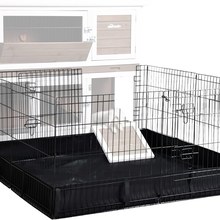
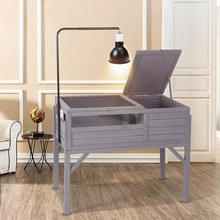
Escape-proof fencing is the starting requirement, and it has to go down as well as up, because a sulcata that wants to leave will dig under it. A tortoise table is a reasonable indoor setup for a juvenile and is a stage rather than a destination: an adult wants 80 to 100 square feet of outdoor space at minimum, and ideally several hundred.
Grazing, Not Feeding
This is the enrichment item that fits the species best and costs nothing. Sulcatas are grazers built to walk and eat continuously through the day, and a bowl of chopped food deletes both halves of that.
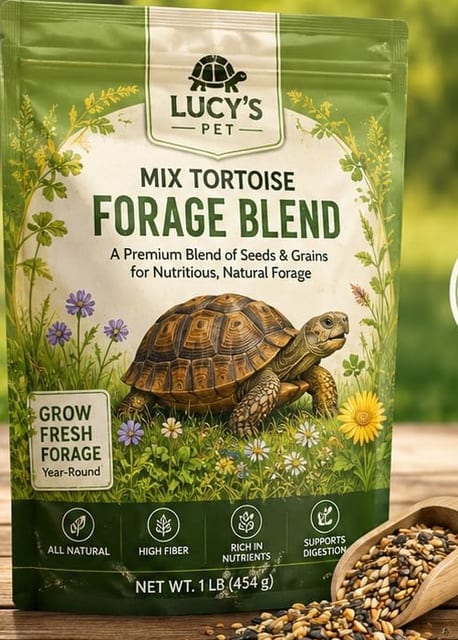
Let them graze on safe growing grass and weeds, sow a tortoise forage seed mix in trays or straight into the enclosure so there is living plant to crop, scatter high-fiber browse across the enclosure instead of piling it, and put food in several places so eating involves travel. Supplement properly, since a grazing reptile in captivity rarely gets the mineral balance right on its own, and a tortoise calcium and multivitamin powder handles that side, on a cadence that changes as the tortoise grows.

Somewhere to Dig
Not optional, and not a behavior you can talk them out of. Sulcatas dig substantial burrows to escape heat, and a captive one will excavate under whatever is nearest if there is nowhere better.
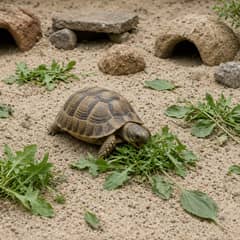
Give a deliberate digging area with deep, diggable substrate, plus a shelter that provides the thermal refuge the burrow would. Then protect fence lines, shed bases and foundations, because a determined adult moves a lot of soil.
Terrain Worth Crossing
Flat lawn is a boring enclosure for a walking animal. Gentle slopes, varied ground texture, rocks, logs and low obstacles turn the space into somewhere with routes through it and not a field.
Keep it navigable. A tortoise that flips onto its back in a hot enclosure can die there, so nothing should be steep enough or wedge-shaped enough to turn one over.
Training, Which the Research Supports
Given the touchscreen and anticipation results, target training a sulcata is entirely reasonable and genuinely useful. A tortoise that will follow a target moves itself for weighing, health checks and enclosure transfers, which for a hundred pound animal is worth real effort.
Vary the feeding schedule while you are at it, so the anticipation has something to work on.
Priority Order
- Secure outdoor space sized for the adult, with fencing that goes down
- Grazing on safe growing plants
- A deliberate digging area, and a thermal shelter
- Scattered, distributed high-fiber browse
- Varied terrain with safe, navigable obstacles
- Target training and a varied feeding schedule
- Novel objects, last
What Not to Do
Do not buy a hatchling without a realistic plan for a hundred pound adult, which is the failure this species is defined by. Do not feed fruit or a red-footed tortoise diet to an arid grazer. Do not assume fencing above ground is enough. Do not build terrain that can flip a tortoise. Do not skip the shelter and expect a burrow to substitute in a climate that gets cold.
The sulcata versus Russian tortoise comparison sets the two side by side, and outdoor space is where they part company.
Sources & Further Reading
4 sources
- Borrowed evidence. No enrichment study exists for this species. The cognition findings below are from red-footed tortoises and box turtles, and are covered in full in our Red-Footed Tortoise enrichment guide.
- Touchscreen performance and knowledge transfer in the red-footed tortoise. PubMed
- Anticipation of cyclical resource availability in the red-footed tortoise. Learning and Behavior
- Case BC, Lewbart GA and Doerr PD. The physiological and behavioural impacts of and preference for an enriched environment in the eastern box turtle. Applied Animal Behaviour Science
- Burghardt GM (2013). Environmental enrichment and cognitive complexity in reptiles and amphibians
❓ Frequently Asked Questions
Is there enrichment research on sulcata tortoises?
No. Nothing has been published on Centrochelys sulcata. The nearest evidence is the red-footed tortoise work on touchscreen learning, anticipation of food on a schedule and cognitive bias, plus a controlled enrichment study in eastern box turtles.
Why does tortoise cognition research matter to a keeper?
Because it changes what counts as reasonable enrichment. A species that can learn a touchscreen task, transfer knowledge between contexts and anticipate a feeding schedule is a candidate for target training and problem-solving feeders, not just a lawnmower with a shell.
How much space does a sulcata need?
More than almost anyone plans for. Adults reach roughly two and a half feet of shell and one hundred pounds or more, and in a suitable climate the honest answer is a secure outdoor enclosure measured in yards rather than any indoor setup.
Do sulcatas burrow?
Heavily, and it is one of the defining things about them. They dig substantial burrows in the wild to escape heat, and in captivity a determined sulcata will excavate under fences, sheds and foundations. Plan for it rather than being surprised by it.
What should they be eating?
Grass and high-fiber browse, mostly. They are grazers, and the common captive failure is feeding them like a red-footed tortoise on fruit and supermarket vegetables, which causes shell and kidney problems over time.
Can sulcatas be kept indoors?
Only while small, and only as a stage rather than a plan. An indoor setup for a full-grown sulcata is not practical in any normal home, and buying one without a realistic outdoor plan is the mistake this species is known for.
📰 More on the Sulcata Tortoise
📘 Sulcata Tortoise care guide
🐢 How Much Does a Sulcata Tortoise Really Cost?
🐢 How to Handle a Sulcata Tortoise (While You Still Can)
🐢 Common Sulcata Tortoise Health Issues and What Causes Them
🐢 Sulcata Tortoise Enclosure Setup: Indoor Is Temporary, Outdoor Is the Goal
🐢 Sulcata Tortoise Feeding: Schedule, Diet, and Why They Stop Eating
🛒 Recommended Gear
As an Amazon Associate, we earn from qualifying purchases through the links above - at no extra cost to you.
Written by Michael Ryan
Mike keeps two rescued bearded dragons, Dex and Cera, and writes the care guides on BeastlyFacts from his own research and mistakes. He is not a veterinarian.
More about Michael Ryan →Comments
No comments yet - be the first!