Rat Enrichment: It Is the Number of Types That Matters
On This Page▾

Rats have more enrichment research behind them than almost any other pet species, and the most useful finding for a pet keeper is not about any particular product.
In pet rats, a greater total number of enrichment types was associated with more frequent digging, nesting and climbing. Not one magic item: nesting material, digging substrate, a foraging device, climbing structure, a tube, a hideaway and a suspended area, counted as categories. Variety is the measured variable.
What the Research Says
The deep background is a 2022 systematic review in Frontiers in Veterinary Science covering environmental enrichment for laboratory rats and mice. It found both benefit similarly from enriched living environments, with no evidence that housing conditions affect the welfare of different strains differently.
The more directly useful paper is an exploratory study of pet rats and their husbandry conditions. It found that a greater total number of enrichment types, listed as nesting material, digging substrate, foraging device, climbing structure, tube, hideaway and suspended area, was associated with more frequent digging, nesting and climbing, all natural behaviors.
That reframes the shopping list. The question is not "is this the best rat toy" but "how many of the seven categories does this cage currently cover". A cage with one excellent item in it and nothing else scores worse than one with seven adequate ones.
The Seven Categories
Work through them rather than buying more of what you already have.
Nesting material. Paper, fleece strips, tissue. Rats build, and material to build with is one of the highest-value cheap items in rodent welfare generally.
Digging substrate. A tub or a deep corner of loose material they can excavate.
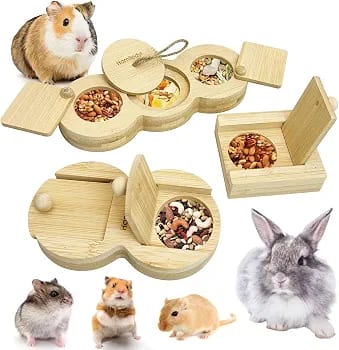
Foraging device. Something food has to be worked out of. A wooden foraging puzzle solves a lid, a snuffle mat makes it scent-led searching instead, and scatter feeding does a version of the same job for free.
Climbing structure. Ropes, ladders, branches. Rats climb constantly and a cage with only floors is half a cage.
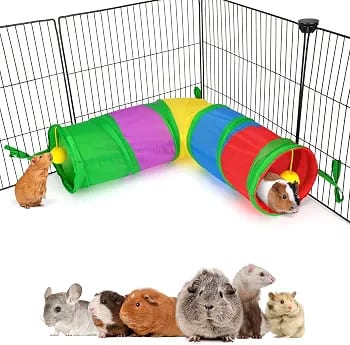
Tube. Connected cover that lets a prey animal cross open space.
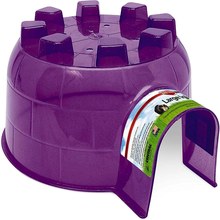
Hideaway. Enclosed sleeping spots, more than one, so a group is not competing for the only dark place.
Suspended area. Hammocks and platforms. Rats sleep off the ground given the option.
Social Housing Comes Before All Seven
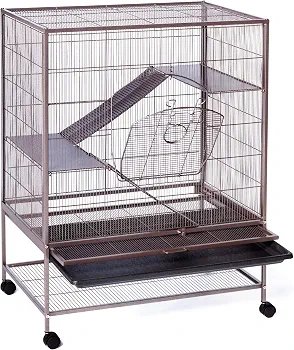
None of the above substitutes for another rat. These are intensely social animals and single housing is a welfare problem that enrichment does not solve. Two is the minimum, a small same-sex group is better, and a cage that fits a group is the first purchase: the minimum floor size and the bar spacing that keeps a rat inside it are what to check before buying. A multi-level rat cage gives them the floors.
Training, Which Rats Are Unusually Good At
Rats learn target training, recall and short trick sequences quickly, and a clicker and target stick is the whole kit. A few minutes daily is cognitive enrichment, exercise and relationship-building at once, and it is free. This is a species where the interaction genuinely is enrichment and not a stressor, which is not true of most small pets, mice included.
The Wheel, in Proportion
A correctly sized solid-surface wheel is a fine addition. Solid surface, never wire or mesh, which injures feet, and large enough that the back stays flat. It is one category of seven, not the centrepiece.

Priority Order
- Companions, before anything else
- A cage large enough for a group with multiple levels
- Coverage across all seven enrichment categories, not depth in one
- Scatter feeding instead of a bowl
- Daily out-of-cage time and training
- A correctly sized solid wheel
- Rotation and novelty, ongoing instead of last
What Not to Do
Do not keep a single rat. Do not buy a better version of a category you already cover while leaving three uncovered, since the study measured breadth. Do not use a wire or mesh wheel, or one small enough to arch the spine. Do not use cedar or pine shavings, which cause respiratory problems in a species already prone to them. And do not treat scatter feeding as a substitute for a proper ration.
Sources & Further Reading
3 sources
- Bored at home? A systematic review on the effect of environmental enrichment on the welfare of laboratory rats and mice. Frontiers in Veterinary Science
- Associations between husbandry conditions, human-animal interactions and animal behavior in pet rats. Applied Animal Behaviour Science
- ILAR Journal. Environmental enrichment for laboratory rodents and rabbits: requirements of rodents, rabbits and research
❓ Frequently Asked Questions
What does the research say matters most for pet rats?
The number of categories covered, not the quality of any one item. Rats with more enrichment types available dug, nested and climbed more often, counting nesting material, digging substrate, a foraging device, climbing structure, a tube, a hideaway and a suspended area as seven separate things.
Is laboratory rat research relevant to pet rats?
Largely yes. A 2022 systematic review in Frontiers in Veterinary Science covering laboratory rats and mice found both benefit similarly from enriched environments, with no evidence that housing conditions affect the welfare of different strains differently. The setting differs, the animal does not.
How many rats should be kept together?
Never one. Rats are intensely social and single housing is a welfare problem no amount of enrichment fixes. Two is a minimum and a small same-sex group is better.
Do rats need a wheel?
A correctly sized solid-surface one is a reasonable addition, but it is one category out of seven rather than the centrepiece. Wire and mesh running surfaces cause foot injuries, and a wheel too small forces a permanently arched spine.
Can rats be trained?
Very readily, and it counts as enrichment. Rats learn target training, recall and simple trick sequences quickly, and training sessions are cognitive stimulation and relationship-building at once.
What is the single cheapest enrichment upgrade?
Scatter feeding. Throwing the ration across the cage instead of putting it in a bowl converts a two minute event into a foraging session, and it costs nothing at all.
📰 More on the Rat
📘 Rat care guide
🐀 How Much Does a Pet Rat Really Cost?
🐀 How to Handle a Rat (And Why It's the Least Likely Small Pet to Bite)
🐀 Common Rat Health Issues (Respiratory Disease Is the One to Know)
🐀 Rat Enclosure Setup: Multi-Level, and Never a Tank
🐀 Rat Feeding: Diet, Portions, and Why Hamster Food Isn't Rat Food
🛒 Recommended Gear
As an Amazon Associate, we earn from qualifying purchases through the links above - at no extra cost to you.
Written by Michael Ryan
Mike keeps two rescued bearded dragons, Dex and Cera, and writes the care guides on BeastlyFacts from his own research and mistakes. He is not a veterinarian.
More about Michael Ryan →Comments
No comments yet - be the first!