Neon Tetra Tank Setup: A 24-Inch Tank, Soft Water, and Dim Light
On This Page▾

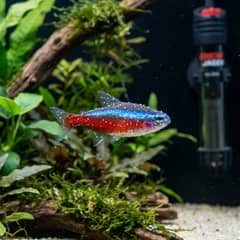
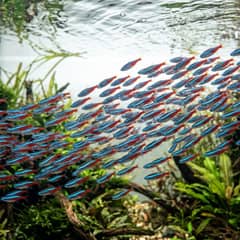
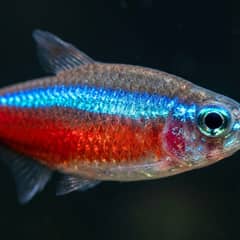
The neon tetra lives in forest streams and minor tributaries of the Amazon basin in Colombia, Brazil and Peru, and it keeps out of the turbid whitewater main channels. The water in those streams carries almost no carbonate hardness. An adult reaches about 1.2 inches (3 cm) and spends its life in midwater in a school. The tank follows from that: room to swim lengthwise, soft water held steady, a floor that leaves it soft, plenty of plants, and low light.
Tank Size: 24 Inches Long for a School of Ten
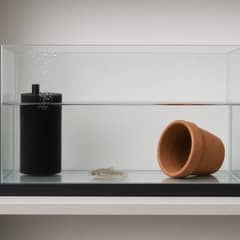
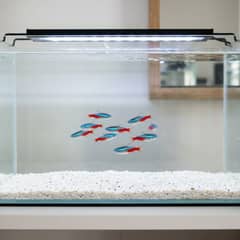
Neons swim as a group, so buy the tank by length: at least 24 inches (60 cm), about 14 gallons or more, for ten fish. The recommended base is 24 x 12 inches (60 x 30 cm) or larger. A standard 10-gallon tank is only 20 inches long and falls short. A 20-gallon long tank clears it with room to spare. Schooling plays out horizontally, so favor a longer tank over a taller one.
The school itself is a mixed-sex group of at least 8 to 10, and ten is the number the tank is sized around.
Temperature: 70 to 77°F, Held Steady
Keep the tank at 70 to 77°F (21 to 25°C). As a tropical species, a heater is necessary for any tank this size, and keeping the temperature stable matters as much as hitting the right number. Swings are more stressful than a slightly imperfect but steady setting.
77°F is the top of the range. A cardinal tetra tank runs at 73 to 81°F, so the two species share 73 to 77°F and no higher.
Water Chemistry: Soft and Slightly Acidic
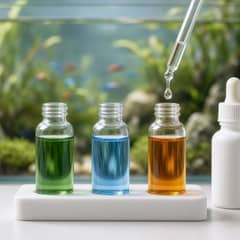
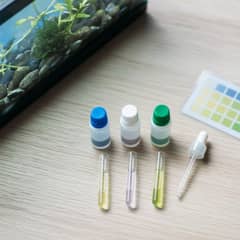
Neon tetras want soft, slightly acidic water, a pH of 6.0 to 7.0, with hardness between 1 and 12 dGH. This is a step away from the harder, more alkaline water a guppy tolerates, and it's worth testing your source water before assuming your setup is automatically suitable. Ammonia and nitrite both need to read zero.
The usual fix for hard tap water is the one that fails. Dosing a pH-down product against a high KH only swings the pH back, so a soft-water fish like the neon tetra needs the tap blended with RO water instead. Mix every top-off and water change the same way the tank was first filled. Always use a water conditioner on tap water before it goes in the tank, dechlorinating and neutralizing chloramine and heavy metals that are otherwise harmful to fish.
Filtration: Gentle Flow
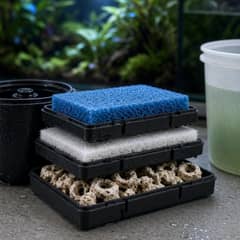
Keep the flow gentle: neon tetras dislike strong current. A sponge filter is a common, effective choice, and a hang-on-back filter works too if you can baffle or reduce its output.
Substrate: An Inert Floor Under a Midwater Fish
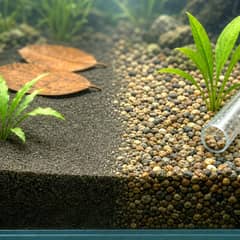
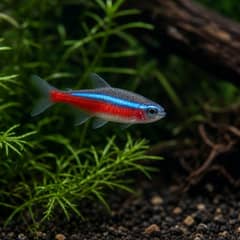
Neons live in midwater and do not dig or sift the bottom, so the floor is there for plants, leaves and water chemistry. Fine gravel or sand suits them, and the species looks its best on sand with driftwood roots and branches laid over it. A neon turns lighter over a pale substrate or background, and a darker color makes neon coloring pop more against the background. A pale fish over a white bed is showing that color response, not illness.
The floor has to leave soft water soft, so it must be inert. Even standard pea gravel carries enough calcium to raise pH and hardness, coral sand pushes the pH past 8.0, above any range a neon is kept in, and calcareous rock such as limestone does the same. A black sand that its maker says will not alter pH meets both needs. About 1 inch of sand is enough where the plants grow on wood; a bed planted into runs 2 inches or more. The setup price covers about 30 lb of sand, roughly an inch across a 20 gallon long; a 2-inch bed for rooted plants takes about 60 lb, double the sand in the setup price. Rooted plants take root tabs beside them, which Seachem calls helpful but not necessary over its sand, or grow in an acidic aquasoil that lowers the pH. Dried leaf litter on top finishes the floor, and the microbes on the decaying leaves give any fry a secondary food source.
Plants: Dense Midground and a Floating Layer
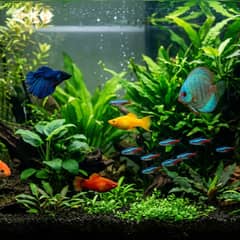
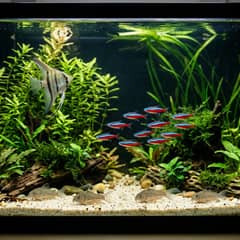
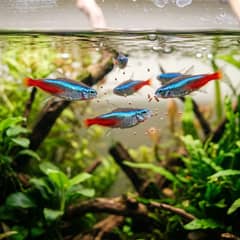
Add dense midground plants and floating plants to dim the light, and the tank starts to resemble the shaded, stained streams the species comes from. The stems break up the open water and the floating layer shades everything under it.
Lighting: Dim to Moderate, 8 to 10 Hours
Neon tetras come from shaded, plant-covered forest streams, so bright, intense lighting over an open tank is the opposite of their home. The species seems to do best under fairly dim lighting and turns lighter in bright conditions. Dense planting and floating plants soften it. Dim to moderate light, roughly 8 to 10 hours a day, suits them. At night the fish turn duller, and the blue stripe looks violet: that is normal night coloring.
Light level can change the color of the neon's closest relative. In a study on cardinal tetras, fish held under intense light had their black and neon stripes go pale within 72 hours, while fish kept at 0 to 250 lux showed the more vibrant color. That study used cardinals, and neons have not been tested the same way.
The neon's stripe is structural color. It comes from stacks of reflective platelets inside cells called iridophores, and as the angle of those platelets shifts, the stripe can change from yellow to violet with the time of day and the mood of the fish.
Source: Practical Fishkeeping, reporting Yoshioka et al. (2010)
Tankmates: Small, Peaceful, Soft-Water Fish
Neons are generally peaceful, and their companions should be too: similarly sized characids, lebiasinids such as pencilfish, small catfish such as Corydoras and the smaller loricariids, and non-predatory small to medium cichlids.
Tankmates have to share the soft water and the 70 to 77°F band and be too small to eat a neon. The pairings that fail are named species by species: an adult angelfish, which eats neons once it is large enough, any fin-nipper, and anything else with a mouth big enough. Ten neons also make a calmer tank than five neons and five rasboras, where neither group reaches the size that settles it.
Blackwater or Clear Water
Wild neons come from both. Many of their streams are stained brownish by humic substances from decomposing leaves and wood, and the species has also been collected from similar habitats with transparent, unstained water. Most neons sold are commercially bred, and farmed fish are more adaptable than wild ones, so a clear tank keeps them well. A tint is the detail that takes a neon tetra tank from adequate to great.
Driftwood and Indian almond leaves release natural tannins that stain the water slightly and lower pH, mimicking the blackwater side of the species' range. They only move the pH in water that is already soft. Against a high KH the tannins are buffered away, for the same reason a bottled pH-down fails, so the RO blend comes first and the wood and leaves second. Peat, the old tannin source, is not needed: its collection is unsustainable and environmentally destructive.
A soft tank with acid going into it has little buffer against a slide. Tanks that go a long time between water changes and are only topped off can see the pH fall gradually or crash, and a rapid drop can kill the fish. Regular water changes and a pH test between them keep the tint from turning into a crash.
Let the Tank Mature Before the Fish Go In
Fish put into a tank that has not finished cycling meet ammonia or nitrite, and they suddenly turn lethargic, stop eating and frequently die. A new aquasoil adds a burden of its own: Tropica recommends changing 25 to 50% of the water at least twice a week for the first 4 weeks after setting up a tank on its soil.
A tank that has just finished cycling is still settling. Neons are not hardy fish, and they react to shifts in water chemistry more than most community species. A young tank drifts in pH and hardness as the driftwood leaches, the substrate settles and the bacteria colony grows into its load. Give the cycled tank time to hold steady readings from one weekly test to the next before the school goes in.
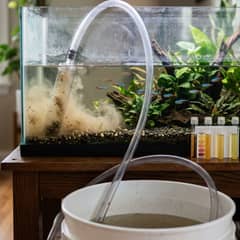
Water changes follow the same logic. Match the new water's temperature and chemistry to the tank, and keep changes modest and regular, so the school never meets a sudden jump.
Always quarantine new fish for at least 30 days before adding them, given the disease risk this species carries. Thirty days is the minimum, and a longer quarantine may be needed. Keep them well fed on a proper micro-pellet or micro-crisp food sized for their small mouths.
Sources & Further Reading
Last reviewed 24 Sep 2026 · 6 sources

A routine chart and equipment log you can fill in for your own setup. The Universal Pet Kit has it, among 19 forms for any pet that you can type into or print.
Frequently Asked Questions
What size tank does a school of neon tetras need?
Length decides it: 24 inches (60 cm) or more, and about 14 gallons, for a school of 10. A 20-gallon long meets that and a standard 10-gallon does not.
What temperature do neon tetras need?
70 to 77°F (21 to 25°C). A heater is necessary in any tank this size, and holding the temperature steady matters as much as the number itself, since swings stress this fish more than a slightly imperfect setting.
What water chemistry do neon tetras need?
Slightly acidic and on the soft side: pH 6.0 to 7.0, with hardness between 1 and 12 dGH. That's a real step away from the harder, more alkaline water species like guppies tolerate, so test your source water before assuming it fits. Ammonia and nitrite both need to read zero.
What kind of filtration is best for a neon tetra tank?
Gentle flow, since neons dislike strong current. A sponge filter is the common choice, and a hang-on-back works if you baffle or reduce the output.
What's the non-obvious detail that makes the biggest difference in a neon tetra tank?
Recreating blackwater conditions. Driftwood and Indian almond leaves release tannins that tint the water and lower pH, which mimics the blackwater side of this species' wild habitat. Add dense midground plants and floating plants to dim the light.
What substrate is best for neon tetras?
Fine sand or gravel that is inert, so it leaves soft water soft. Pea gravel, coral sand and limestone all raise pH and hardness, and a darker floor brings out the color, since neons turn lighter over a pale substrate.
What fish can live with neon tetras?
Peaceful fish of a similar size that share soft water and 70 to 77°F: other small characids, pencilfish, small Corydoras and loricariid catfish, and non-predatory small cichlids. Leave out adult angelfish, fin nippers and anything with a mouth big enough to swallow a neon.
How long should a new neon tetra tank run before the fish go in?
Until it has finished cycling, with ammonia and nitrite at zero, and then until pH and hardness hold steady from one weekly test to the next. A tank on a new aquasoil also needs its first weeks of frequent water changes behind it.
More on the Neon Tetra
Recommended Gear
As an Amazon Associate I earn from qualifying purchases through the links above, at no extra cost to you.

Written by Michael Ryan
Mike keeps two rescued bearded dragons, Dex and Cera, and writes the care guides on BeastlyFacts from his own research and mistakes. He is not a veterinarian.
More about Michael Ryan →You May Also Like
Subscribe - it's free
An occasional email when something new is worth your time. No spam.
Deep Dive
Health and More