Ember Tetra Tank Setup: A 10-Gallon School, Soft Water, and Dense Plants
On This Page▾

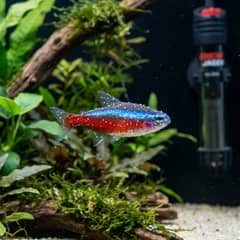
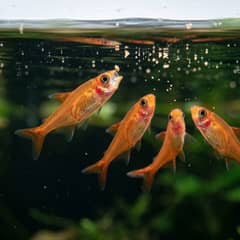
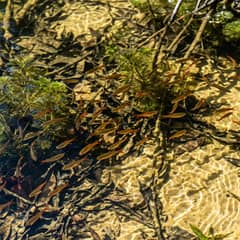
The ember tetra is thought to live off the main channels of the Araguaia River basin in central Brazil, in minor tributaries, backwaters and oxbow lakes where the water is soft and weakly acidic and the bottom lies under fallen leaves and branches. The species was first described from the Rio das Mortes, one of the basin's rivers, and an adult reaches about 0.8 inch (2 cm). A tank for a school of ten is built from that picture: soft water, a dark planted floor with leaves on it, gentle flow, and no tankmate big or rowdy enough to push a fish this small aside.
Tank Size: Ten Gallons for a School of Ten
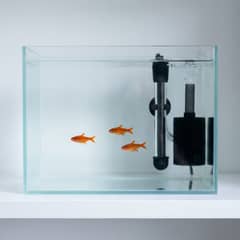
A 10-gallon tank is the size for a school of 10. The footprint guidance for this species is a base of at least 18 x 12 inches (45 x 30 cm) or the equivalent, set for the recommended purchase of 8 to 10 fish, and a 10-gallon roughly matches it. Aim for 10 or more.
The school is the point of keeping embers, and in the group-size study on neon tetras, groups of 10 shoaled the most.
Temperature: 75 to 82°F, With 82 as the Ceiling
75 to 82°F (24 to 28°C) is the range, held by a submersible heater. 82°F is the ceiling, so the heater sits inside the range with room to spare above it.
That band overlaps a neon tetra tank, kept at 70 to 77°F, only between 75 and 77°F. A cardinal tetra tank, kept at 73 to 81°F, shares more of it, from 75 to 81°F. An ember tank treats 82°F as its limit.
Water Chemistry: Soft, and Acidic to Neutral
Embers want soft water that runs from acidic to neutral: pH 5.0 to 7.0, with a general hardness of 1 to 10 dGH. That is the same pH range a cardinal tank is run at, so the two species differ on temperature far more than on chemistry.
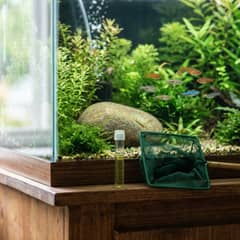
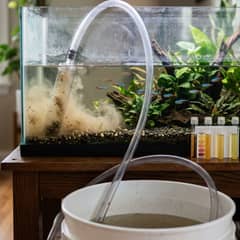
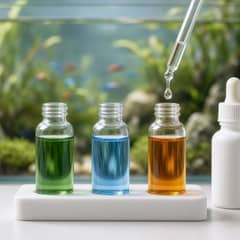
Test the source water before the tank is filled. Hard tap water comes down by blending it with RO water, which lowers GH and KH together so the pH follows and then holds. A bottled pH-down product forces the number for a while and leaves the hardness that set it untouched. Every top-off and water change is dechlorinated with a water conditioner and mixed the same way the tank was first filled.
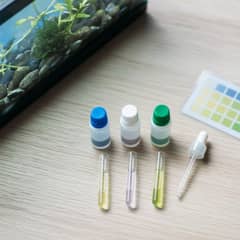
Keep testing once the tank is running. GH and pH that climb in a tank filled with soft water mean something inside it is dissolving, and the gravel and stone are the first things to check, for the reasons the substrate section below covers.
Filtration: Gentle Flow
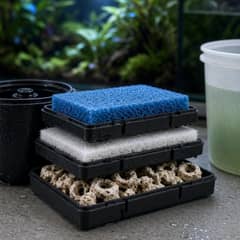
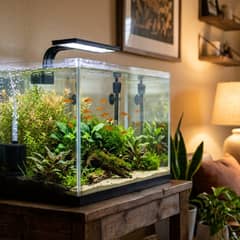
Keep the flow gentle. A little water movement does no harm, and a sponge filter fits that brief. It is also the gentlest intake for a tank that holds shrimp, which matters when dwarf shrimp share the tank. A hang-on-back works too when its output is baffled or turned down.
Substrate: A Dark Floor That Leaves the Water Soft
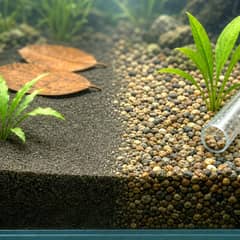
Embers are best kept in a heavily planted tank, preferably over a dark substrate, and keepers report brighter color over a dark floor and background, an observation from the hobby that nobody has measured. A black sand or a dark, small-grained gravel meets it. At the one wild ember site described firsthand, near Aruanã on the Araguaia, the bottom was leaf litter over a yellow, clay-like floor mixed with fine gravel and sand.
Whatever goes down has to leave soft water soft, so the floor is an inert substrate. Even standard pea gravel carries enough calcium to raise pH and hardness, and coral sand and limestone belong only in a tank meant to stay hard. A tank planted into the floor needs a deeper bed, fed with root tabs beside the rooted plants, or laid as an acidic aquasoil, which pulls the water toward the ember's range.
Dried leaves and driftwood branches on top suit this species. As the leaves break down, colonies of microbes establish on them and grow a biofilm that fry graze on, and they bring pH down a little. They do not soften hard water: that still comes from the RO blend.
Plants: Dense Stems and a Floating Layer
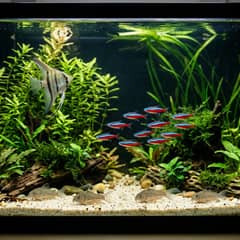
Plant the tank heavily. Dense stems and leaves recreate the planted backwaters the fish comes from and give the school cover. At the Aruanã site, the fish moved among stands of Eichhornia diversifolia, Cabomba furcata, Ludwigia inclinata, Ludwigia sedoides and flooded grasses, while the central channel was mostly free of plants.
Floating plants earn a place on the surface too, and they shade the water beneath them. Root-feeding plants go into the substrate with root tabs beside them.
The ember tetra is rated Least Concern, with a wild population that can double in under 15 months, and it is both fished and kept commercially for the aquarium trade.
Source: FishBase
Lighting: Short Days While the Plants Settle
The wild water at Aruanã was clear, with little overhead cover, so plenty of light hit it. In the tank, light is set for the plants. A new planted tank starts on short days, about 6 hours of light at first, then works up gradually toward 8 to 12 hours as the plants grow in. Keep fertilizer low at the start for the same reason: too much light and food early on feeds algae. If algae takes hold, shorten the hours again. A timer keeps the schedule more reliably than a person does.
Light level can change a tetra's color. In a study on cardinal tetras, fish held under intense light lost color in their black and neon stripes within 72 hours, while fish kept at low light, 0 to 250 lux, showed the more vibrant color. That study used cardinals, and an ember's orange has not been tested the same way.
Tankmates: Small, Calm and Peaceful
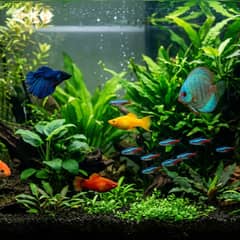
Ember tetras are very peaceful fish, and they lose out to any tankmate that is rowdy or much bigger than they are. That one trait decides most of what goes in the tank with them. In a calm community they work well, and they make an ideal dither fish for Apistogramma and other dwarf cichlids. An ember does not normally hunt fry either.
The test is a peaceful animal of similar size that won't eat them. That covers:
- Similarly sized, peaceful characids, and other nano schooling fish such as small rasboras and danios.
- Small catfish: Corydoras on the bottom, and otocinclus.
- Calm fish that keep to the surface, such as hatchetfish or pencilfish.
- Dwarf cichlids such as Apistogramma.
- Adult dwarf shrimp.
In a general community, embers also combine with smaller barbs and anabantoids. The barbs to leave out are the fin nippers. Tiger barbs are notorious for biting the fins of other fish, worst when too few are kept or space is tight, and they make a poor companion for timid fish. Serpae tetras have the same reputation for nipping and tend to dominate and bully less robust species. Embers themselves are not known as fin nippers.
Big fish are the other risk. Angelfish reach about 6 inches (15 cm) in body length and may eat small fish such as tetras.
Bettas and dwarf gouramis are a fish-by-fish call. A single blue betta or powder blue dwarf gourami can make a striking centerpiece over an ember school, a pairing some keepers recommend. Some individuals turn territorial, though, and an ember loses out to a tankmate that does.
Shrimp are a split answer. Embers leave adult dwarf shrimp alone, so a grown colony of Neocaridina or Caridina is safe with them. Shrimplets are another matter: almost all fish will opportunistically go after baby shrimp, and embers are no exception, though a fish this size struggles to eat anything but newly hatched ones. A tank meant to raise shrimp and hold a school of embers will lose some of its young to the fish, and dense plants are what keep that number down, since shrimplets spend their first few weeks hiding in them.
Cycle the Tank Before the School Goes In
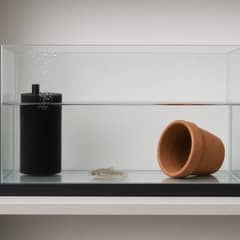
An ember tank is cycled before any fish are added: ammonia and nitrite both read zero, and nitrate has started to build. Fish put into a tank that has not finished cycling meet ammonia or nitrite at toxic levels, and in new tank syndrome they suddenly turn lethargic, stop eating and frequently die. An aquasoil is reported to release a burst of ammonium right after it goes in, which is one more reason the readings have to settle before fish arrive.
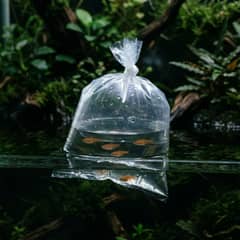
Adding the whole school of 10 at once is one of the two safe ways to stock a newly cycled tank, as long as the water is tested every day until the readings settle. Ten fish arriving together is a sudden jump in waste, and daily tests show whether the filter is keeping up.
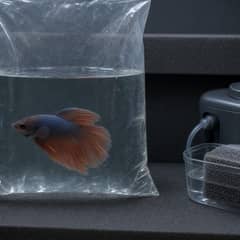
New fish spend 30 days in a bare quarantine tank before they join a display tank that already holds fish or shrimp. Thirty days is the minimum, and longer may be needed.
Sources & Further Reading
Last reviewed 1 Nov 2026 · 3 sources

A routine chart and equipment log you can fill in for your own setup. The Universal Pet Kit has it, among 19 forms for any pet that you can type into or print.
Frequently Asked Questions
What size tank do ember tetras need?
A 10-gallon tank for a school of 10, on a base of roughly 18 x 12 inches (45 x 30 cm) or the equivalent. Ten or more is the group to aim for.
What temperature do ember tetras need?
75 to 82°F (24 to 28°C), held steady by a heater. 82°F is the top of the range, so set the heater inside it and never above it.
What water chemistry do ember tetras need?
Soft, acidic to neutral water: pH 5.0 to 7.0 and a hardness of 1 to 10 dGH. Ammonia and nitrite both need to read zero in a fully cycled tank before the school goes in.
Do ember tetras need a planted tank?
Yes. Ember tetras are best kept in a heavily planted tank over a dark substrate, with floating plants as a useful addition and filtration kept gentle.
Do ember tetras need a filter?
Yes, a gentle one. A sponge filter fits a species that wants little water movement and is the safest intake where dwarf shrimp share the tank; a hang-on-back works once its output is baffled.
What substrate is best for ember tetras?
A dark, inert sand or small gravel, washed before it goes in. Skip crushed coral, coral sand and any gravel or stone that fizzes in vinegar, since calcium pushes pH and hardness up past what a soft-water fish wants.
What fish can live with ember tetras?
Small, peaceful species of a similar size: other small tetras and rasboras, Corydoras and otocinclus, hatchetfish or pencilfish, and dwarf cichlids such as Apistogramma. Angelfish may eat them, and fin nippers such as tiger barbs and serpae tetras bully them.
More on the Ember Tetra
Recommended Gear
As an Amazon Associate I earn from qualifying purchases through the links above, at no extra cost to you.

Written by Michael Ryan
Mike keeps two rescued bearded dragons, Dex and Cera, and writes the care guides on BeastlyFacts from his own research and mistakes. He is not a veterinarian.
More about Michael Ryan →You May Also Like
Subscribe - it's free
An occasional email when something new is worth your time. No spam.
Deep Dive
Health and More