Neon Tetras Aren't Handled, But the School Size Isn't Optional
On This Page▾

A neon tetra is a fish to watch, and the only time a keeper's hands come near one is the minute it moves from a bag or a net into water. The welfare question with this species is group size, and getting that number right changes how these fish behave. The move itself still has its weak points: a bag that runs short of air, water chemistry that changes too fast, and a keeper's bare hand in tank water.
The Number That Matters: Ten
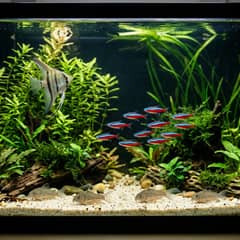
Neon tetras are obligate schooling fish: they need a group to feel secure and behave normally. Eight is the least to buy, and ten is better. In a home aquarium study, neon tetras in smaller groups showed more darting and aggression and were slower to come out to feed than neons in a group of ten. For this species the number works as a welfare requirement.
Buy the whole school in one trip if the tank is ready for it. A pair of neons added ahead of the rest has no school to hide in. Ready means a tank that has run for a while after cycling, never one that finished cycling last week.
What a Properly Schooled Group Looks Like
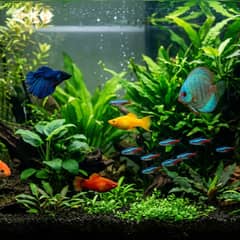
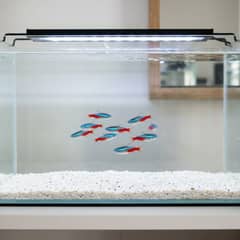
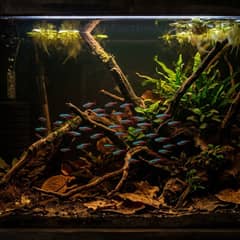
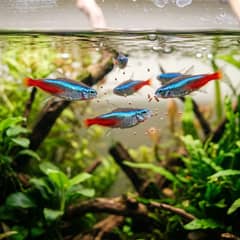
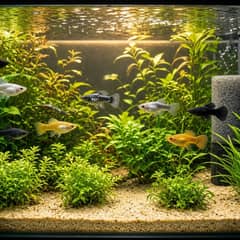
Confident, brightly colored fish swim together in a loose group and work the mid-water of the tank instead of hiding in corners. It is one of the more rewarding things to watch in a community aquarium, and it only happens reliably once the school is big enough.
Netting: Leave the Bag in the Water
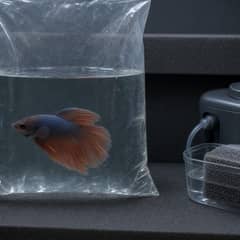
A net is the one tool that touches a neon, and its usual job is moving fish into a bag, at the shop or between tanks. The method to avoid has a helper holding a half-filled bag up in the air while the neons get tipped into it from the net. The better way keeps the bag in the tank: float it open on the surface and net the fish across into it there.
The Drive Home
Ask for the bag to be filled one part water to three parts air. For the ride, the bag goes into a dark container, or gets wrapped in a towel or a few sheets of newspaper.
Bag water gets worse with every mile. The fishes' waste pushes ammonia up, and the carbon dioxide they breathe out builds up and drags the pH down. On a short drive neither gets far, and anything longer brings in the oxygen, insulation and container choices for moving fish on a longer trip.
The Minutes Between the Bag and the Tank
The one real handling job is getting new neons into the tank, and it follows the same float, mix, net and release every aquarium fish gets. Neons react more to a change in water chemistry than most community fish, so the mixing is never rushed. Keep the fish fairly dark, float the bag, and add tank water a little at a time until the bag holds more aquarium water than shop water.
| Method | How long | When it fits |
|---|---|---|
| Floating and mixing | 30 to 60 minutes, a little tank water every few minutes | Shop water and tank water close in pH and hardness |
| Drip acclimation | A couple of hours, at 1 to 2 drips a second | The two differ much in pH or hardness, the case where slow mixing earns its time |
Either way, the neons cross into the tank by net. The bag water goes down the drain, never into the aquarium. The lights stay dim for the first hour or two, and from then on each water change stays at a size the fish never notice.
Telling Males From Females
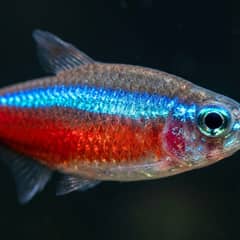
Sexing a neon is hard until the fish are mature. Adult females are rounder-bodied and a little larger than the slimmer males. Seen from the side, that fuller belly makes the female's blue stripe look slightly bent, and a male's stripe runs straight. In a school of ten, the plumpest few are the females.
Breeding Neons
A community tank almost never produces young neons, and the reason is chemistry and light. Spawning needs very soft, acidic water, hardness around 1 to 5 dGH and a pH of 5.5 to 6.5, in a very dimly lit tank. Successful home spawnings have run at 75°F and 78°F. The eggs and fry are light sensitive, and the adults eat any eggs they find.
That shapes the setup. A small bare tank, a clump of Java moss or a layer of leaf litter for the eggs to fall into, soft water, and the tank kept dark. Add a pair or two of conditioned adults, and take them out once eggs appear. The eggs hatch in about 24 hours, though some batches take up to 36, and the fry swim free a few days after that. The fry start on infusoria-sized food and move to microworm or newly hatched brine shrimp once they can take it. Young neons color up at about four weeks.
A neon's color shifts with its surroundings. At night the fish dulls and its blue stripe turns toward violet, and in bright, clear water over a pale bottom the whole fish grows lighter.
Source: Seriously Fish
Fish Tank Granuloma: Gloves Over Cuts
Floating a bag, netting fish across and pouring away the bag water all put a keeper's hands in aquarium water, and that water can carry Mycobacterium marinum. The bacterium lives in fresh and salt water and in aquarium tanks, and it gets into a person through broken skin. People who keep aquariums carry a higher risk, most of all with a cut or scrape on the hand.
It usually shows 2 to 3 weeks after exposure as a reddish to purple bump that becomes a painful nodule and can open into a sore. Elbows, fingers and the backs of the hands are the usual sites. Clearing it can take several months on more than one antibiotic, so a bump that does not go away is a reason to see a doctor.
Two habits prevent it: rubber gloves for tank work, and a thorough wash of the hands and arms once the job is done. A hand with a fresh cut never goes into the water bare.
First-Timer Mistakes
- Buying two or three neons and calling it a school: the most common mistake with this species.
- Adding them to a tank that has only just finished cycling, which stresses an already sensitive fish.
- Mixing them with fin-nipping tankmates, which disrupts schooling even in an adequate group.
How Neon Tetras Compare to the Guppy
The two look interchangeable on a beginner's shopping list: small, colorful, community friendly. Their care diverges. Guppies are hardy livebearers that tolerate harder, more alkaline water and breed without help. Neon tetras are egg scatterers that want soft, slightly acidic, steady water, and they react badly to swings. A keeper who has done well with guppies should check that assumption before buying neons, because guppies put up with a wider range of water than neons do.
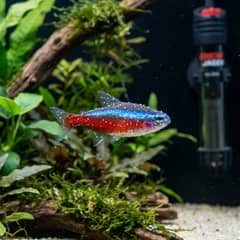
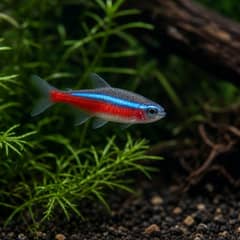
The fish a neon gets confused with most often is the closely related cardinal tetra, and the red stripe tells them apart. It runs the full body length on a cardinal, but only the back half on a neon.
Sources & Further Reading
Last reviewed 21 Jul 2026 · 4 sources
- Paracheirodon innesi (Neon Tetra), Seriously Fish
- Saxby A, Adams L, Snellgrove D, Wilson RW and Sloman KA (2010). The effect of group size on the behaviour and welfare of four fish species commonly kept in home aquaria. Applied Animal Behaviour Science 125(3-4): 195-205. DOI 10.1016/j.applanim.2010.04.008
- Practical Fishkeeping: How to breed Neon tetras, John Robertson; What you need to know about bagging fish, Nathan Hill
- Fish tank granuloma, MedlinePlus, US National Library of Medicine

A pet profile and a sitter sheet you can fill in, so anyone who helps knows the routine. The Universal Pet Kit has it, among 19 forms for any pet that you can type into or print.
Frequently Asked Questions
Do you handle neon tetras the way you'd handle a hamster or a bird?
No. Neon tetras are watched, not handled. What decides how well they do is the size of the school they live in.
How many neon tetras should I keep together?
Ten, with eight as the least to buy. Smaller groups show more darting and aggression and are slower to come out to feed, so treat the number as a welfare requirement.
What does a properly schooled group look like?
Bright fish moving together through the middle of the tank, out in the open instead of tucked into corners. It only looks like that once the school is big enough.
How do you acclimate neon tetras?
Float the bag in dim light and add a little tank water every few minutes for 30 to 60 minutes, until it holds more tank water than shop water, then net the fish into the tank and pour the bag water away. If the two waters differ much in pH or hardness, drip them in over a couple of hours instead.
What's the most common neon tetra beginner mistake?
Buying two or three and calling it a school. That's the big one. Adding them to a tank that hasn't finished cycling, and mixing them with fin-nippers, round out the list.
How can you tell a male neon tetra from a female?
Only once they're adults. Females are rounder-bodied and a little larger than males, who stay slimmer. The fuller belly makes a female's blue stripe look slightly bent, while a male's stripe runs straight.
Can you catch anything from a neon tetra tank?
Aquarium water can carry Mycobacterium marinum, the bacterium behind fish tank granuloma, and it gets in through a cut or scrape. Rubber gloves for tank work and a thorough wash of hands and arms afterward prevent it.
How do neon tetras compare to guppies?
They look interchangeable on a shopping list and aren't. A guppy is a hardy livebearer that tolerates harder, alkaline water and breeds without much intervention. A neon tetra is an egg-scatterer that wants soft, slightly acidic, steady water, and it reacts badly to swings.
More on the Neon Tetra

Written by Michael Ryan
Mike keeps two rescued bearded dragons, Dex and Cera, and writes the care guides on BeastlyFacts from his own research and mistakes. He is not a veterinarian.
More about Michael Ryan →You May Also Like
Subscribe - it's free
An occasional email when something new is worth your time. No spam.
Deep Dive
Health and More