Common Ember Tetra Health Issues (and Why the Ich Heat Cure Stops at 82°F)
On This Page▾

No disease belongs to the ember tetra in particular. This fish of about 0.8 inch, from the soft, weakly acidic backwaters of the Araguaia River basin in central Brazil, meets the problems any small soft-water tetra meets, and poor diet and poor water quality raise the risk of every one. Two things set it apart: the top of its temperature range sits below the heat that kills ich, and its soft water is where copper, a standard fish medication, is most dangerous.
Signs That Need Action Today
A head count at feeding time is the daily check in a school of 10. These are the signs that cannot wait for tomorrow.
Test ammonia and nitrite first:
- Fish gasping at the surface or breathing fast.
- Two or more fish showing the same sign at once.
- A fish found dead. Take the body out of the tank before anything else.
Start ich treatment today:
- White spots like grains of salt on the body or fins.
- Fast breathing that continues once the water tests clean, since ich can infect the gills.
Watch closely and check again tomorrow:
- Flashing: rubbing against plants, glass or substrate.
- A fish off its food or hanging listless.
- Extra mucus on the skin.
- Color fading to dull.
- Ragged fin edges, or a cotton-like tuft on the skin or fins.
- A fish growing thin while it keeps eating.
The first four are the early signs of ich and show up before the spots do, so a fish showing them gets a daily look for spots until they pass. Gasping, lethargy and a lost appetite are just as often the water as a parasite, which is why telling a water problem from an illness starts with the test kit and only then moves on to the fish.
What a Healthy Ember Looks Like
| Check | Healthy | Worth a closer look |
|---|---|---|
| Skin and scales | Smooth and unblemished | Spots, extra mucus, cotton-like tufts |
| Fins | Intact | Ragged or bloody |
| Eyes | Bright and clear | Cloudy or bulging |
| Swimming | Steady, with the school | Circling, drifting or listless |
| Body | Even and full | Thinning while still eating |
| Color | Its usual orange | Fading to dull |
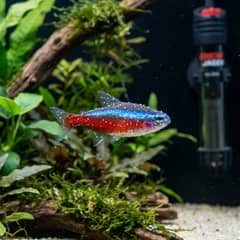
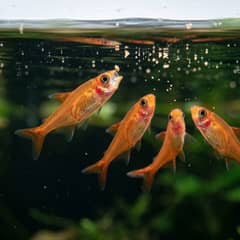
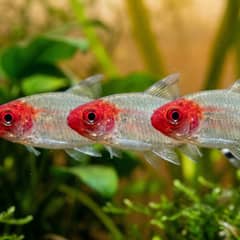
Adult males are more intensely colored than females, especially in spawning condition, so a spread of orange across the school is normal. The one to watch is a fish fading from its own shade.
Water Quality Comes First
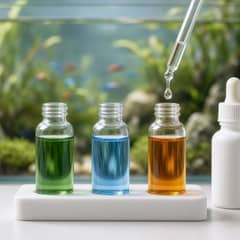
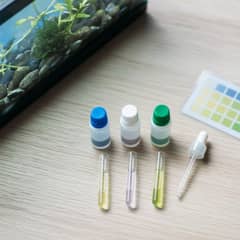
Embers do best kept in soft, weakly acidic water like their own: 75 to 82°F, pH 5.0 to 7.0 and 1 to 10 dGH. Holding the tank steady inside that range matters more than hitting one exact number, and a liquid test kit run before each weekly water change catches a drift before it harms the fish. In water this soft, KH is what holds pH still, and it is the reading to understand before adjusting anything, copper included.
A dull ember usually means its care slipped somewhere. Diet is the other half: poor nutrition depresses the immune system, and overfeeding brings a run of health problems. An ember's small mouth takes tiny, slow-sinking food, so a fine food fed in small amounts suits it better than a pinch of flake that drifts down uneaten. Company counts too: an ember is a shoaling fish, and a school of 10 is part of keeping it well.
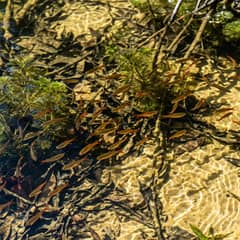
At one spot in the Araguaia basin where ember tetras live, the water almost vanishes in summer.
Source: Practical Fishkeeping
Ich: Warm to the Ceiling, Then Treat
Ich, or white spot disease, usually arrives through infected water or a newly added fish. The spots tend to appear long after the infection starts, so the watch list above is usually the first warning. Infected gills show as fast breathing or gasping, and a large infestation can kill, especially a fish already weakened by something else.
Most ich strains cannot survive above 86°F, and for fish that live comfortably that warm, holding the tank there clears an outbreak. The ember's range tops out at 82°F, four degrees short, so the heat method is not for this fish. Heat still helps up to the ceiling, because the parasite multiplies faster in warmer water and each new generation comes into reach of the treatment sooner. Raise the tank slowly to 82°F with a reliable aquarium heater and an air stone for the extra oxygen warm water needs, and let one of these do the killing:
- Not aquarium salt. Salt is unproven for this species at the 4 to 5 grams per liter that kills ich; use an ich medication instead.
- An ich medication, dosed to the label or to a vet's directions. Vets typically treat the water with formalin or copper sulfate products over several doses, but copper is the one to avoid in a soft ember tank, for the reason two sections down.
Keep treating until every sign of illness is gone. Warming to the ceiling and treating is the route every fish whose ceiling stops short of 86°F takes, the neon tetra among them.
Fin Rot and Fungus: Damage First, Then Infection
Both usually follow something else. Water molds such as Saprolegnia move in after an injury, poor water or a chill, as grayish-white, cotton-like growths on the skin, gills, eyes or fins. Fin rot is bacterial, often Aeromonas, and leaves fins ragged; columnaris can pass for either, with slimy or cotton-like skin lesions. An ember does not compete well with boisterous or much larger tankmates, so calm company and steady water are most of the prevention.
Fix the water, then move the fish to the hospital tank. In clean conditions one potassium permanganate treatment often controls external Saprolegnia and can help early columnaris. Past that, a bacterial infection needs an antibiotic chosen by lab testing: stacking or rotating several drugs, called shotgunning, breeds resistant bacteria.
Internal Parasites
Weight loss, lethargy and a poor appetite are the usual signs. Camallanus, red worm disease, is the one that shows: blood-red worms protruding from the vent. Cyclops and Daphnia carry it as intermediate hosts, so live crustaceans can bring it in. Spironucleus shows as weight loss with white, stringy feces, and heavy tapeworm loads leave fish thin and listless. Each needs a different drug, and fresh smears under a microscope tell which, so this is a vet's call, not a guessed dewormer.
Neon Tetra Disease and Its Lookalikes
Neon tetra disease is caused by a microsporidian parasite, Pleistophora hyphessobryconis, that infects skeletal muscle. It is named for its type host, the neon tetra, but it is recorded from other tetras and from angelfish, rasboras, barbs and zebrafish, so the name does not confine it to neons. The spores are extremely resistant, and microsporidia are considered untreatable.
Mycobacteriosis looks much the same: paleness, wasting and skeletal deformity such as a bent spine, sometimes with bulging eyes or skin ulcers. It is also untreatable in fish, cannot be detected with nonlethal tests, and can cause a skin infection in people. Low oxygen, low pH and a heavy organic load favor it, and an infected tank is disinfected before new fish go in. For both diseases the rule that protects any school holds: a dead fish comes out as soon as it is found, whatever killed it.
Copper, Soft Water and Shrimp
Copper grows more toxic to fish as total alkalinity falls, and below 50 ppm, about 2.8 dKH, copper treatment is not recommended at all because the risk of killing fish is high. A soft ember tank with little KH can sit under that line, so the KH test comes before any copper product is considered. Copper is also toxic to invertebrates, and dwarf shrimp often share an ember tank.
Shrimp come out before any medication goes in, whatever the label says. Formalin is toxic too and is used only by its instructions. Treating in the hospital tank keeps the school, the shrimp and the plants away from every drug.
Quarantine Every New Fish
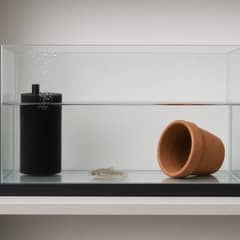
New fish are the usual way ich reaches an established tank, and a separate tank is worth having no matter where the fish come from. Buy from a clean tank where every other fish looks healthy, then give each new ember at least 30 days in quarantine before it meets the school, longer if anything shows. A modest separate tank with a gentle sponge filter covers it, and the same tank becomes the hospital when a fish gets sick.
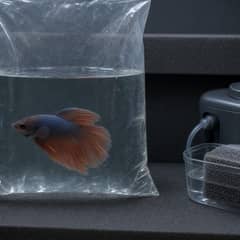
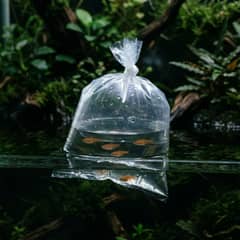
Arrival day carries its own risk. On a long trip, ammonia builds in the bag from the fish's own waste and pH drops as carbon dioxide rises, so the fish arrive already under strain. The bag water stays out of the tank, since it can carry that waste and pest snail eggs, and with fish this small the bag and net get checked afterward for any that got stuck.
When a Fish Vet Is Worth It, and How to Find One
Most diagnoses above end at a microscope or a lab, including a necropsy of a dead fish. Guessing with store medicines skips that, and in an ember tank a wrong guess can mean copper in soft water or antibiotics that leave resistant bacteria behind.
Vet licenses do not cross state lines, but any vet can consult an aquatic vet in any state, so a local exotic or small-animal vet can take the case with a fish vet's help. The American Association of Fish Veterinarians' directory lists fish vets by state or country, and the World Aquatic Veterinary Medical Association covers keepers outside North America. Online advice without an exam cannot legally set a treatment plan.
Bring:
- At least 1 quart of tank water in a plastic bag or clean plastic bottle, capped underwater so no air is trapped.
- On municipal water, a second sample of under about 3 ounces in glass, for a chlorine test.
- The history: tank volume, water source, filtration, new additions and their quarantine, past medications, and the number and species of fish.
- Video or photos of the tank, filter, and sick and healthy fish if the fish cannot travel. Any dead fish goes with a water sample.
An ember that is eating, holding its orange color and moving with the school in steady, soft water is a healthy one. Nearly everything that goes wrong with the species starts in that water or arrives with the next fish.
Sources & Further Reading
Last reviewed 1 Nov 2026 · 5 sources
- Fish White Spot Disease (Ich) - VCA Animal Hospitals
- Merck Veterinary Manual: Disorders and Diseases of Fish; Parasitic Diseases of Fish; Bacterial Diseases of Fish; Mycotic Diseases of Fish; Nutritional Diseases of Fish; Management of Aquarium Fish; Environmental History of Aquatic Systems; Selection of Fish
- Use of Copper in Freshwater Aquaculture and Farm Ponds (Watson and Yanong), UF/IFAS Extension FA-13
- How To Find A Fish Vet To Help Your Fish (Jessie Sanders, DVM, Fish Practice)
- Seriously Fish: Hyphessobrycon amandae

Log weight, feeding and meds, so your vet has the full picture. The Universal Pet Kit has it, among 19 forms for any pet that you can type into or print.
Frequently Asked Questions
Can you treat ich in ember tetras with heat?
Not with heat alone. Most ich strains die above 86°F, and the ember tetra's range tops out at 82°F. Warm the tank slowly to 82°F with an air stone running, which speeds up the parasite's cycle, and let an ich medication do the killing. Salt is unproven for this species at the 4 to 5 grams per liter that kills ich; use an ich medication instead.
How long should new ember tetras be quarantined?
At least 30 days in a separate tank before they join an established school. New fish and water carried in with them are how ich usually reaches a tank, and a month gives a hidden infection time to show where it can be treated without exposing every other fish.
Do ember tetras get any species-specific diseases?
None are known. Embers get the same problems as any small soft-water tetra, and poor diet and poor water quality raise the risk of all of them. Steady water at 75 to 82°F, pH 5.0 to 7.0 and 1 to 10 dGH, tested once or twice a week, plus a school of 10 or more, prevents most of it.
What signs mean an ember tetra needs help today?
Gasping at the surface or fast breathing, two or more fish showing the same sign, or a dead fish all call for an ammonia and nitrite test straight away. White spots on the body or fins mean ich treatment starts the same day, and so does fast breathing that continues once the water tests clean.
Why is my ember tetra losing its color?
Fading color is an early sign of ich and also what a fish shows when water or diet has slipped, so test ammonia and nitrite first, then check the fish daily for white spots.
Can I use a copper medication in an ember tetra tank?
Usually not. Copper grows more toxic to fish as alkalinity falls, and it is not recommended below 50 ppm total alkalinity, about 2.8 dKH, which a soft ember tank can sit under. It is also toxic to invertebrates, so any shrimp come out before any medication goes in.
How do I find a vet for a sick ember tetra?
Start with the vet you already use. A local exotic or small-animal vet can bring in an aquatic vet from any state to consult, and the American Association of Fish Veterinarians' directory lists fish vets by state or country. Take at least a quart of tank water and the tank's history to the visit.
More on the Ember Tetra
Recommended Gear
As an Amazon Associate I earn from qualifying purchases through the links above, at no extra cost to you.

Written by Michael Ryan
Mike keeps two rescued bearded dragons, Dex and Cera, and writes the care guides on BeastlyFacts from his own research and mistakes. He is not a veterinarian.
More about Michael Ryan →You May Also Like
Subscribe - it's free
An occasional email when something new is worth your time. No spam.
Deep Dive
Health and More