Canary Cage Setup: Length Matters More Than Height
On This Page▾

Canary cage setup is simple, and the one detail that trips up first-time owners is choosing a tall, narrow parrot-style cage when this species needs the opposite shape entirely.
Cage Size and Shape
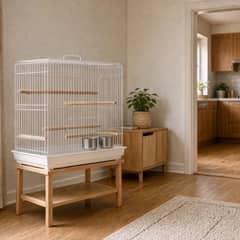
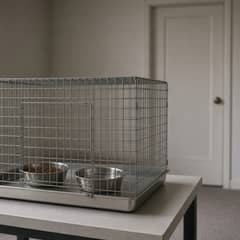
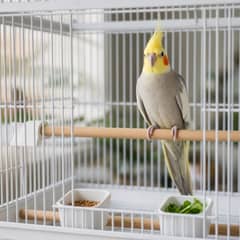
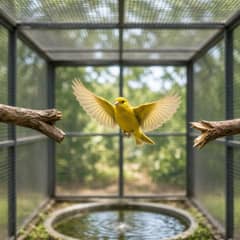
Two feet long by one foot deep by one foot tall is the smallest cage for one canary, and a bigger cage is better. A cage around 24 by 18 by 18 inches or larger gives the bird real room, and more than one canary needs more again. A canary flies from perch to perch instead of climbing, so choose length over height: a flight cage, wide and long, suits it far better than a tall, narrow cage. Extra height does no harm as long as the length is there.
Choose powder-coated steel. Homemade cages, wooden cages and galvanized wire can expose a bird to toxic metals and chemicals, and no part of the cage or its toys should carry lead, zinc or lead paint. A removable grate over the tray keeps the bird's feet out of its droppings.
One Male per Cage
Male canaries should not be housed together, because they fight. A lone canary in its own cage is the normal arrangement, and two males means two cages. Males kept in separate cages within earshot of each other often sing more. Keeping canaries in a group is a different project, with its own space, feeding station and sex ratio rules.
Bar Spacing
Choose a cage with bars 3/8 inch apart or closer. That stops an escape and keeps a head or leg from catching between the bars.
Perches
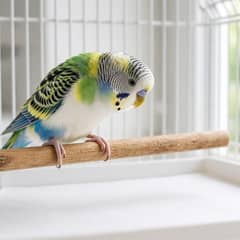
Perches about 3/8 to 3/4 inch across fit a canary's foot. Mix perches of varied diameter and texture within that range, since a foot that grips the same dowel all day is the foot that develops pressure sores. Natural branches, wood and braided rope all work. Skip sandpaper covers and gravel perches. They scrape the soles of the feet, and the bird picks off the gravel and swallows it. Set at least two perches, one at either end of the cage so the bird has to fly between them, and keep the middle clear. Never hang one over a food or water dish, where droppings land in the bowl.
Food and Water Dishes
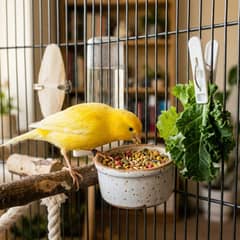
Use three separate stainless steel dishes, one each for dry food, fresh food and water, and wash and rinse every one daily. With two or more canaries in one cage, give each bird its own feeding station so they do not compete. Set the dishes near the perches, not under them.
Diet Basics
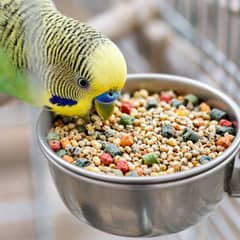
Build the diet on a pelleted food made for canaries, about three quarters of it, with a small amount of seed, fresh vegetables daily, a cuttlebone for calcium and no grit. Measure the pellets and seed out each morning, one to two teaspoons per bird, instead of keeping the dish heaped.
Toys and Toy Safety
Canaries do not chew their toys apart, but they still use them. Small swings, ladders and toys with little bells suit most birds. A mirror is worth testing: some canaries enjoy one, others are afraid of it, and some turn territorial at the bird they see. Leather or fabric straps are fine until they fray. Loose threads wrap around toes, so take a frayed toy out. Rotate toys now and then, and replace worn perches, dishes and toys.
Where to Put the Cage
Put the cage in a bright room the family uses, out of reach of cats and dogs and out of direct sun, where it could overheat. Keep it away from drafts, air conditioning vents and radiators. Keep it well away from the kitchen, where overheated nonstick cookware gives off colorless, odorless fumes that can kill a bird, and away from aerosol sprays and smoke. Airborne toxins are the canary's weak point.
Temperature
Normal household temperature, 65 to 80°F, works well, with about 75°F as the target. Canaries can get used to cooler rooms, but avoid sudden swings. No supplemental heat is needed indoors.
Bathing
Offer a shallow bird bath at least twice a week. Many canaries would bathe every day if allowed. Put the bath in during the morning, away from the food dishes, and take it out after an hour or two so the cage floor stays dry. A bird that ignores the dish can be misted with lukewarm water from a clean spray bottle a few times a week instead. A canary's comfortable humidity runs 60 to 80 percent. A home heated through the winter often runs drier than that, and the bath matters more then.
Cage Floor and Cleaning
Line the floor with newspaper, butcher paper or plain brown paper. Keep cedar, redwood, pressure-treated wood and synthetic fibrous nesting material out of the cage.
The routine is short:
- Daily: spot-clean droppings and scattered seed, wash every food and water dish with soap and water, and take out fresh produce within a couple of hours, before it spoils.
- At least weekly: replace the paper liner completely, more often when two canaries share a cage.
The deep clean, once or twice a month:
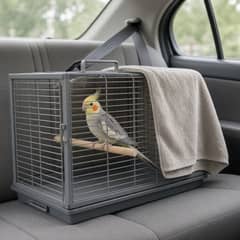
- Move the canary to a travel cage in another room, with separate air.
- Take out the liner, perches, dishes and toys.
- Wash the cage and everything in it with a cleaner safe near a bird this sensitive, such as a bird-safe cage cleaner or a 3% bleach solution.
- Rinse until no smell of the cleaner is left.
- Let everything dry completely.
- Reline the floor, put the clean pieces back, and return the bird.
A canary's lungs react to fumes, so use cleaners made for use around pets and keep the bird out of the room until everything is dry.
Light and UV
Give the bird a clear day and night cycle, which supports normal behavior and, in males, healthy singing. Let the day length follow the season instead of holding it fixed year round. At night the bird needs dark, undisturbed sleep, and a breathable cage cover gives it that in a room where the lights stay on.
A bird makes vitamin D in its skin from ultraviolet light, and it needs that vitamin D to absorb calcium. Window glass filters out UV, so a cage beside a window does not count. Time outdoors in an escape-proof cage in mild weather gives real sun, with you right there and shade in the cage. An outdoor cage also needs mosquito screening, because mosquitoes carry canary pox. Indoors, a full-spectrum UV light made for birds, set 12 to 18 inches from the perches, fills the gap. Put it on a timer matched to the daylight outside, adjust it each month as the days change, and keep it between 10 and 12 hours a day. Replace the bulb every six months, since its output fades.
Setup Order
- Place the cage in its spot, away from the kitchen and drafts.
- Fit the grate and line the tray with paper.
- Put the perches at the ends, leaving the middle clear.
- Clip on the three dishes, none under a perch, and add the cuttlebone.
- Fill the dishes with food and fresh water.
- Hang a toy or two at the edges.
- Set up the UV light on a timer, and keep the cage cover within reach for the first night.
- Put the bath in the next morning, once the bird has settled.
Wide, Clean and Away From the Kitchen
Buy the longest flight cage the room allows, put the perches at the ends, and keep the paper fresh. Give the bird UV and a bath, then guard the air: no smoke, sprays or kitchen fumes anywhere near it.
Sources & Further Reading
Last reviewed 26 Jul 2026 · 4 sources
- LafeberVet: Basic Information Sheet, Canary
- VCA Animal Hospitals: Canaries, General; Cage Hygiene in Birds
- PetMD: Canary Care Sheet
- Chicago Exotics Animal Hospital: Canary Care, adapted from Peter Coutteel DVM

A routine chart and equipment log you can fill in for your own setup. The Universal Pet Kit has it, among 19 forms for any pet that you can type into or print.
Frequently Asked Questions
What size and shape cage does a canary need?
At least 24 inches long for one bird, and longer is better. The shape counts for more than the height: a canary flies between perches instead of climbing, so a long flight cage beats a tall, narrow one.
How wide can the bar spacing be on a canary cage?
About 3/8 inch or narrower, which blocks both escape and a head caught between the bars.
What temperature does a canary need?
Ordinary room temperature, 65 to 80°F, with about 75°F as the target. Nothing supplemental is needed indoors, though the cage should sit away from drafts, AC vents, and radiators.
Do canaries need a bird bath?
Yes. A shallow dish of water at least twice a week keeps the feathers in condition, and most canaries bathe readily. Misting with lukewarm water from a clean spray bottle works for a bird that will not use the dish.
What should line the bottom of a canary cage?
Newspaper, butcher paper or plain brown paper, spot-cleaned daily and replaced at least weekly. Cedar, redwood and pressure-treated wood do not belong in the cage.
Why does air quality matter so much for canaries?
Canaries are sensitive to airborne toxins. Fumes from overheated nonstick cookware, aerosols and smoke can all be dangerous, so keep the cage well away from the kitchen and from any sprays.
Recommended Gear
As an Amazon Associate I earn from qualifying purchases through the links above, at no extra cost to you.

Written by Michael Ryan
Mike keeps two rescued bearded dragons, Dex and Cera, and writes the care guides on BeastlyFacts from his own research and mistakes. He is not a veterinarian.
More about Michael Ryan →You May Also Like

Subscribe - it's free
An occasional email when something new is worth your time. No spam.
Health and More