Canary Enrichment: He May Be Singing Because He Is Alone
On This Page▾

The thing everyone loves about canaries is the thing most likely to be misread.
In canaries, the absence of a potential mate increases song production, and the presence of a mate greatly reduces it. A male singing constantly is doing what an unpaired male does. That is not a reason to panic, and it is a reason to stop using song volume as your welfare readout.
What the Song and Stress Research Says
Canaries are one of the best studied songbirds in neuroscience, and most of that work is about the brain. Two threads are useful for the cage.
Song is signaling, not mood. Song production in canaries is strongly shaped by season and social context. Long days promote song, and the absence of a mate increases the number of songs while the presence of one greatly diminishes singing. There is a nice loop in it too: producing song promotes the incorporation of new neurons into the brain regions that control song output.
Cage size shows up in corticosterone. A study measuring stress hormone in canary droppings found a robust daily rhythm in birds on short-day cycles, and a significant change in corticosterone excretion when group-bred birds were restrained in smaller cages. That is a physiological reading on something owners treat as a matter of preference.
Singing does something to the canary's brain, not only to its day. New neurons are incorporated into the song control system in response to song production, which is one of the findings that overturned the idea that adult vertebrate brains do not add neurons.
Flight Distance
The item the corticosterone result points at. Canaries fly rather than climb, and what they need is horizontal distance between perches, not height.
A long flight cage beats a tall decorative one by a wide margin. Leave the middle open so there is a flight path, and resist the urge to fill the center with toys.
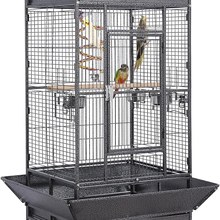
If the cage is small, the study says the bird's stress physiology already knows.
Perches at Varied Diameter
Perches are the item most likely to be quietly harming a small bird. Uniform dowel of one thickness holds the foot in a single position all day, which is how pressure sores start.
Perches of varied diameter and natural branch with irregular surfaces let the foot change position. Site them at the ends of the cage so the flight path stays clear, and avoid sandpaper covers entirely.

Bathing
The easiest win with this species. Canaries bathe readily and often daily, and a shallow cage bath is used enthusiastically.

Offer clean water in the morning and remove it later so it does not become drinking water contamination. Good feather condition follows from it, and the bird visibly wants to.
Light Cycles That Mean Something
Photoperiod drives song, molt and reproduction in this species, so a canary kept under an artificial light schedule that never changes is being held in a permanent season.
A light cycle that tracks the natural year, or at least varies, is closer to what the bird is built for, and it matters for molting properly. Twelve hours of genuine dark for sleep, undisturbed, is the other half.
Foraging, in a Small Way
Less elaborate than a parrot needs, and still worth doing. Millet sprays hung so they have to be worked at, greens clipped to the bars, seed scattered across a shallow tray, and safe branches with leaves to pick through.
Nothing complicated. Canaries do not solve puzzle boxes, and a bit of variety in how food arrives beats an identical cup every morning.
Company, Decided Deliberately
Less socially dependent than parrots. A single canary in a good flight cage is a reasonable setup, unlike a single cockatoo.
Do not house two males together, since they are territorial and will fight. A male and female pair, or a group of females in a large enough flight, both work. And remember the song finding before you conclude a pair has made the bird miserable.
Priority Order
- A long flight cage with a clear flight path
- Perches of varied diameter, sited at the ends
- Daily bathing water
- A light cycle that varies through the year, and twelve hours of dark
- Varied food presentation, millet and greens to work at
- Company chosen deliberately, never two males
- Novel objects, last and modest
What Not to Do
Do not read constant song as proof of contentment. Do not buy a tall narrow cage for a bird that flies horizontally. Do not fill the center of the cage with toys. Do not use uniform dowel perches or sandpaper covers. Do not house two males together. Do not keep the bird under an unchanging artificial light schedule. And do not treat handling as enrichment, since canaries are watching birds rather than contact birds.
Sources & Further Reading
4 sources
- Circadian rhythm and stress response in droppings of Serinus canaria
- Reversing song behavior phenotype: testosterone driven induction of singing and measures of song quality in adult male and female canaries (Serinus canaria)
- Perineuronal nets in HVC and plasticity in male canary song. PLoS ONE
- Environmental enrichment for birds. Veterinary Partner (VIN)
❓ Frequently Asked Questions
Is there research on canary welfare?
There is a large body of neuroscience on canary song, and one directly useful welfare study measuring corticosterone in droppings. It found a robust daily rhythm in birds on short-day light cycles, and a significant change in corticosterone excretion when group-bred birds were confined to smaller cages.
Does more singing mean a happier canary?
Not reliably. In canaries, the absence of a potential mate increases the number of songs produced, and the presence of a mate greatly reduces singing. Song is a signaling behavior with a function, and reading its volume as a contentment score gets it backwards as often as not.
So should I get my canary a mate?
Not necessarily, and not casually. Canaries are less socially dependent than parrots and males are territorial toward each other. The point of the finding is to stop treating song volume as a welfare reading, not to change the housing on the strength of it.
Can canaries be kept together?
Males should not be housed together, since they are territorial and will fight. A male and female pair, or a group of females, can work in a large enough flight cage. A single canary in a good flight cage is a perfectly reasonable setup.
What is the single most important thing to provide?
Flight distance. Canaries are small active birds that fly rather than climb, so a long horizontal cage is worth far more than a tall narrow one, and the corticosterone finding points at cage size as something that registers physiologically.
Do canaries need a bath?
They bathe enthusiastically and often daily, and it is good for feather condition and clearly something they want to do. A shallow bath offered regularly is one of the easiest pieces of enrichment for this species.
📰 More on the Canary
🛒 Recommended Gear
As an Amazon Associate, we earn from qualifying purchases through the links above - at no extra cost to you.

Written by Michael Ryan
Mike keeps two rescued bearded dragons, Dex and Cera, and writes the care guides on BeastlyFacts from his own research and mistakes. He is not a veterinarian.
More about Michael Ryan →Comments
No comments yet - be the first!