Lovebird
Birds
The feisty, affectionate little parrot that bonds deeply with its person!
Mike has looked after neighbors’ budgies and lovebirds on and off for years.
On This Page▾
🤓 Did you know? Lovebirds mate for life in the wild and are famous for their strong pair bonds. They even feed each other and sit side-by-side for hours! This is where they got their name.

🗓️ The first week
The numbers a new owner needs in the first week, each from the article it links to. Rows with no link come from the encyclopedia.
- Day one
- At least 30 days, and up to 45, quarantined in a separate room with its own airspace, away from any bird you already own. A multi-bird household or aviary is safer nearer 90 days.Quarantine guide →
- Enclosure
- 18 by 18 by 24 inches minimum for one bird, 24 by 18 by 24 for a pair, and bigger is always better. Long, horizontal cages suit lovebirds, which fly side to side rather than climbing.Setup guide →
- Bar spacing
- Between three-eighths and five-eighths of an inch, half an inch ideally. Wider spacing lets a lovebird trap its head between the bars, which can be fatal.Setup guide →
- Cage material
- Powder-coated or stainless steel only. Avoid homemade cages, wood components, or galvanized wire, all carry a real risk of zinc or other toxic exposure, and lovebirds chew constantly.Setup guide →
- What to leave out
- No nest box or happy hut unless you're actually breeding. Nest-like furnishings, tunnel-shaped bird tents included, are one of the most common and avoidable triggers for hormonal aggression and chronic egg-laying in this species.Setup guide →
- One bird or two
- A single hand-raised lovebird bonds to you and becomes tame and interactive, but needs roughly two hours of daily interaction. A bonded pair bonds to each other instead, largely ignores its keeper, and is closer to keeping a pair of finches, entertaining but rarely tame.Handling guide →
- Handling
- Territorial and aggressive when frightened or threatened, especially females and during hormonal periods. Reaching into the cage of a defensive bird is a reliable trigger; switching to exterior food dishes and stick-training avoids it.Handling guide →
- Budget
- $50 to $150 for a common color, $200 to $400 or more for rare mutations. Roughly $300 for a complete starter setup, and $20 to $35 a month after that.Cost guide →
- Adult size
- 5 to 6.5 inches (13 to 17 cm); 1.5 to 2 oz.
- Lifespan
- 10 to 15 years typically, up to 20 with excellent care.Cost guide →
- Disease risk
- Psittacine beak and feather disease hits feather and beak cells and the immune system, and lovebirds are particularly susceptible. It's often fatal, has no cure, and spreads easily, so test any new bird before it meets an established one.Health guide →
- Power outage
- Keep feeding and watering through an outage rather than pulling food the way you would for a reptile; a small bird carries almost no fat reserve. The real danger is combustion, not cold: no candles, gas heat, or a generator run anywhere near the bird's room.Emergency plan →
🚨 Emergency card
Call the vet now if you see any of these.
- Lethargy or appetite loss
- Feathers held fluffed for long stretches
- Any shift in normal behavior
- Breathing difficulty
- Straining or visible abdominal swelling (possible egg binding)
An avian vet, found before you need one. Lovebirds mask symptoms well, so a sudden change is worth acting on rather than waiting.
📰 Where to go next
How Much Does a Lovebird Really Cost?
$50 to $150 for the bird, roughly $300 for setup, and the real cost decision: one bird or two.
How to Handle a Lovebird (And Why the Name Is Misleading)
Why the name is misleading, exterior food dishes over reaching in, and stick-training a defensive bird.
Common Lovebird Health Issues and What Causes Them
PBFD, egg binding, feather plucking, and when a change in behavior means the vet.
Lovebird Cage Setup: What Your Bird Actually Needs
The 18x18x24 minimum, bar spacing as a safety issue, and why the nest box has to wait.
Lovebird Feeding: Calcium, Vitamin A, and the Hen That Keeps Laying
The pellet and vegetable split, the vitamin A and calcium gaps this species runs into, what chronic laying costs a hen, and why dusting seed fails.
Lovebird Enrichment: Foraging, Toys, and What Cuts Boredom
Contra-freeloading, the toy count that actually works, and the signs enrichment isn't covering current needs.
🛒 What to buy
Prices and the reasoning behind each item are in How Much Does a Lovebird Really Cost?.
❓ Frequently Asked Questions
How much does a lovebird cost to buy?
$50 to $150 for a common peach-faced or Fischer's. Rare mutations (lutino, blue, pied, and combinations) go for $200 to $400 or more, and exceptional individuals reach $1,000. Adoption typically runs $20 to $100. A hand-raised bird costs more than a parent-raised one and is generally the better choice for a tame, interactive pet.
What size cage does a lovebird need?
18 by 18 by 24 inches minimum for one bird, 24 by 18 by 24 for a pair, and bigger is always better. Long, horizontal cages suit lovebirds, which fly side to side rather than climbing.
When is a lovebird health issue an emergency?
They mask symptoms, so a sudden change is worth acting on: lethargy, appetite loss, feathers held fluffed, or any shift in normal behavior all warrant a prompt vet visit instead of waiting. Egg-binding, breathing difficulty, and severe lethargy all mean an immediate trip to an avian vet.
📚 Encyclopedia
Lovebird
Agapornis spp.
Subscribe - it's free
New care guides straight to your inbox. No spam. 🐾
🖨️ Printable Guide
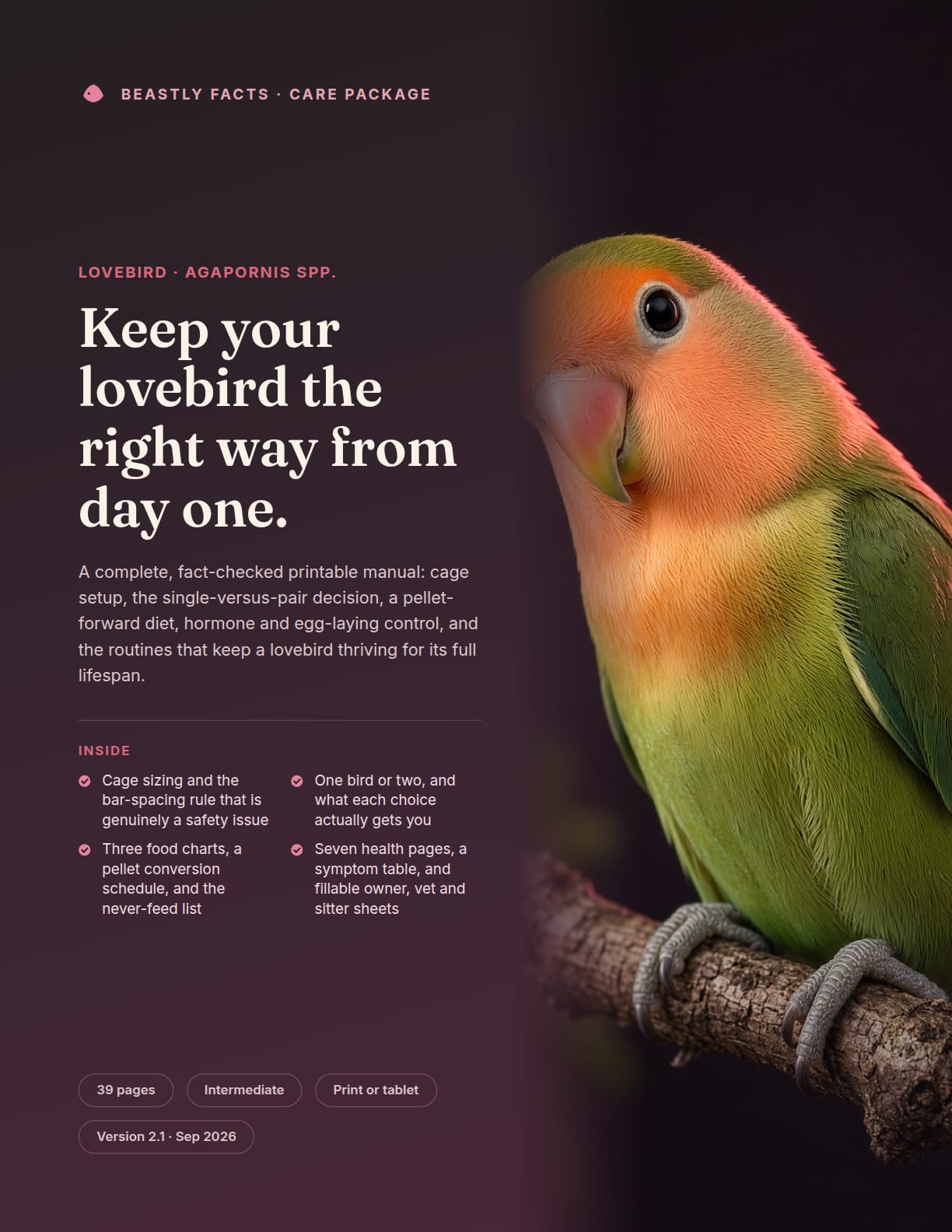
Lovebird Care Package
39 pages · PDF · $8.99
⚖️ Legal Guide
📰 Deep Dive
❤️ How Much Does a Lovebird Really Cost?
❤️ How to Handle a Lovebird (And Why the Name Is Misleading)
❤️ Common Lovebird Health Issues and What Causes Them
❤️ Lovebird Cage Setup: What Your Bird Actually Needs
🦜 Lovebird Feeding: Calcium, Vitamin A, and the Hen That Keeps Laying
❤️ Lovebird Enrichment: Foraging, Toys, and What Cuts Boredom
🩺 Health and More
⚠️ Household Hazards for Pet Birds: The Complete Safety Checklist
🦠 Avian Gastric Yeast (Megabacteriosis): The Silent Weight-Loss Disease
🚪 Quarantining a New Bird: The Real Timeline and Why It Matters
💩 Reading Bird Droppings: The Daily Health Check Every Owner Should Know
🌙 Photoperiod and Sleep: The Light Schedule That Controls Your Bird's Hormones
🦜 Converting a Seed-Eating Bird to Pellets Without Starving It
✂️ Wing Clipping: Flighted vs. Clipped, Both Sides Explained
🔦 Bird Emergency Plan: Power Outages, Travel, and Transport
⚖️ Sexing, Weight, and Body Condition in Pet Birds: What Actually Works
🥚 Chronic Egg Laying and Egg Binding in Budgies, Cockatiels, and Lovebirds
🪶 Why Is My Bird Losing Feathers? Molt vs. Plucking vs. PBFD vs. Giardia
🦜 Choosing a Pet Bird: What You're Actually Signing Up For
🦠 Avian Polyomavirus: Budgerigar Fledgling Disease and French Molt
🦜 Reading Bird Body Language: Fluffed Content vs. Fluffed Sick
🐦 Colony and Aviary Keeping: Budgies, Canaries, and Finches in Groups
🌫️ Feather Dust, Air Quality, and Bird Fancier's Lung
🎯 Parrot Training: The Behavior Ladder From Budgie to Macaw
🩹 Bird First Aid Kit and Grooming: Nails, Beak, and Blood Feathers
📋 Succession Planning for a Pet That May Outlive You
🕊️ Adopting a Rescue Parrot: The First Months, Honestly
🧭 Four Pets Decided Before You Ever Set Up the Tank
🦜 Lovebird vs. Budgie: Which Small Parrot Actually Fits Your Household
🦅 The Ultimate Birdwatching Guide: Best Places, Times, and Tips for Beginners (2026)