Budgie / Parakeet
Birds
The cheerful little chatterbox that picks up phrases you never taught it!
Mike has looked after neighbors’ budgies and lovebirds on and off for years.
On This Page▾
🤓 Did you know? Budgies can learn to talk and have been known to learn over 1,700 words! The Guinness World Record holder was a budgie named Puck who knew 1,728 words, more than any other bird on record!

🗓️ The first week
The numbers a new owner needs in the first week, each from the article it links to. Rows with no link come from the encyclopedia.
- Day one
- At least 30 days, and up to 45, quarantined in a separate room with its own airspace, away from any bird you already own. A multi-bird household or aviary is safer nearer 90 days.Quarantine guide →
- Enclosure
- 18x18x18 inches is the figure often cited as an absolute minimum for one bird, but a wider flight-style cage serves them far better, something closer to 30x18x18 inches for a pair. Width matters more than height, since budgies fly side to side rather than climbing.Setup guide →
- Bar spacing
- Half an inch or less. Wider spacing risks a bird squeezing through and escaping, or getting its head caught trying.Setup guide →
- Diet
- Pellets should make up roughly 60 to 80% of the diet, with fruit, vegetables, and greens at another 20 to 25%, and seeds treated as an occasional extra. A seed-only diet is directly linked to malnutrition, obesity, and fatty liver disease.Setup guide →
- Temperature
- A practical ambient range is about 65 to 85°F, with 70 to 75°F ideal. Budgies have no sweat glands and are more heat-sensitive than that range might suggest.Setup guide →
- Handling
- Give a new bird a week or two to settle before any taming. Then work through hand-in-the-cage, millet from the fingers, and step-up training, in that order, moving on only once the bird is calm at the current step.Handling guide →
- Sexing
- Adult males typically show a blue to purple-blue cere, adult females a tan, brown, or pale white one. Juveniles of both sexes show pink or pale purple until it settles into adult color, usually between 6 and 12 months.Cere color guide →
- Budget
- $20 to $80 for the bird, $175 to $475 for a complete starter setup, and first-year totals (including the bird) commonly $350 to $900. Food runs $5 to $15 a month, toys and perches $10 to $30.Cost guide →
- Adult size
- 7 inches (18 cm); 1 to 1.4 oz.
- Lifespan
- Not well documented in the wild; typically 7 to 15 years in captivity, with the oldest documented individual living 29 years, 2 months.
- Zoonotic risk
- Psittacosis, caused by Chlamydia psittaci, is zoonotic, meaning it can spread to people. Signs include respiratory symptoms, diarrhea, weakness, and an enlarged liver. If your budgie shows these signs, mention the possibility to your vet directly, and keep any newly introduced bird separate from the rest of your flock while you watch for signs like these.Health guide →
- Power outage
- Keep feeding and watering through an outage rather than pulling food the way you would for a reptile; a budgie carries almost no fat reserve. The real danger is combustion, not cold: no candles, gas heat, or a generator run anywhere near the bird's room.Emergency plan →
🚨 Emergency card
Call the vet now if you see any of these.
- Fluffed-up feathers combined with sleeping during the day
- Tail-bobbing with each breath
- Open-mouth breathing
- Sitting on the floor of the cage instead of perching
An avian vet, found before you need one. Budgies mask illness well, so any of the above means a vet within 24 hours, not a few days of watching and waiting.
📰 Where to go next
How Much Does a Budgie Really Cost?
$20 to $80 for the bird, $175 to $475 for a starter setup, and the avian vet costs most owners underestimate.
Budgie Cage Setup: Width Over Height, and a Few Rules That Actually Matter
The 18x18x18 minimum, why width beats height, bar spacing, and the pellet-first diet.
How to Handle and Tame a Budgie
Letting a new bird settle, the taming progression from hand-in-cage to step-up, and why punishing a bite backfires.
Common Budgie Health Issues and Why Diet Drives Most of Them
Fatty liver disease, the tumor that can look like a limp, egg binding, and the signs that mean a vet the same day.
Budgie Feeding: The Squeak That Means Iodine
How much of the diet is pellets, the iodine deficiency budgies are prone to and the breathing sound it makes, and why grit is a risk.
Budgie Enrichment: Foraging, Toys, and Cutting Cage Boredom
Foraging first, destructible toys, and the difference between a resting bird and a bored one.
Why Is My Budgie's Cere Changing Color? What It Actually Means
Reading the cere to sex a budgie, and when a color change means more than hormones.
🛒 What to buy
Prices and the reasoning behind each item are in How Much Does a Budgie Really Cost?.
❓ Frequently Asked Questions
How much does a budgie itself cost?
$20 to $80. It's the cheapest part of ownership, the cage and long-term avian vet care are where the budget goes.
Is a budgie the same thing as a parakeet?
Yes, in the way most people in the US use the word. 'Parakeet' is a broad, non-scientific term for a large group of small to medium parrots with long tail feathers, and the budgerigar (Melopsittacus undulatus), the bird this guide covers, is just one species within that group, though it's by far the most commonly kept one. So every budgie is a parakeet, but not every parakeet is a budgie, ring-necked and monk parakeets are different species entirely. When a US pet store sells a bird simply labeled 'parakeet' with no other name attached, it's almost always a budgie.
What size cage does a budgie need?
18x18x18 inches is the figure usually cited as an absolute minimum for one bird, but a wide flight-style cage serves them far better, nearer 30x18x18 for a pair. Width beats height, since budgies fly side to side rather than climbing.
What are the signs a budgie needs to see a vet the same day?
Fluffed feathers plus daytime sleeping, tail-bobbing with each breath, open-mouth breathing, or sitting on the cage floor instead of perching. Budgies mask illness well, so any of those means a vet within 24 hours, not a few days of watching.
Subscribe - it's free
New care guides straight to your inbox. No spam. 🐾
🖨️ Printable Guide
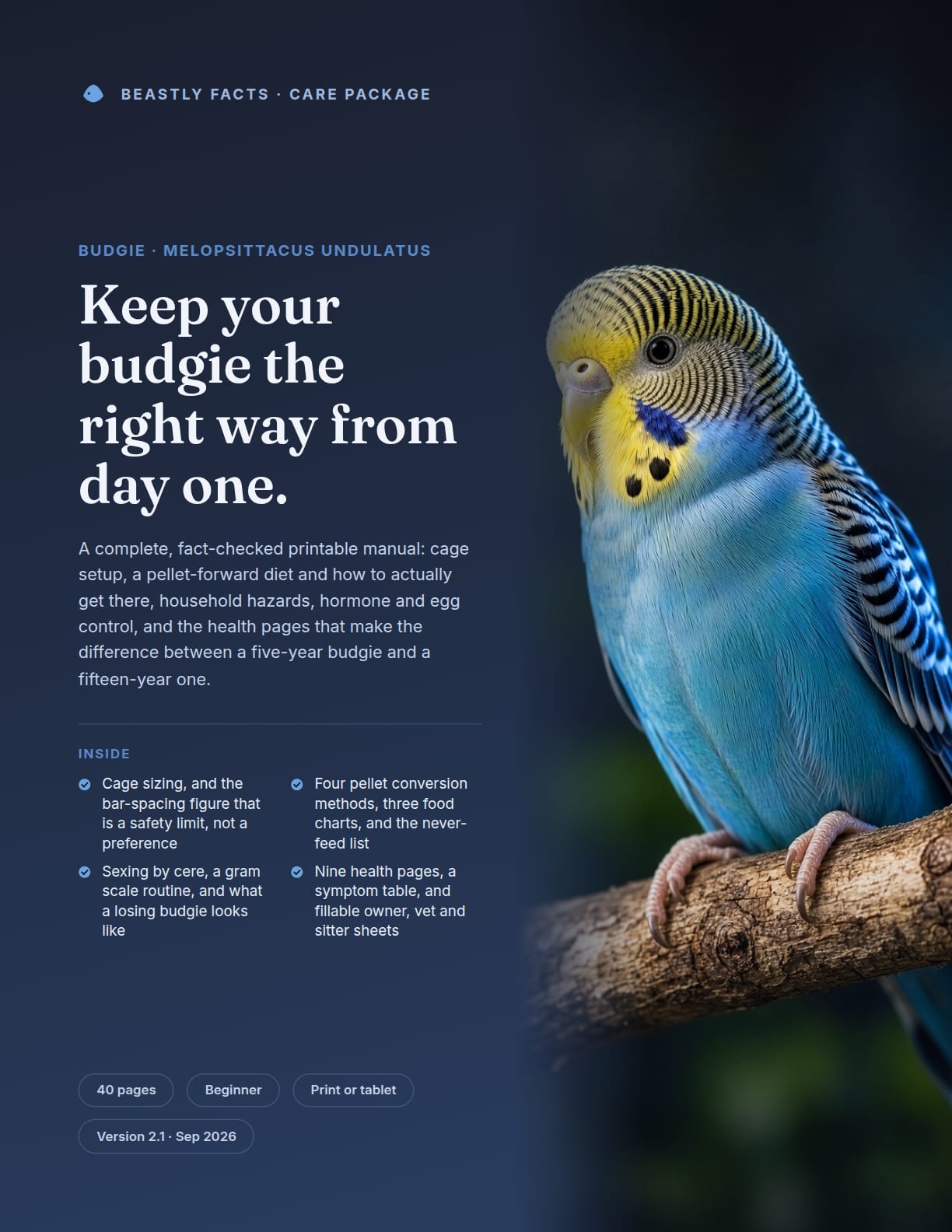
Budgie Care Package
40 pages · PDF · $8.99
📰 Deep Dive
🐦 How Much Does a Budgie Really Cost?
🐦 How to Handle and Tame a Budgie
🐦 Common Budgie Health Issues and Why Diet Drives Most of Them
🐦 Budgie Cage Setup: Width Over Height, and a Few Rules That Actually Matter
🦜 Budgie Feeding: The Squeak That Means Iodine
🐦 Budgie Enrichment: Foraging, Toys, and Cutting Cage Boredom
🩺 Health and More
⚠️ Household Hazards for Pet Birds: The Complete Safety Checklist
🦠 Avian Gastric Yeast (Megabacteriosis): The Silent Weight-Loss Disease
🚪 Quarantining a New Bird: The Real Timeline and Why It Matters
💩 Reading Bird Droppings: The Daily Health Check Every Owner Should Know
🌙 Photoperiod and Sleep: The Light Schedule That Controls Your Bird's Hormones
🦜 Converting a Seed-Eating Bird to Pellets Without Starving It
✂️ Wing Clipping: Flighted vs. Clipped, Both Sides Explained
🔦 Bird Emergency Plan: Power Outages, Travel, and Transport
⚖️ Sexing, Weight, and Body Condition in Pet Birds: What Actually Works
🥚 Chronic Egg Laying and Egg Binding in Budgies, Cockatiels, and Lovebirds
🪶 Why Is My Bird Losing Feathers? Molt vs. Plucking vs. PBFD vs. Giardia
🦜 Choosing a Pet Bird: What You're Actually Signing Up For
🦠 Avian Polyomavirus: Budgerigar Fledgling Disease and French Molt
🦜 Reading Bird Body Language: Fluffed Content vs. Fluffed Sick
🐦 Colony and Aviary Keeping: Budgies, Canaries, and Finches in Groups
🌫️ Feather Dust, Air Quality, and Bird Fancier's Lung
🎯 Parrot Training: The Behavior Ladder From Budgie to Macaw
🩹 Bird First Aid Kit and Grooming: Nails, Beak, and Blood Feathers
📋 Succession Planning for a Pet That May Outlive You
🕊️ Adopting a Rescue Parrot: The First Months, Honestly
📏 Rabbit and Budgie: Two Classic Pets, Almost Always Kept Too Small
🦜 Budgie vs. Cockatiel: Which Beginner Bird Fits You Better
🦜 Lovebird vs. Budgie: Which Small Parrot Actually Fits Your Household
🦅 The Ultimate Birdwatching Guide: Best Places, Times, and Tips for Beginners (2026)