Neon Tetra
Paracheirodon innesi
On This Page▾
🌍 Overview
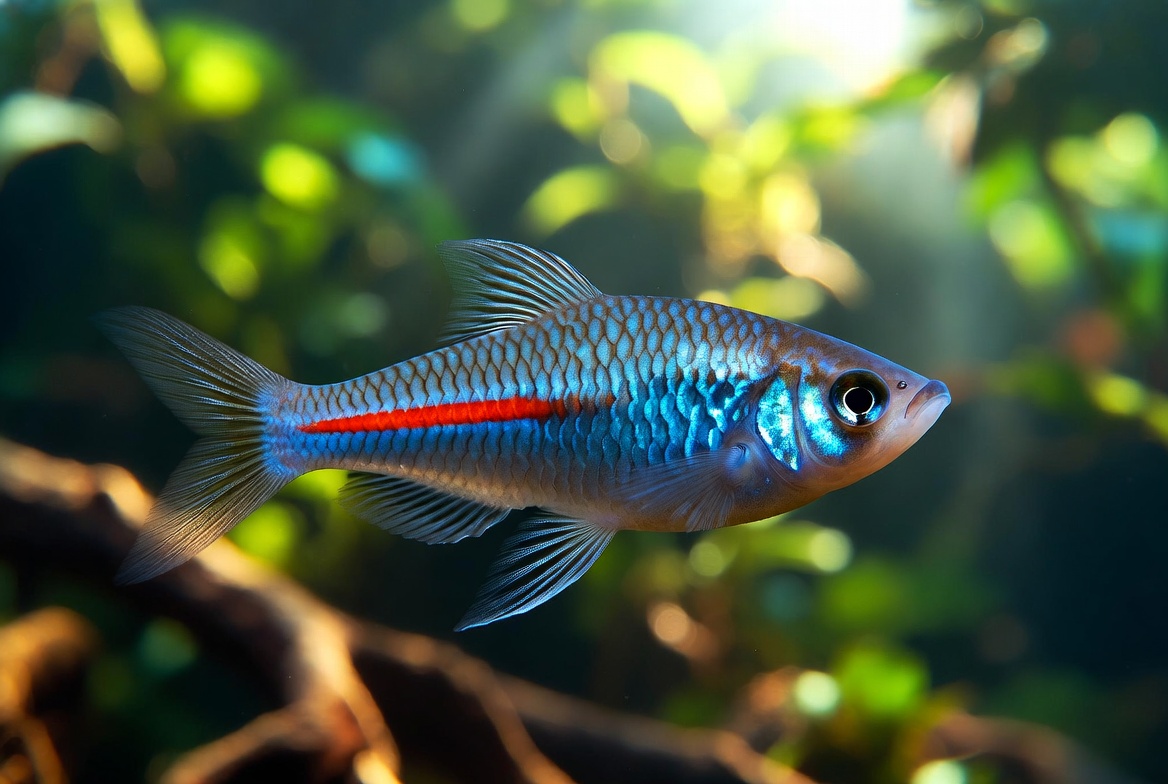
The neon tetra is a small, brightly colored schooling fish native to the clearwater and blackwater streams of the western Amazon Basin. Its iridescent blue stripe is produced by light-reflecting cells called iridophores rather than pigment, and this stripe visibly dims while the fish sleeps at night - a natural nocturnal change. Neon tetras are intensely social and rely on large schools for both natural behavior and reduced individual stress.
📋 Quick Facts
Native Range
Amazon Basin (Peru, Colombia, Brazil)
Natural Habitat
Clearwater and blackwater forest streams
Adult Size
1-1.5 inches (2.5-4 cm)
Wild Diet
Small insects, worms, crustaceans, and zooplankton
Wild Lifespan
5-8 years
Conservation Status
Not evaluated (widespread and common)
📜 History
Few aquarium fish arrived with as much theater. Auguste Rabaut carried thirteen live specimens out of the Amazon to the Paris firm Lepant, where they were christened the neon fish, and in 1935 the stock changed hands for 6,500 dollars to two Hamburg dealers, Hugo Schnell and Walter Griem. In July 1936 five neons were flown to the Shedd Aquarium in Chicago aboard the airship Hindenburg at a transport cost of 3,000 dollars, and only one survived the trip. George S. Myers described the species that same year as Hyphessobrycon innesi, honoring the American aquarium publisher William T. Innes, who had supplied the preserved material. Roughly two million are now sold in the United States each month, nearly all farm raised in Southeast Asia.
⚖️ Compare
Neon Tetra
Human
Adult Size
1-1.5 inches (2.5-4 cm)
5-6 feet (150-185 cm); ~135-200 lbs
Wild Lifespan
5-8 years
~73 years (global average)
Wild Diet
Small insects, worms, crustaceans, and zooplankton
Omnivorous - eats just about anything
Native Range
Amazon Basin (Peru, Colombia, Brazil)
Global - originated in Africa roughly 300,000 years ago
Natural Habitat
Clearwater and blackwater forest streams
Everywhere from arctic tundra to tropical megacities
Conservation Status
Not evaluated (widespread and common)
Least Concern (8+ billion and counting)
🧠 Test Yourself
What's the Neon Tetra's native range?
Subscribe - it's free
New animal facts and care guides straight to your inbox. No spam. 🐾
📰 Deep Dive
🐠 How Much Does Neon Tetra Ownership Really Cost?
🐠 Neon Tetras Aren't Handled, But the School Size Genuinely Isn't Optional
🐠 Common Neon Tetra Health Issues (Including the Disease Named After This Fish)
🐠 Neon Tetra Tank Setup: Soft Water, Dim Light, and a Blackwater Feel
🐠 Neon Tetra Feeding: Schedule, Diet, and the Rule That Prevents an Outbreak
🐠 Neon Tetra Enrichment: Someone Counted, and the Number Is Ten
🩺 Health and More
🐠 Aquarium Power Outages, Transport, and Moving Your Fish: The Complete Plan
🦠 How to Cycle a Fish Tank, Start to Finish: Fishless and Fish-In
🧽 Aquarium Filtration: How It Actually Works and How to Maintain It
🪣 Aquarium Water Changes: How Much, How Often, and What the Number Is For
🐟 Aquarium Stocking and Tankmates: How Many Fish, and Which Ones Go Together
🧪 Freshwater pH, GH, and KH: Why Chasing a Number Backfires
🤓 Did You Know?
A neon tetra's iridescent blue stripe isn't pigment - it's produced by light-reflecting cells called iridophores. That stripe actually dims or goes nearly dark while the fish sleeps at night, a completely natural nocturnal color change rather than a sign of illness.
Explore More