Why Bearded Dragons Need UVB Lighting (And Why Skipping It Is Deadly)
On This Page▾

Picture this: you bring home a bearded dragon, set up a beautiful enclosure, stock it with crickets and leafy greens, and feel like a proud reptile parent. But if you skipped the UVB light - or grabbed a cheap bulb that barely qualifies - your dragon is already in trouble. Not next week. Not next month. Right now, silently, at the cellular level.
UVB lighting is not a luxury accessory or a nice-to-have upgrade. For bearded dragons, it is as essential as food and water. Without it, their bodies cannot produce vitamin D3, which means they cannot absorb calcium, which means their bones soften, their muscles fail, and their organs begin to shut down. It is a slow, painful process - and it is entirely preventable.
In the wild, bearded dragons bask under the blazing Australian sun for hours each day, soaking up intense ultraviolet radiation that fuels nearly every biological process in their bodies. In captivity, we have to replicate that. Get it right, and your dragon thrives. Get it wrong, and the consequences can be devastating and irreversible. Let's make sure you get it right.
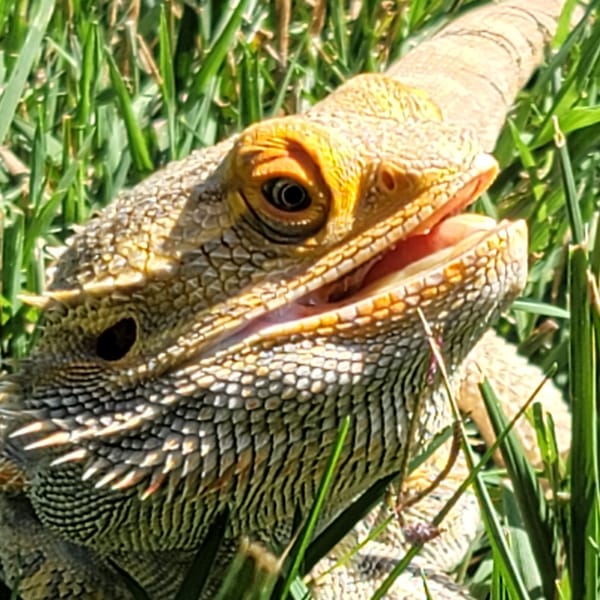
Bearded dragons can actually see ultraviolet light! They have a fourth type of cone cell in their eyes that detects UV wavelengths invisible to humans. In the wild, this helps them identify healthy food, read social signals from other dragons, and navigate their sun-drenched Australian habitat - where UV index levels regularly hit 12 or higher, among the most intense on Earth.
What UVB Does Inside Your Dragon
When UVB rays hit a bearded dragon's skin, they trigger a photochemical reaction that converts a precursor molecule into previtamin D3. The dragon's body then processes this into active vitamin D3 - the same essential nutrient that mammals get partly from sun exposure. This is not a shortcut or a workaround; it is the primary biological pathway bearded dragons evolved to use.
Vitamin D3 is the key that unlocks calcium absorption in the gut. Without adequate D3, even a calcium-rich diet is largely wasted - the calcium passes through the digestive system without being absorbed into the bloodstream. And calcium is not just about bones. It is critical for muscle contraction, nerve function, heart rhythm, and egg production in females.
The chain reaction is elegant and unforgiving: no UVB means no D3, no D3 means no calcium absorption, no calcium absorption means systemic failure. You can supplement with D3 powder, and many keepers do as a backup, but research consistently shows that UVB-synthesized D3 is more bioavailable and better regulated by the dragon's own body than oral supplements alone. The bulb is not optional.
Metabolic Bone Disease: The Silent Killer
Metabolic Bone Disease, or MBD, is the most common and most heartbreaking consequence of inadequate UVB exposure. It is not a single disease but a syndrome - a cascade of skeletal and systemic problems that develop when a dragon's body is chronically starved of calcium and D3. Vets who work with reptiles see it constantly, and it is almost always the result of preventable husbandry mistakes.
Early signs of MBD can be subtle: slight lethargy, reduced appetite, a reluctance to move. As it progresses, the symptoms become impossible to ignore. Bones soften and deform, particularly in the jaw and limbs. You may notice tremors or muscle twitching, a wobbly gait, or limbs that bend in directions they should not. In severe cases, dragons develop full paralysis and are unable to lift their own bodies.
Here is the brutal truth about MBD: it is almost entirely preventable, but once it reaches an advanced stage, the damage is often irreversible. Deformed bones do not straighten. Neurological damage may be permanent. Treatment can halt the progression and improve quality of life, but it cannot undo what has already been lost. The best treatment for MBD is making sure it never happens - and that starts with proper UVB lighting from day one.
UVA vs. UVB: Two Different Jobs, Both Essential
Not all ultraviolet light is the same. UVA and UVB are distinct wavelength ranges, and they do very different things for your bearded dragon. UVB (wavelengths of 280-315 nm) is the one responsible for vitamin D3 synthesis - the biological heavy lifter we have been discussing. UVA (315-400 nm) operates on a different level, influencing behavior, mood, appetite, and social interaction. Because bearded dragons can see UVA, it affects how they perceive their environment and even how vibrant colors appear to them.
A dragon kept without UVA may become lethargic, lose interest in food, or display abnormal behaviors - not because it is sick in the traditional sense, but because its sensory world is incomplete. Most quality reptile UVB bulbs emit both UVA and UVB, so if you are using a proper reptile-specific T5 HO or mercury vapor bulb, you are likely covering both bases. Avoid generic 'full spectrum' bulbs marketed for plants or humans - they rarely provide meaningful UVB output for reptiles.
Photoperiod and Basking: Letting Your Dragon Self-Regulate
In the wild, bearded dragons do not bask under UV light for 24 hours straight - they follow the sun's natural cycle and move in and out of shade as needed. In captivity, replicating this rhythm is critical. A proper photoperiod of 12-14 hours of light followed by 10-12 hours of complete darkness mimics the Australian day-night cycle and supports healthy circadian rhythms, digestion, sleep, and hormonal balance.
Bearded dragons are remarkably good at self-regulating their UV exposure when given the opportunity. They will bask directly under the UVB source when they need to synthesize D3, then retreat to a shaded area when they have had enough. This is why enclosure design matters: your dragon needs a clear basking zone directly under the UVB bulb, and a shaded retreat where the UV intensity drops off. A timer on your lights makes maintaining the correct photoperiod effortless and consistent.
| Bulb Type | UVB Output | Lifespan | Best For | Price Range |
|---|---|---|---|---|
| T5 HO Fluorescent | High (10-12% UVB) | 6-12 months | Bearded dragons, large enclosures, desert species | $20-$40 |
| T8 Fluorescent | Moderate (5-8% UVB) | 6-12 months | Smaller enclosures, less demanding species | $10-$25 |
| Mercury Vapor Bulb | Very High (combined heat + UVB) | 12-18 months | Large enclosures needing combined heat and UVB | $30-$60 |
| Compact Fluorescent (CFL) | Low (2-5% UVB) | 6 months | Supplemental use only, small species | $8-$20 |
| LED UV | Very Low (minimal UVB) | 24-36 months | UVA enrichment only, not suitable as primary UVB source | $15-$50 |
Setting Up UVB Lighting the Right Way
The T5 HO (high-output) fluorescent tube is the gold standard for bearded dragon UVB lighting, and for good reason. It produces intense, consistent UVB output across a wide area, making it ideal for the large enclosures adult bearded dragons require. For a T5 HO bulb rated at 10-12% UVB, the recommended mounting distance is approximately 10-12 inches from the basking surface. Too far away and the UVB intensity drops dramatically; too close and you risk overexposure.
One of the most common and costly mistakes keepers make is failing to replace UVB bulbs on schedule. Here is the catch: UVB output degrades long before the bulb stops glowing. A bulb that looks perfectly bright to your eyes may be producing little to no useful UVB after 6-12 months of use. Most manufacturers recommend replacing T5 HO bulbs every 6 to 12 months, and T8 bulbs every 6 months. Mark your calendar, set a phone reminder, do whatever it takes - because your dragon cannot tell you the light is failing.
One more critical rule: never place glass or plastic between the UVB bulb and your dragon. UVB rays do not pass through standard glass or acrylic - they are absorbed by it. This means a bulb mounted outside a glass-topped enclosure is essentially useless for UVB purposes. The bulb must be inside the enclosure, or the enclosure must have a mesh top that allows UVB to pass through directly to your dragon.
- Prevents Metabolic Bone Disease (MBD) - the most common and devastating reptile health issue
- Supports natural basking behavior and healthy circadian rhythms
- Improves appetite, mood, and overall activity levels
- Easy to set up with modern T5 HO fixtures and timers
- Quality bulbs like the Arcadia Dragon Lamp have a long, reliable lifespan of up to 12 months
- Bulbs must be replaced every 6-12 months even when they still appear to glow brightly
- Quality T5 HO fixtures and bulbs have a higher upfront cost than basic setups
- Incorrect placement or distance from the basking spot can still result in insufficient UVB exposure
Sources
2 sources
UVB lighting is not a detail you can cut corners on. It is the foundation of your bearded dragon's health - the invisible force that keeps their bones strong, their muscles working, their appetite sharp, and their spirit alive. Every hour under a proper UVB bulb is an investment in years of healthy, happy life. Every hour without it is a withdrawal from a biological account that will eventually run dry.
The good news is that getting UVB right is not complicated or expensive once you know what you are doing. A quality T5 HO bulb, a proper fixture, the right mounting distance, a timer, and a replacement schedule - that is it. That is the difference between a dragon that merely survives and one that truly thrives. Your bearded dragon is counting on you to get this right. Now you have no excuse not to.
UVB is the one thing a bearded dragon cannot do without, but it is not the only surprise about them. Our ten surprising bearded dragon facts covers the rest.
Written by Michael Ryan
Written from Mike’s own two dragons, Dex and Cera.
Mike keeps two rescued bearded dragons, Dex and Cera, and writes the care guides on BeastlyFacts from his own research and mistakes. He is not a veterinarian.
More about Michael Ryan →Comments
No comments yet - be the first!