Swordtail Enrichment: One Male, or Space for Several
On This Page▾

Most livebearer advice is about males and females. With swordtails, the male-to-male question matters just as much.
Male swordtails compete hard with each other, and more than one male in a small tank tends to produce a hounded loser. Keep one, or keep several only where the tank is large and planted enough that the aggression spreads, and give them the horizontal distance a large active livebearer actually uses.
What the Research Says
Nothing on swordtails specifically. The applicable thread is livebearer sexual harassment, covered in full in our Guppy enrichment guide.
The research identifies costs to females of persistent male attention. In the molly Poecilia mexicana, females become more vigilant with hampered feeding opportunities when males court them. A guppy study found effects reaching into the next generation.
The male-to-male aggression in swordtails is not from that literature, and it is the thing most likely to cause a visible problem in a home tank, so it leads here.
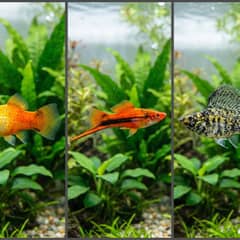
Some female swordtails are reported to develop a sword and male-like features, though whether that is true sex change or a late-developing male is an open question. It regularly convinces people their shop sold them the wrong fish.
One Male in a Small Tank
The most useful stocking rule for this species. With exactly two males, every contest is between the same pair and the loser has nowhere to be.
One male with a group of females is the simplest answer. Several males in a large, well-planted tank works because the aggression distributes, and it needs the space to be real rather than nominal.
Sex Ratio
Several females to each male, and more is better, for the same reasons as any livebearer. A pursued female feeds less and rests less.
Combined with the rule above: one male and several females is a clean, easy setup.
Length, and a Lid
Swordtails are the largest and most active of the common livebearers, and strong swimmers that use horizontal distance. A 20 gallon long is a stopgap rather than a floor, since 36 inches long is the shortest tank to consider, and 48 inches is the better buy for a group that will use the length it's given.
They are also excellent jumpers. A tank without a lid will lose fish, and it is one of the more common and entirely avoidable losses in this species.
Cover and Broken Sight Lines
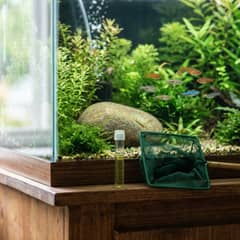
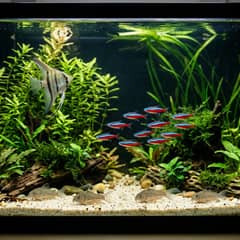
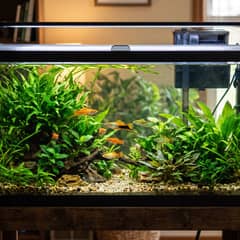
Dense live planting along the sides and back, with open water through the middle.
Planting does double duty here: cover for pursued females, and broken sight lines that stop a dominant male from tracking a subordinate across the whole tank. If you are keeping several males, this is what makes it work.
Flow and Filtration
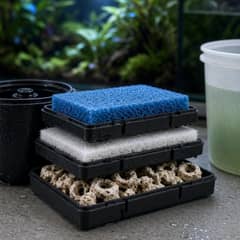
Active fish from moving water that use current, and big enough to need a filter sized for the tank. A hang-on-back filter rated above the tank volume handles both.
Aim the outflow along the length so there is a faster end and a slower end.
Feeding Across the Tank
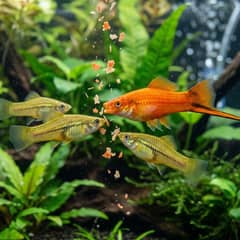
Spread food across the tank, never into one corner, so chased females and subordinate males still eat. Include vegetable content, since swordtails graze on algae and biofilm.
Plan for the Fry
Mixed-sex swordtails breed steadily and the fish are large enough that overstocking hits water quality quickly. Decide in advance: a single-sex group, a rehoming plan, or tank mates that will thin the fry.
Priority Order
- One male in a small tank, or several only with the space for it
- Several females per male, more where the tank allows
- A long tank with a lid
- Dense planting that breaks sight lines, with open water through the middle
- Filtration and flow suited to a large active fish
- Food spread across the tank, with vegetable content
- A plan for the fry
What Not to Do
Do not keep more than one male in a small tank. Do not run the tank without a lid, since swordtails jump. Do not use a small tank for the largest common livebearer. Do not keep a bare tank where a dominant fish can see everything. Do not let the population run unmanaged.
The platy, swordtail and molly overview sets the swordtail beside the other two common livebearers, where its need for swimming length is the trait that separates it.
Sources & Further Reading
Last reviewed 24 Sep 2026 · 4 sources
- Cross-generational effects of sexual harassment on female fitness in the guppy. PubMed
- Plath et al. (2008): Male mating behavior and sexual harassment in population hybrids of cave- and surface-dwelling Atlantic mollies. Bulletin of Fish Biology 10: 69 to 80 (PDF, downloads)
- SeriouslyFish: Xiphophorus hellerii
- Great fish: Swordtails, Nathan Hill, Practical Fishkeeping
- Borrowed evidence. No welfare study covers swordtails. The livebearer harassment findings below are covered in full in our Guppy enrichment guide.
Frequently Asked Questions
Is there research relevant to swordtail welfare?
Not on swordtails directly. The applicable evidence is the livebearer harassment research, which finds that females under constant male pursuit stay vigilant and lose time feeding.
Why avoid more than one male in a small tank?
Because with two, all the competition lands on one fish. Male swordtails can be aggressive toward each other, and a subordinate male with nowhere to go gets pursued. In a small tank keep one male, and add more only in a large, planted tank where the aggression can spread.
What sex ratio should I keep?
Several females per male, and more females is better. With swordtails the male-to-male question matters as much as the male-to-female one, much as it does for male sailfin mollies kept without females.
How big a tank do they need?
Longer than most livebearer advice suggests. Swordtails are the largest and most active of the common livebearers, strong swimmers that use horizontal distance, and they are also accomplished jumpers, so the tank needs a lid.
Do female swordtails ever grow swords?
Occasionally, it is reported. Some females seem to develop a sword and male-like features, and whether that is genuine sex change or a male that matured late is not settled. It is not a health problem and it does surprise people.
What is the most common mistake?
A small tank with more than one male in it. That concentrates aggression and gives the loser nowhere to go.
More on the Swordtail
Recommended Gear
As an Amazon Associate I earn from qualifying purchases through the links above, at no extra cost to you.

Written by Michael Ryan
Mike keeps two rescued bearded dragons, Dex and Cera, and writes the care guides on BeastlyFacts from his own research and mistakes. He is not a veterinarian.
More about Michael Ryan →You May Also Like
Subscribe - it's free
An occasional email when something new is worth your time. No spam.
Deep Dive
Health and More