Swordtails Aren't Handled Either, But Ratio Is a Real Handling Decision
On This Page▾

Swordtails are an observation and enjoyment pet, not a hands-on one, the same as most other community aquarium fish. What actually counts as "handling" with this species is getting a new fish home safely and getting the male-to-female ratio right, since an unbalanced tank causes more real stress here than with a molly or platy.
What Swordtails Are Like
Active, energetic, and hardy, swordtails are noticeably more vigorous open-water swimmers than a molly or platy of similar size. Males reach about 5.5 inches including the sword, while females, which carry no sword at all, actually grow slightly longer still, up to about 6.2 inches, an unusual size reversal for a fish where the male carries the more elaborate ornament.
Bringing a New Swordtail Home
Float the sealed transport bag in your tank for 15 to 20 minutes so the water temperature equalizes gradually. From there, drip acclimate over roughly 45 to 60 minutes using airline tubing to slowly mix your tank water into the bag, instead of dumping the fish straight in. Net the fish out and into the tank at the end, never pour bag water into your aquarium, it can carry ammonia the fish produced during transport.
From there, the fish belongs in a separate quarantine tank for 2 to 4 weeks, not straight into your display tank. A modest tank with a gentle sponge filter is enough, and it catches most problems, ich and fin rot included, before they ever reach your established fish.
Sexing Swordtails
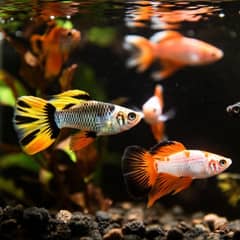
Telling males from females is straightforward once you know what to look for. Males carry the namesake sword, a colorful lower extension of the tail fin, along with a gonopodium, a modified, rod-like anal fin used to fertilize females internally, in place of the fuller, fan-shaped anal fin females have. Females also tend to develop a dark gravid spot near the vent as they near giving birth.
Worth knowing if you're sexing a group of young fish: hobbyists have reported, for generations, individual swordtails that spend months looking and acting like a female before eventually developing a sword, male coloring, and even fathering broods of their own. It's been studied since the 1930s, but it remains a genuinely disputed question, not settled fact, researchers disagree on whether this is true sex reversal or simply male traits emerging late in a fish that was missexed as a juvenile. Either way, a young fish you've confidently sexed as female isn't a permanent guarantee.
How Swordtails Breed
Swordtails are livebearers, females give birth to free-swimming fry directly instead of laying eggs that need separate incubation. That alone sets them apart from most other commonly kept aquarium fish, and it comes with a real consequence worth understanding before you buy.
A single mating can keep a female swordtail producing fry for months afterward, since females store sperm internally and don't need a male present again for each new brood. Gestation runs about 4 weeks, and a typical brood lands somewhere between 20 and 100 or more fry, depending on the female's size and age. Put a male and female together with no plan, and the tank doesn't stay the size you started with.
Swordtail parents don't provide any care after birth, and adults will readily eat their own fry given the chance. Dense live planting or a dedicated breeding tank gives fry somewhere to hide until they're large enough to hold their own.
The Handling Consideration: Male Ratio and Aggression
This is the part of swordtail keeping that genuinely functions as a handling decision instead of a passive care detail. Males compete for females and can be territorial toward each other, and a female fielding constant mating attempts from an unbalanced ratio of males shows real, measurable stress. Sources commonly recommend one male to three or four females, some put the workable minimum at two or three, but the higher end spreads attention out more effectively in anything short of a large, heavily planted tank.
Get the ratio wrong and the consequences aren't just behavioral. Persistent chasing leads to fin damage and ongoing stress in the pursued fish, and stressed fish are more vulnerable to illness, which makes the ratio a health question as much as a breeding one.
Managing Population, Practically
Keep males and females in separate tanks if you want to avoid breeding entirely, or keep a males-only group for a colorful, breeding-free display instead, with the caveat that exactly two males is the one combination to avoid. If you do want controlled breeding, stick to the ratio above and expect regular broods to manage, rehoming or selling fry as they mature, or letting natural predation control numbers if you aren't removing fry deliberately.
First-Time Keeper Mistakes
- Buying a single male with too few females, or several males together in a small tank, the single most common ratio mistake with this species
- Undersizing the tank. 20 gallons is a genuine floor for a small trio, but most sources recommend 29 to 30 gallons as the real starting point given how active swordtails are
- Skipping the lid. Swordtails are capable jumpers
- Housing swordtails and platies together without a plan, the two species interbreed readily since they share a genus, so an unplanned mix can leave you with fry that aren't cleanly either species
How Swordtail Handling Compares to Molly and Guppy Breeding
Swordtails, mollies, and guppies are all livebearers in the family Poeciliidae, and the underlying breeding biology looks nearly identical across all three: internal fertilization, sperm storage, and repeat broods from a single mating. Our Molly handling guide covers the same dynamics for that species in detail.
Where swordtails genuinely differ is male behavior. Mollies and guppies get by on a looser one-to-two-or-three ratio in most community setups, but swordtail males are consistently described as more combative with each other and more persistent with females, which is why getting the ratio right reads as a real handling responsibility with this species rather than just a breeding preference.
The Swordtail encyclopedia profile covers the species itself.
Sources & Further Reading
Last reviewed 15 Sep 2026 · 4 sources
❓ Frequently Asked Questions
Do you handle swordtails the way you'd handle a hamster or a bird?
No. Swordtails are an observation and enjoyment pet, not a hands-on one. If you need to move one, guide it with a net rather than touching it directly. Physical contact isn't part of normal swordtail care.
How do I safely bring home and acclimate a new swordtail?
Float the sealed bag in your tank for 15 to 20 minutes to equalize temperature, then drip acclimate over 45 to 60 minutes so the fish adjusts gradually to your water chemistry. Net the fish into the tank rather than pouring in any bag water, since it can carry ammonia the fish produced during transport.
How can I tell if my swordtail is male or female?
Males carry the namesake sword, a colorful extension of the lower tail fin, along with a modified anal fin called a gonopodium used to fertilize females internally. Females lack the sword entirely, have a fuller fan-shaped anal fin, and are the larger sex, an unusual reversal for a fish where the male carries the flashier ornament.
Why does male-to-female ratio matter so much with swordtails?
Because males can be persistent toward females and combative toward each other. Sources commonly recommend one male to three or four females, some say two or three is enough, but the higher end spreads out mating attempts more effectively and reduces the fin damage and stress that come with a single female fielding constant attention.
Do I need to quarantine a new swordtail?
Yes. A separate tank for 2 to 4 weeks before adding a new fish to your established tank catches most problems before they spread, the same practice that applies across nearly every aquarium fish.
📰 More on the Swordtail
📘 Swordtail care guide
🐠 How Much Does Swordtail Fish Ownership Really Cost?
🐠 Common Swordtail Health Issues (Including the One That Isn't a Pathogen)
🐠 Swordtail Tank Setup: A Real 29 to 30 Gallons and a Lid That Actually Seals
🐠 Swordtail Feeding: Schedule, Diet, and Why They Stop Eating
🐠 Swordtail Enrichment: Two Males Is the Number That Causes Trouble
Written by Michael Ryan
Mike keeps two rescued bearded dragons, Dex and Cera, and writes the care guides on BeastlyFacts from his own research and mistakes. He is not a veterinarian.
More about Michael Ryan →Comments
No comments yet - be the first!