Guppy Enrichment: The Sex Ratio Is a Welfare Decision
On This Page▾

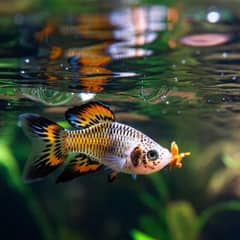
Most stocking advice for guppies is about color. The research is about what happens to the fish that are not colorful.
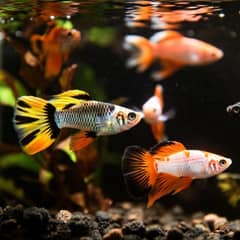
Male guppies pursue females close to continuously, and the costs of that harassment have been measured: reduced feeding and a forced change in where females live. The effects can carry into the next generation. The fix is boring and effective: several females per male, or an all-male tank.
What the Research Says
Sexual harassment in guppies and related livebearers is a well-studied area, and it maps directly onto how people stock tanks.
Direct costs to females. Harassment costs females feeding time and habitat choice. Across nine livebearer species that included the guppy, females spent significantly less time feeding with a male present than with another female. In wild Trinidadian guppies, male harassment drives females into habitats they otherwise do not prefer and leads the sexes to segregate. In the closely related Poecilia mexicana, females flee, become more vigilant in the presence of males, and have hampered feeding opportunities as a result.
Costs to the next generation. In one guppy study, lifetime fecundity did not differ between treatments, but offspring did. Females under high sexual harassment produced daughters with smaller bodies and sons with shorter gonopodia that were less attractive to females and less successful.
That last finding is the one worth carrying. The harassed females still produced offspring, so a keeper counting fry would see nothing wrong. The cost showed up in the fish that came out.
The guppy is one of the most-studied fish in evolutionary biology, largely because those short generations and obvious sexual selection make it a natural laboratory. The side effect is that we know more about the social costs of a badly stocked guppy tank than about almost any other aquarium fish.
Sex Ratio, First
The single decision that matters most, and it is free.
Several females to each male, and more females is better still. In harassment experiments, tanks with one male per female put the females under more pressure than tanks with one male per roughly six females, and those two ratios match what is found in the wild.
Or keep males only. It avoids the harassment question entirely, avoids the endless fry, and keeps the color, since males are the colorful sex. For a lot of keepers this is the better answer and it rarely gets suggested.
What does not work is stocking on looks, which produces a male-heavy tank, which is the arrangement the research describes.
Cover, as a Social Tool
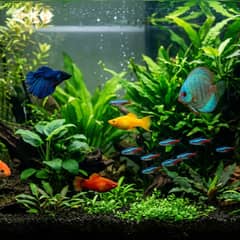
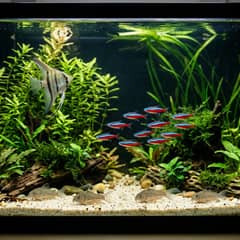
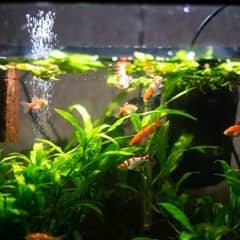
Dense live planting, including floating plants, offers females somewhere to get out of a male's line of sight, the same refuge-seeking that wild females show under harassment.
Cover in a livebearer tank is not just decoration or fry protection. It is what lets a female get a rest. Plant heavily along the sides and back and leave swimming space through the middle.
Floating plants do double duty, since fry hide in the roots and survive at a rate you can actually manage.
Space and Numbers
Guppies are active and social and do better in groups than in pairs. A 10 gallon tank is a reasonable starting point for a small group, and bigger is easier because a livebearer tank does not stay the size you stocked it.
Plan for the fry. A mixed-sex guppy tank produces a new brood roughly monthly, and overstocking is how water quality collapses.
Water Stability
Guppies suffer in unstable water.
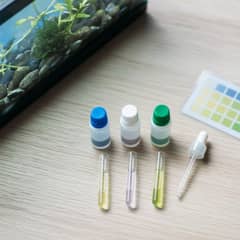
A cycled tank, water conditioner on everything that goes in, and small regular changes.
Feeding
Fast, greedy surface feeders. Spread food across the surface rather than in one spot, so the females that are being chased still get some.
That is the practical link back to the research: a female feeds less with a male near, and food arriving in one place makes it worse. Vary the diet with frozen and live foods.
Priority Order
- Several females per male, or an all-male tank
- Dense planting and floating cover for females to retreat into
- A group rather than a pair, with space for the fry
- Food spread across the surface
- Stable, cycled water
- A plan for the population
- Varied diet
What Not to Do
Do not stock a guppy tank on which fish look best, which produces the male-heavy ratio the research warns about. Do not keep a single male with a single female. Do not keep a bare tank with no cover for females. Do not feed in one corner. Do not let the population run unmanaged. And take real care moving a heavily pregnant female, which can stress a female badly.
Sources & Further Reading
Last reviewed 9 Sep 2026 · 3 sources
- PubMed (U.S. National Library of Medicine): Gasparini, Devigili and Pilastro (2012): Cross-generational effects of sexual harassment on female fitness in the guppy. Evolution 66(2), DOI 10.1111/j.1558-5646.2011.01455.x; Darden and Croft (2008): Male harassment drives females to alter habitat use and leads to segregation of the sexes; Killen et al. (2016): Male sexually coercive behaviour drives increased swimming efficiency in female guppies
- Plath et al. (2007): Sexual harassment in live-bearing fishes (Poeciliidae): comparing courting and noncourting species
- USGS Nonindigenous Aquatic Species: Poecilia reticulata
Frequently Asked Questions
Is there research on guppy welfare?
There is a substantial body of research on sexual harassment in guppies and related livebearers, which is the single most useful thread for someone stocking a tank. It documents direct costs to females from constant male pursuit.
What are those costs?
Harassment costs females feeding time and a say in where they live. Across nine livebearer species including the guppy, females spent less time feeding with a male present, and in wild guppies harassment pushes females into habitats they would otherwise avoid. In a related livebearer, females stay more vigilant around males and flee, which costs them more feeding time.
Does it affect the offspring?
In one study, yes. The daughters were smaller and the sons had shorter gonopodia, which made them less attractive and less successful in coercive matings. Lifetime fecundity did not differ, so counting fry would show nothing.
What sex ratio should I keep?
Several females to each male, and more is better. Keeping males only is the other workable answer and avoids the problem entirely, along with the endless fry.
Why do people end up with too many males?
Because males are the colorful ones and get sold that way. A tank stocked on appearance ends up male-heavy, which is the exact arrangement the harassment research argues against.
Do guppies need planting?
Yes, and for a specific reason here. Dense planting offers females a refuge from pursuit, as wild females seek out, with somewhere to break line of sight and rest, and it gives fry somewhere to hide from the adults. In a livebearer tank, cover is a social tool rather than decoration.
More on the Guppy
Recommended Gear
As an Amazon Associate I earn from qualifying purchases through the links above, at no extra cost to you.

Written by Michael Ryan
Mike keeps two rescued bearded dragons, Dex and Cera, and writes the care guides on BeastlyFacts from his own research and mistakes. He is not a veterinarian.
More about Michael Ryan →You May Also Like
Subscribe - it's free
An occasional email when something new is worth your time. No spam.
Deep Dive
Health and More