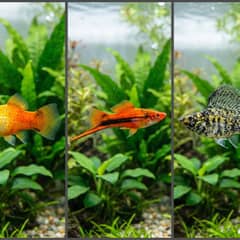
Swordtail Tank Setup: Go 36 to 48 Inches Long and Use a Lid That Seals
On This Page▾

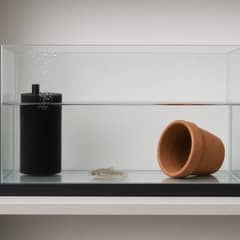
Measure a swordtail tank in length, not gallons: 36 inches is the shortest to consider and 48 is the better buy, which means a 30-gallon or 40-gallon breeder at the least and a 33-gallon long or 55 when the space allows. The tank sold as a 29 is only 30 inches long and does not qualify.
Swordtails need more room than a guppy or molly, a filter that keeps some water moving, and a lid that seals, since this is a capable jumper, not just a hobbyist exaggeration.
Tank Size
At least 36 inches long is the floor for a small trio, a step up from the 10-gallon tank that gets a small guppy or platy group by, and a 40-gallon breeder (36 inches) is the usual way to meet it. A group wants 48 inches, which is a 33-gallon long or a 55, and as much length as the space allows. That more generous size is the real target, since swordtails are noticeably more active, open-water swimmers than a molly or platy of similar size. Go long and rectangular rather than tall, and use a lid, more on that below.
A 20-gallon long tank is a temporary home for a pair at most: at 30 inches long it falls short of the 36-inch minimum above, and a 36 to 48 inch tank is the better real-world target for most keepers.
Temperature
A tropical range of 72 to 82°F works, and keepers report them tolerating cooler water. Hold the temperature steady anywhere inside that range; stability matters more than hitting an exact number, so avoid sudden swings. A heater is necessary unless your room stays consistently warm year-round.
Water Chemistry
Swordtails do best with a pH of 7.0 to 8.0 and moderately hard to hard water, roughly 10 to 25 dGH. If your tap water runs soft, a mineral supplement, crushed coral or a commercial buffering product, can bring it into range.
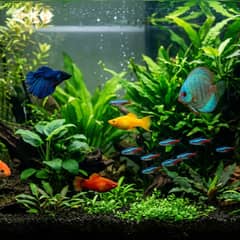
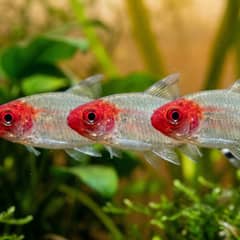
Swordtails do best beside similar-sized, easygoing fish: platies, mollies, cory catfish, rosy barbs, kuhli loaches and otocinclus all fit. Platies are the one caution, since they can hybridize with swordtails. Aggressive or boisterous fish are the ones to avoid, because a swordtail does not defend itself and turns timid around them.
The Jumping Risk
This is worth its own section because it's one of the more consequence-heavy details in swordtail keeping, and it's real, not hobbyist exaggeration. Swordtails are powerful jumpers, and a secure lid is the only thing that stops them. Hobbyist reports consistently describe fish escaping through gaps far smaller than you'd expect, and a gap at the back of a lid well under an inch wide is often enough.
A swordtail doesn't need a dramatic opening to get out. Reports from experienced keepers describe fish escaping through gaps of well under an inch between a glass lid and the tank rim, and the usual outcome for an escaped fish, drying out on the floor before anyone notices, is entirely preventable with a lid that actually seals rather than one that just sits on top.
A full mesh or glass lid with no meaningful gaps is the fix, not an optional upgrade. Leave a feeding hatch or filter cutout no larger than necessary, and check it after any tank rearranging, since even a temporarily propped-open corner is enough.
Filtration
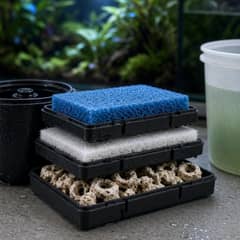
Swordtails don't need especially strong filtration, though they appreciate some water movement. Filter flow should run at 4 to 5 times the tank's volume per hour for this species, and a bigger, more active fish in a bigger tank produces a bigger bioload to match. For a standard or growing group, a hang-on-back filter or a stronger canister filter handles the load comfortably.
If fry survival is the priority instead, a dedicated breeding or nursery tank, a gentle sponge filter is the better call, since it won't pull small fry into strong current the way a power filter can.
Substrate
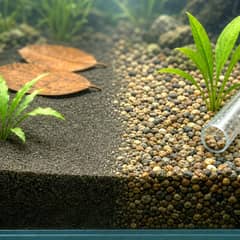
Fine gravel or sand both work well. Avoid sharp or coarse gravel, which can damage fins, especially on longer-finned lyretail and hi-fin varieties.
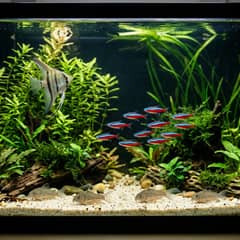
Pick a dark one: swordtails look best in a heavily planted tank over a dark substrate. Wild-type fish also suit a stream layout, with water-worn rocks and small boulders set on the floor.
The floor does not have to be inert, since swordtails want moderately hard to hard water, but a full buffering bed overshoots. Calcareous substrates release calcium and other minerals that make water harder and more alkaline, and a whole bed of crushed coral or coral sand pushes the pH above 8.0, the top of the swordtail's 7.0 to 8.0 range. In soft tap water the gentler option is a small amount of coral mixed into the dark gravel, the way keepers in very soft water areas use it to stop the pH falling. Ordinary pea gravel already carries enough calcium to boost pH and hardness on its own. Any calcareous floor commits the tank to hard water and rules out soft-water tankmates.
Lighting
A basic LED light on an 8 to 10 hour daily cycle is enough for the fish and for the plants below, as long as the plants are low-light species. A plug-in timer keeps the day the same length every day.
Planting for Female Refuge
Dense live plants aren't just decoration in a swordtail tank, they're a genuine, practical tool for two separate problems. First, the same problem a molly tank has: swordtail parents don't look after fry, and adults will eat them given the chance, so dense live plants give fry somewhere to hide.
Second, and more specific to this species, planting gives females somewhere to physically break line of sight from a persistent male.
The plants that survive a basic LED are the low-light ones, and hard, alkaline swordtail water narrows the list further. Three cover the job between them:
- Vallisneria 'Tiger' for the back wall. Its striped strap leaves run 30 to 50 cm (12 to 20 inches), it needs no strong light or CO2, and it grows best in hard, carbonate-rich water, drawing its carbon from the carbonates. It spreads by runners into a screen a female can slip behind.
- Hornwort (Ceratophyllum demersum) for fast cover. It is rootless, low-light, low-CO2 and fast-growing, and it can be planted in bunches or left to drift near the surface, where the tangle hides newborn fry.
- Anubias barteri var. nana for the lower levels. It is a slow, low-light plant that grows best tied to rock or driftwood rather than planted in the substrate. Tie it on with fishing line until it grips, and never bury the rhizome, which rots when covered.
Plant the tall species along the back and one end, and leave the front and middle open for swimming. A swordtail is a long open-water fish, and the refuge works when it sits beside the swimming lane, not across it.
The Non-Obvious Requirement: Cycling and Conditioning
Cycle the tank before adding fish. Building the beneficial bacteria colony that processes waste takes 4 to 6 weeks with a fishless cycle, and a slow one can run to 8, or somewhat less with a bottled bacteria product. Skipping this step is one of the most common beginner mistakes in the hobby generally, and it's a fast route to ammonia-driven stress.
Always use a water conditioner on tap water before it goes in the tank, dechlorinating and neutralizing chloramine and heavy metals that are otherwise harmful to fish. A water test kit lets you confirm the cycle actually finished and catch drift afterward.
The Swordtail encyclopedia profile has more on the species itself.
Sources & Further Reading
Last reviewed 12 Sep 2026 · 5 sources
- SeriouslyFish: Xiphophorus hellerii
- FishBase: Xiphophorus hellerii
- Practical Fishkeeping: Great fish: Swordtails; Matt Clarke, Frequently asked questions on aquarium substrates
- UF/IFAS Extension: Ammonia in Aquatic Systems
- Tropica plant pages: Vallisneria spiralis 'Tiger', Ceratophyllum demersum, Anubias barteri var. nana

A routine chart and equipment log you can fill in for your own setup. The Universal Pet Kit has it, among 19 forms for any pet that you can type into or print.
Frequently Asked Questions
What size tank does a swordtail need?
Go by length. A swordtail tank should be at least 36 inches long, so a 30-gallon or 40-gallon breeder is the smallest worth buying, and 48 inches (a 33-gallon long or a 55) is better. The tank sold as a 29 is only 30 inches long, so it falls short. Pick length over height, and add a lid, since swordtails are capable jumpers.
What temperature do swordtails need?
Tropical, 72 to 82°F, and keepers report them tolerating cooler water. Hold it steady anywhere inside that range rather than chasing a number, and avoid sudden swings. A submersible heater is necessary unless the room stays warm all year.
What water chemistry do swordtails need?
pH 7.0 to 8.0 in moderately hard to hard water, roughly 10 to 25 dGH. Soft tap water can be brought up with crushed coral or a commercial buffering product.
Do swordtail tanks need a secure lid?
Yes. Swordtails are powerful jumpers, and hobbyist reports describe fish escaping through gaps of well under an inch. A tight-fitting lid isn't optional the way it might be for a slower species.
What kind of filtration is best for a swordtail tank?
Filtration doesn't need to be particularly strong, but swordtails appreciate some water movement: filter flow at 4 to 5 times the tank's volume per hour is the working target for this species. A hang-on-back or canister filter suits a standard or growing group; a gentle sponge filter is the better call specifically if you're prioritizing fry survival.
More on the Swordtail
Recommended Gear
As an Amazon Associate I earn from qualifying purchases through the links above, at no extra cost to you.

Written by Michael Ryan
Mike keeps two rescued bearded dragons, Dex and Cera, and writes the care guides on BeastlyFacts from his own research and mistakes. He is not a veterinarian.
More about Michael Ryan →You May Also Like
Subscribe - it's free
An occasional email when something new is worth your time. No spam.
Deep Dive
Health and More