Guppy Feeding: Schedule, Diet, and Why They Stop Eating
On This Page▾

Guppies take food readily and will beg no matter how full they already are, which makes too much the easier mistake at feeding time, and the water pays for it when the extra goes uneaten.
Feeding Schedule by Life Stage
- Fry (newborn to roughly 2 to 4 weeks): The highest feeding frequency of any stage, tiny stomachs and rapid growth. Guppies are livebearers, so fry take newly hatched baby brine shrimp or finely crushed flake from birth. Feed small amounts 3 to 5 times a day, and as often as every 2 to 3 hours in the earliest days.
- Juveniles (roughly 1 to 3 to 4 months): Around 3 to 4 meals a day, more frequent and higher-protein than adult feeding, tapering as they approach adult size. In a trial on juveniles 30 days old, fish fed four meals a day grew the heaviest and fish fed one meal a day used their food most efficiently, and all four groups survived. Treat the exact number as approximate.
- Adults: At least once a day, in small portions that together come to about 3% of body weight. Feed what the fish finish quickly and clear away the rest. There is no single right number: anywhere from once a day to three times a day works. The portion rule holds at any frequency: feed only what's fully cleared within about 1 to 2 minutes.
- Fry and juveniles: Young fish can take up to about 5% of their body weight a day, split across several small feeds in food fine enough for their mouths.
What Guppies Eat
Wild guppies feed on zooplankton, small insects and detritus, so the aquarium diet leans on animal protein with some plant matter alongside. Guppies are omnivores and will also naturally graze on tank algae. The base should be a high-quality tropical flake or small pellet made for community fish, crushed if the pieces are too big for the mouths in the tank, and not goldfish food, which is made for a different fish. Rotate in live, frozen, or freeze-dried foods such as brine shrimp, daphnia, bloodworms, and mosquito larvae, plus tubifex worms from a commercial source and microworms, especially for fry. Add small amounts of blanched vegetables cut fine and small (spinach, zucchini, cucumber, peas, and lettuce) and algae wafers. Small amounts of boiled egg yolk are an occasional protein treat some keepers use. A wide variety is how an aquarium diet covers the nutrients a single food misses.
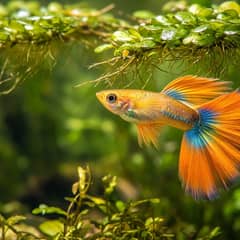
Food also feeds a male guppy's orange. That orange is carotenoid color, and a guppy cannot make carotenoids, so it has to eat them. Across six wild populations, brothers raised on diets with more carotenoid were more attractive to females in every population.
Thaw frozen food before feeding, never microwave it, and never refeed something previously thawed and left over, that encourages bacterial growth. Because guppies have small mouths, flake or finely crushed pellet generally works better than large pellets.
Leftovers and Foods to Skip
Bread, cereal, and other processed human foods do not belong in the tank, because none of them match a guppy's actual nutritional needs. Whatever the fish leave behind rots and fouls the water, so remove uneaten food and cut the next portion back. Scoop the seedy center out of cucumber pieces before feeding. Skip spoiled or expired food, guppies will typically nibble it and reject it anyway. More than any single food, overfeeding is the mistake to watch: keepers commonly link it to constipation and swim bladder problems, and uneaten food rotting in the tank crashes water quality.
Why Guppies Stop Eating
- Impending birth. Female guppies, livebearers, often eat less or refuse food entirely in the day or so before giving birth, from reduced stomach capacity and a shift toward finding a secluded spot to deliver. Appetite typically returns quickly afterward.
- Stress. New-tank relocation, tank cleaning, and aggressive tankmates are all common triggers. Too many males for the females is another, since females spend less time feeding when a male is near, and roughly 1 male per 2 to 3 females reduces mating-chase stress.
- Poor water quality. Ammonia or nitrite spikes and low oxygen are worth testing for rather than waiting out.
- Water outside the range. Guppies are tropical fish kept at 64 to 82°F, and water outside that range is worth correcting before anything else. Cold water slows metabolism directly, causing lethargy and appetite loss along with weakened immune function, so hold the temperature steady anywhere inside the range. Guppies tolerate cooler water, down to about 63 to 64°F, but cold slows them down and dulls their appetite.
- Illness. Ich, velvet disease, bacterial infections, and dropsy usually come with other visible signs, and appetite loss is one of the early ones.
- Pickiness. Guppies may reject an unfamiliar food or one too large for their small mouths, easily fixed by switching food or crushing pellets smaller.
When to Worry
There's no single, universally agreed number for how long a guppy can safely go without food, and that's worth stating plainly rather than picking a side. Usual hobbyist practice treats a skipped meal or even a full day as not inherently concerning if the fish otherwise looks and behaves normally, especially around a known trigger like pregnancy or a tank disturbance. A guppy that keeps refusing food once the water tests clean is the one to call a vet about.
Appetite loss combined with lethargy, hiding, or erratic swimming, gasping at the surface, clamped or discolored fins, cloudy eyes, visible injuries, white spots, or a swollen pinecone-like body points to illness or bad water. Test water parameters immediately, and consider a fish-health specialist rather than waiting, especially if the signs spread to other fish.
Sources & Further Reading
Last reviewed 1 Aug 2026 · 5 sources
- Merck Veterinary Manual: Nutritional Diseases of Fish; Disorders and Diseases of Fish
- FishBase: Poecilia reticulata
- Norazmi-Lokman et al. (2020): Effects of different feeding frequency on Siamese fighting fish and Guppy juveniles
- Plath et al. (2007): Sexual harassment in live-bearing fishes (Poeciliidae)
- Grether GF (2000). Carotenoid limitation and mate preference evolution: a test of the indicator hypothesis in guppies (Poecilia reticulata). Evolution 54(5):1712-1724

A routine chart and equipment log you can fill in for your own setup. The Universal Pet Kit has it, among 19 forms for any pet that you can type into or print.
Frequently Asked Questions
How often should I feed my guppy?
At least once a day, in small portions that add up to about 3% of body weight. Guppies take food readily, so too much is the easier mistake, and uneaten food left to rot fouls the water. Adults land somewhere between once and three times a day. Only offer what's fully cleared in about 1 to 2 minutes, because guppies beg regardless of actual hunger.
What should guppy fry eat?
Guppies are livebearers, so fry are born able to take newly hatched baby brine shrimp or flake crushed fine from the first day. Fry can take up to about 5% of their body weight a day, split into small feeds, and they eat far more often than adults, as often as every 2 to 3 hours in the earliest days.
Can I feed guppies goldfish food?
No, goldfish food is made for a different fish and is a poor match for what guppies need. Use a flake or small pellet formulated for tropical community fish instead.
What do guppies eat in the wild?
Zooplankton, small insects and detritus. Tank-bred guppies accept most foods, but a flake or small pellet for tropical community fish, with live, frozen or freeze-dried foods rotated in, covers the same ground.
Does tank algae help a guppy's color?
It can. Single-celled algae are the main carotenoid source for wild guppies, so the algae film they graze and an algae wafer in the rotation both carry the pigment behind a male's orange.
Why has my guppy stopped eating?
For a female close to giving birth, this is often completely normal, reduced stomach capacity and a shift in focus toward finding a place to deliver. Stress from a new tank, tank cleaning or too many males chasing the females is a common cause, along with poor water quality, cold water, water outside the 64 to 82°F range, and illness. Test the water first.
How long can a guppy safely go without eating?
There's no agreed number. A skipped meal, or even a full day, is not inherently concerning while the fish otherwise looks and behaves normally. If a guppy keeps refusing food and the water tests clean, call a vet.
What symptoms alongside not eating mean trouble?
Lethargy, hiding, gasping at the surface, clamped or discolored fins, cloudy eyes, white spots, or a swollen pinecone-like body. Any of these paired with appetite loss is a signal to test water parameters immediately rather than wait it out.
More on the Guppy

Written by Michael Ryan
Mike keeps two rescued bearded dragons, Dex and Cera, and writes the care guides on BeastlyFacts from his own research and mistakes. He is not a veterinarian.
More about Michael Ryan →You May Also Like
Subscribe - it's free
An occasional email when something new is worth your time. No spam.
Deep Dive
Health and More