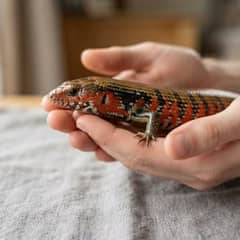
How to Handle a Gargoyle Gecko (And How It Differs From a Crested Gecko)
On This Page▾

Gargoyle geckos are docile and slow-moving as adults, one of the calmer arboreal geckos to handle, though juveniles are a different story entirely.
Age Matters a Lot
Young gargoyle geckos are skittish and jumpy, quick to leap at the slightest disturbance. Adults settle considerably as they mature. Don't judge the species by a nervous juvenile, the calm reputation this gecko has earned really does apply mostly to grown animals.
Getting Started
Wait about two weeks after bringing a new gecko home before handling it. Start with 5-minute sessions every other day, working up to about 15 minutes, and cap total daily handling around 20 minutes even once your gecko is tame.
Handle over a bed, couch, or close to the ground, jumpy geckos leap when startled, and a fall from height is a real injury risk for a small animal. Let the gecko walk onto your hand rather than grabbing it out of a hide. "Treadmilling," moving one hand in front of the other as it walks, keeps things calm for jumpy individuals. Handling during the day, when gargoyle geckos are naturally sleepier, also tends to go smoother than an evening session.
Two Defense Mechanisms Worth Understanding
Biting. Rare, and almost always provoked. Gargoyle geckos have noticeably larger teeth than crested geckos, so an adult bite can actually draw blood, unlike a crested gecko's, which typically can't break skin. Still a minor injury, wash it with soap and water.
Tail drop. Like most geckos, a gargoyle will drop its tail if grabbed by it, startled badly, or restrained roughly. Never grab or hold the tail. Unlike crested geckos, gargoyle geckos do regrow their tail. The regrown tail comes back slightly different, prehensile and cartilage-based rather than bone, with somewhat asymmetrical scales, but fully functional.
Crested geckos and gargoyle geckos are close cousins, but only one of them can regrow a lost tail. A 2024 genome study confirmed gargoyle geckos regenerate their tails while crested geckos have permanently lost that ability. Same family, one very different superpower.
The Crested Gecko Comparison
Gargoyle geckos and crested geckos get lumped together constantly, but they differ in a few concrete ways that matter for handling:
- Tail regrowth: gargoyle regrows, crested does not.
- Bite: gargoyle can draw blood, crested typically can't.
- Climbing: crested geckos stick well to glass, gargoyles climb glass poorly and need more grippable branches instead.
- Temperament: juvenile gargoyles tend to be jumpier than juvenile cresties, but many keepers find settled adult gargoyles calmer overall.
If you're deciding between the two species, the crested gecko is the one that sticks to glass without needing branches to do it.
A Few More Things
Gargoyle geckos are territorial and can be cannibalistic toward hatchlings, and mating itself can be rough enough to cause tail loss. House them singly. Wash your hands before and after handling.
Among the other easygoing geckos, the mourning gecko and the African fat-tailed gecko are the closest comparisons on temperament.
Sources & Further Reading
Last reviewed 24 Jul 2026 · 3 sources
- ReptiFiles: Gargoyle Gecko Handling
- CB Reptile: Gargoyle Gecko Handling
- Danelle's Critters: Crested Gecko vs. Gargoyle Gecko
- Lozito, T.P., et al. (2024). "Chromosome-level genome assembly and annotation of the crested gecko, Correlophus ciliatus, a lizard incapable of tail regeneration." Gigabyte, PMC11558660.
❓ Frequently Asked Questions
Are gargoyle geckos calm enough to handle?
Adults, generally yes, they're docile and slow-moving, one of the calmer arboreal geckos to handle. Juveniles are a different story, they're skittish and jumpy, so don't judge the species by a nervous young gecko.
How soon can I handle a new gargoyle gecko?
Two weeks after it comes home. Begin with 5-minute sessions every other day, work up toward 15, and keep the daily total near 20 minutes even once it's tame.
Do gargoyle geckos bite, and does it hurt more than a crested gecko's bite?
Rarely, and almost always because it was provoked. Gargoyle teeth are noticeably bigger than a crested gecko's, so an adult bite can break skin where a crestie's can't. It's still a minor wound: soap and water.
Can a gargoyle gecko regrow its tail, unlike a crested gecko?
Yes, and this is one of the biggest differences between the two species. Gargoyle geckos regenerate a dropped tail, confirmed by peer-reviewed genome research, while crested geckos cannot. The regrown tail is prehensile and cartilage-based rather than bone, with somewhat asymmetrical scales, but it's fully functional.
Can I house two gargoyle geckos together?
No. They're territorial, hatchlings can be cannibalized, and mating alone gets rough enough to cost a tail. Keep them one to an enclosure, and wash your hands around handling.
📰 More on the Gargoyle Gecko
📘 Gargoyle Gecko care guide
🦎 How Much Does a Gargoyle Gecko Really Cost?
🦎 Common Gargoyle Gecko Health Issues and What Causes Them
🦎 Gargoyle Gecko Tank Setup: A Low Ceiling, Not No Heat at All
🦎 Gargoyle Gecko Feeding: Schedule, Diet, and Why They Stop Eating
🦎 Gargoyle Gecko Enrichment: Build Up, and Fill What You Build
Written by Michael Ryan
Mike keeps two rescued bearded dragons, Dex and Cera, and writes the care guides on BeastlyFacts from his own research and mistakes. He is not a veterinarian.
More about Michael Ryan →Comments
No comments yet - be the first!