Russian Tortoise
Turtles & Tortoises
The compact, hardy tortoise that digs first and asks later!
On This Page▾
🤓 Did you know? Russian tortoises are one of the world's most cold-tolerant tortoise species. They can survive sub-zero temperatures in the wild by hibernating (brumating) deep underground for months at a time!

🗓️ The first week
The numbers a new owner needs in the first week, each from the article it links to. Rows with no link come from the encyclopedia.
- Legal
- One state, Colorado, bans it, four require a permit, four attach a condition, and Hawaii, which bans almost everything, expressly allows it. Forty-three states place no rule on it at all.Legal guide →
- Enclosure
- A 4x2x2 ft tortoise table, about 8 square feet, is the absolute indoor minimum, genuinely a minimum rather than a goal. Sources disagree on the target: at least 12 square feet, or our own functional recommendation of roughly 7x3.5 ft, about 24 square feet.Setup guide →
- Temperature
- Basking 95 to 100°F at the surface, cool side in the 70s°F. Night drops to about 60°F are fine, and most homes need no supplemental night heat.Setup guide →
- Humidity
- Ambient 30 to 50%, low and dry for this arid species, but a moist hide lined with peat moss for a humid microclimate to hydrate and shed in.Setup guide →
- UVB
- A 10 to 12% T5 HO tube, covering a third to half the enclosure, for a basking-area UVI near 3.0 to 4.0. Coil and compact bulbs aren't adequate.Setup guide →
- Substrate
- A 50/50 topsoil and coconut coir mix, or a similar sand and loam blend, deep enough to burrow in and kept slightly damp. No pure sand.Setup guide →
- Diet
- Unlimited grass hay and a rotation of wild weeds, dandelion, plantain, and clover among them, as the staple, rather than cultivated grocery greens. High-oxalate greens like spinach and chard stay off the rotation. Fruit minimal to none.Setup guide →
- Brumation
- Physiologically programmed to brumate 2 to 4 months over winter at 40 to 55°F, but indoor keepers can skip it entirely by maintaining full lighting, heat, and feeding year-round.Setup guide →
- Handling
- An observation pet, not one built for regular handling. House males separately, they ram and bully other tortoises. Skilled climber and digger, more of an escape risk than it looks.Handling guide →
- Budget
- $50 to $150 for a hatchling ($225 to $400 older captive-bred). $372 to $775 to set up. $365 to $715 a year.Cost guide →
- Adult size
- 5 to 10 inches.
- Lifespan
- 40 years or more typical, some individuals reaching 50-plus.Cost guide →
- Hygiene
- Wash hands with soap right after any contact, keep the tortoise out of the kitchen, and never clean the enclosure in a kitchen sink or a bathtub people use.Hygiene guide →
- Soaking
- Juveniles 10 to 15 minutes twice a week, adults about once a week, in lukewarm water no deeper than the elbows, and never unattended. Watch for urates: white and soft is hydrated, dry and gritty is not.Tortoise Soaking →
🚨 Emergency card
Call the vet now if you see any of these.
- Wheezing, nasal discharge, open-mouth breathing, or lethargy (respiratory infection, does not resolve on its own)
- Soft, discolored, or foul-smelling patches on the shell (shell rot, can progress to life-threatening septicemia)
- Watery, jelly-like urine, or straining to urinate
- A soft or deformed shell with weak limbs
A reptile-experienced vet, found before you need one. Run a fecal test on any newly acquired tortoise regardless of symptoms; respiratory infection needs antibiotics and doesn't wait.
📰 Where to go next
How Much Does a Russian Tortoise Really Cost?
$50 to $400 for the tortoise, $372 to $775 to set up, and why the 40-plus year lifespan should decide the purchase.
Russian Tortoise Enclosure Setup: Compact Housing With Real Requirements
The real floor target beyond the 8 sq ft minimum, the 95-100°F basking spot, low ambient humidity with a moist hide, and the brumation decision indoor keepers get to make.
How to Handle a Russian Tortoise
Why this is an observation pet, the talented climbing and digging that makes escapes easy, and why males need separate enclosures.
Common Russian Tortoise Health Issues and What Causes Them
Metabolic bone disease, respiratory infection, shell rot, pyramiding, parasites, and the kidney infection specific to this genus.
Russian Tortoise Feeding: Fiber, Calcium, and Growing Slowly
Why grazing and fiber beat a bowl of salad, the calcium ceiling as well as the floor, and the test for a tortoise carrying too much.
Russian Tortoise Enrichment: Digging, Grazing, and Exploration
Deep diggable substrate, scatter feeding over a bowl, and why secure outdoor time is the richest enrichment available.
🛒 What to buy
Prices and the reasoning behind each item are in How Much Does a Russian Tortoise Really Cost?.
❓ Frequently Asked Questions
What size enclosure does a Russian tortoise need?
4 feet by 2 by 2 is the absolute indoor minimum, though something nearer 7 feet by 3.5 is the comfortable working size. Use an open-topped tortoise table rather than a closed glass aquarium.
Is a respiratory infection an emergency in a Russian tortoise?
Yes. It's caused by temperatures running chronically low, excess humidity, or drafts, and it does not resolve on its own, it needs antibiotics. Always see a vet immediately, and raise temperature and ensure hydration while arranging care.
Do Russian tortoises need to brumate?
They're physiologically programmed to, entering roughly 2 to 4 months of dormancy over winter at 40 to 55°F. Indoor keepers have a real choice most others don't: by maintaining full lighting, heat, and feeding year-round, you can keep your tortoise active through winter instead of brumating it.
Subscribe - it's free
New care guides straight to your inbox. No spam. 🐾
🖨️ Printable Guide
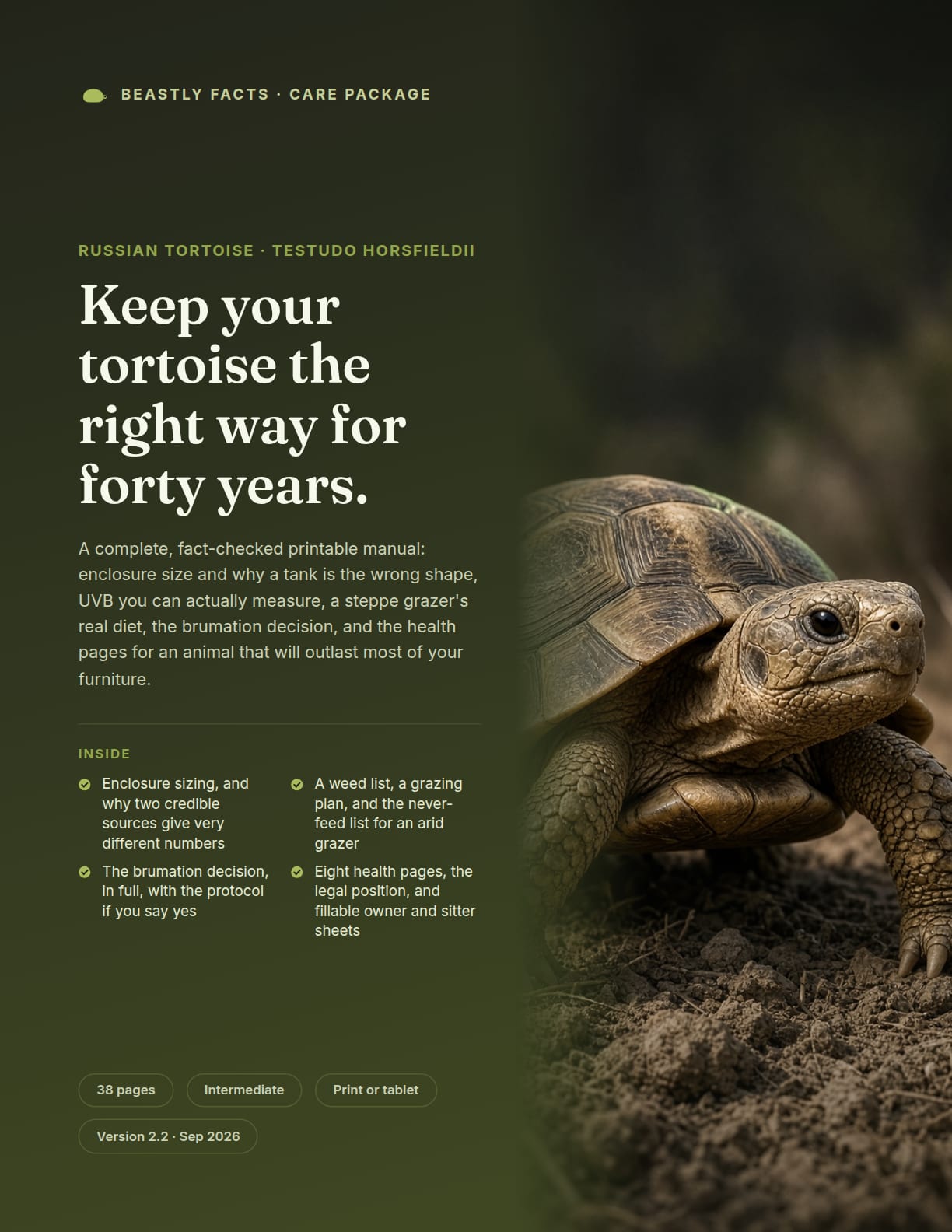
Russian Tortoise Care Package
38 pages · PDF · $8.99
⚖️ Legal Guide
📰 Deep Dive
🐢 How Much Does a Russian Tortoise Really Cost?
🐢 How to Handle a Russian Tortoise
🐢 Common Russian Tortoise Health Issues and What Causes Them
🐢 Russian Tortoise Enclosure Setup: Compact Housing With Real Requirements
🐢 Russian Tortoise Feeding: Fiber, Calcium, and Growing Slowly
🐢 Russian Tortoise Enrichment: Digging, Grazing, and Exploration
🩺 Health and More
🔌 Reptile Emergency Plan: Power Outages, Travel, and Pet Sitters
🐢 Tortoise Herpesvirus: Why Every New Tortoise Needs Months of Quarantine, Not Weeks
💧 Reading Reptile Stool, Urates, and Hydration: A Daily Health Check
🐢 Tortoise Soaking: How Often, How Deep, How Warm, and How Long
🧼 Salmonella and Reptile Hygiene: The Rules That Actually Matter
🌡️ Reptile Heating and Thermostats: Preventing Burns
🐢 Tortoise Brumation: Which Species, and How to Do It Right
🐢 Tortoise Sexing, Eggs, and Egg Binding
🌿 Safe Weeds and Wild Plants for Tortoises, Uromastyx, and Iguanas
🏡 Outdoor Reptile Housing: Pens, Predators, and What Actually Kills Them
📋 Succession Planning for a Pet That May Outlive You
🦎 Understanding Reptile Shedding (Ecdysis)
⚠️ Four Pets, Four Things Nobody Mentions Before You Buy
🦎 Three Reptiles Worth Starting With, Each for a Different Reason
🐢 Sulcata Tortoise vs. Russian Tortoise: Which Tortoise Actually Fits Your Space
🤩 Fun Facts
🐢 100-Year Commitment
Tortoises can live for over 100 years, so adopting one is genuinely a lifelong commitment. You may need to include them in your will!