Goldfish
Fish
The pond classic that outgrows the bowl, the myth, and your expectations!
On This Page▾
🤓 Did you know? Goldfish have real, months-long memories and can be trained to push levers, navigate mazes, and recognize shapes and colors - directly contradicting the popular '3-second memory' myth. They also grow to the size of their environment: a goldfish kept in a tiny bowl doesn't stay small because it's content, it's stunted, which is a sign of poor welfare rather than a convenient feature.

🗓️ The first week
The numbers a new owner needs in the first week, each from the article it links to. Rows with no link come from the encyclopedia.
- Tank size
- 20+ gallons for one fancy goldfish (29+ gallons is the better setup), plus 10 more gallons per additional fish. 55 gallons minimum for one common or comet, more per additional fish, better in an outdoor pond. 40 gallons minimum for a shubunkin, 55+ gallons or a pond better.Bowl myth guide →
- Filtration
- Process the tank's total volume at least 4 times an hour, ideally 5 to 10 times. Running two filters on one goldfish tank is common practice among experienced keepers, not overkill.Setup guide →
- Water temperature
- A coldwater species, comfortable in the 65 to 75°F range. No heater strictly required.Setup guide →
- Water parameters
- Ammonia and nitrite at 0, nitrate under roughly 20 ppm. Weekly water changes of 25 to 50%, always with a dechlorinator treating the new water first.Setup guide →
- Cycling
- Cycle the tank fully before adding any fish, the same as any other species.Setup guide →
- Feeding schedule
- Juveniles get 2 to 3 small feedings a day. For adults, sources genuinely diverge, so treat 1 to 2 small meals a day as the safe range, feeding only what's eaten in about 30 seconds to 2 minutes.Feeding guide →
- Diet
- A quality sinking pellet formulated specifically for goldfish as the base, not tropical fish flake. Supplement 2 to 3 times a week with blanched vegetables and high-protein treats in moderation.Feeding guide →
- Not eating
- Short gaps of 3 to 4 days are fine for a healthy adult in an established tank. The trigger to seek help is 24 to 48 hours of refusal combined with lethargy, pineconing scales, clamped fins, abnormal floating or sinking, gasping at the surface, visible wounds or white spots, cotton-like growths, or a visibly thinning body.Feeding guide →
- Handling
- Guide it into a container of tank water rather than lifting it out by hand. If a net is needed, wet it first and use soft rubber, never knotted nylon. Keep the fish out of water as briefly as possible.Handling guide →
- Budget
- The fish itself often costs less than $10. A complete setup typically runs $150 to $400. Ongoing costs run $10 to $30 a month.Cost guide →
- Adult size
- 6 to 8 inches for a fancy goldfish, 10 to 14+ inches for a common or comet, 10 to 12 inches for a shubunkin.Bowl myth guide →
- Lifespan
- 10 to 15 years typical; 20 to 30+ years in spacious, well-kept ponds.
- Tankmates
- Fancy with fancy, single-tail with single-tail. Not a tropical tank: guppies and anything slower at the food are the pairings that fail.Aquarium Stocking and Tankmates →
- Ich
- No heat cure: 86°F is past a coldwater ceiling. Salt at a tablespoon per 5 gallons or malachite green at full strength until the deaths stop.Treating Ich →
- Quarantine
- At least 30 days in a bare hospital tank before joining others. Thirty days is the floor, not the target, and a full two months is reasonable for a fish you especially don't want to lose.Quarantine guide →
- Power outage
- Oxygen loss is the fast danger, not the cold or the dark. Aerate right away with a battery air pump, or agitate the surface by hand roughly every 10 to 15 minutes in a small tank and every 20 to 30 minutes in a larger one. Don't feed, and don't restart a filter that's been off for hours without checking it first.Power outage guide →
🚨 Emergency card
Test the water first, then act on these today.
- Persistent loss of buoyancy
- Severe fin damage
- Visible ulcers
- Ongoing lethargy or appetite refusal
- An over-the-counter treatment that is not working
An aquatic vet, found before you need one. Most of the health list is prevented, not treated, through water quality, quarantine, and appropriate feeding.
📰 Where to go next
How Much Does a Goldfish Really Cost?
The fish itself under $10, a $150 to $400 setup where filtration is the real cost, and $10 to $30 a month after that.
Goldfish Tank Setup: Bigger Than You Think, Filtered More Than You'd Guess
The real tank size, filtration turnover math, water parameters, and cycling before the fish goes in.
The Goldfish Bowl Myth: What the Research Actually Shows
Why goldfish don't grow to fit their tank, the real space requirements by variety, and what self-cleaning bowl kits get wrong.
Goldfish Feeding: Schedule, Diet, and Why They Stop Eating
Schedule by life stage, pellets versus flakes versus gel, safe foods by tier, and the honest range of reasons a goldfish stops eating.
How to "Handle" a Goldfish (Net and Cup, Not Hands)
Why the slime coat matters, the net-and-container method, and what to do when bare hands are unavoidable.
Common Goldfish Health Issues (And What Actually Prevents Them)
Ich, flukes, anchor worm, velvet, fin rot, swim bladder disorder, dropsy, popeye, ulcers, and the signs that mean a vet visit.
Goldfish Enrichment: Space, Plants, and Foraging Done Right
What the research actually shows about plants and substrate, space and layout, and social stocking done right.
🛒 What to buy
Prices and the reasoning behind each item are in How Much Does a Goldfish Really Cost?.
❓ Frequently Asked Questions
Can I keep a goldfish and a betta together?
Not recommended. Goldfish need cooler water (65-75°F) than bettas (78-80°F), and goldfish are voracious fin-nippers that will target a betta's long fins. The temperature mismatch alone makes this pairing a poor fit for either species.
How do I know if my current goldfish tank is too small?
Test the water. If ammonia or nitrite ever reads above zero between water changes, or if you're doing water changes more than twice a week just to keep the fish alive, the tank is undersized for the bioload it's carrying - regardless of what the fish looks like.
Why has my goldfish stopped eating?
Water quality problems are the single most commonly cited cause, ammonia or nitrite spikes especially in a newer tank. Overfeeding-driven constipation, stress from tank mates or a small enclosure, and early disease are the other common culprits. Seasonal pond dormancy and spawning behavior can also reduce appetite normally.
📚 Encyclopedia
Goldfish
Carassius auratus
Subscribe - it's free
New care guides straight to your inbox. No spam. 🐾
🖨️ Printable Guide
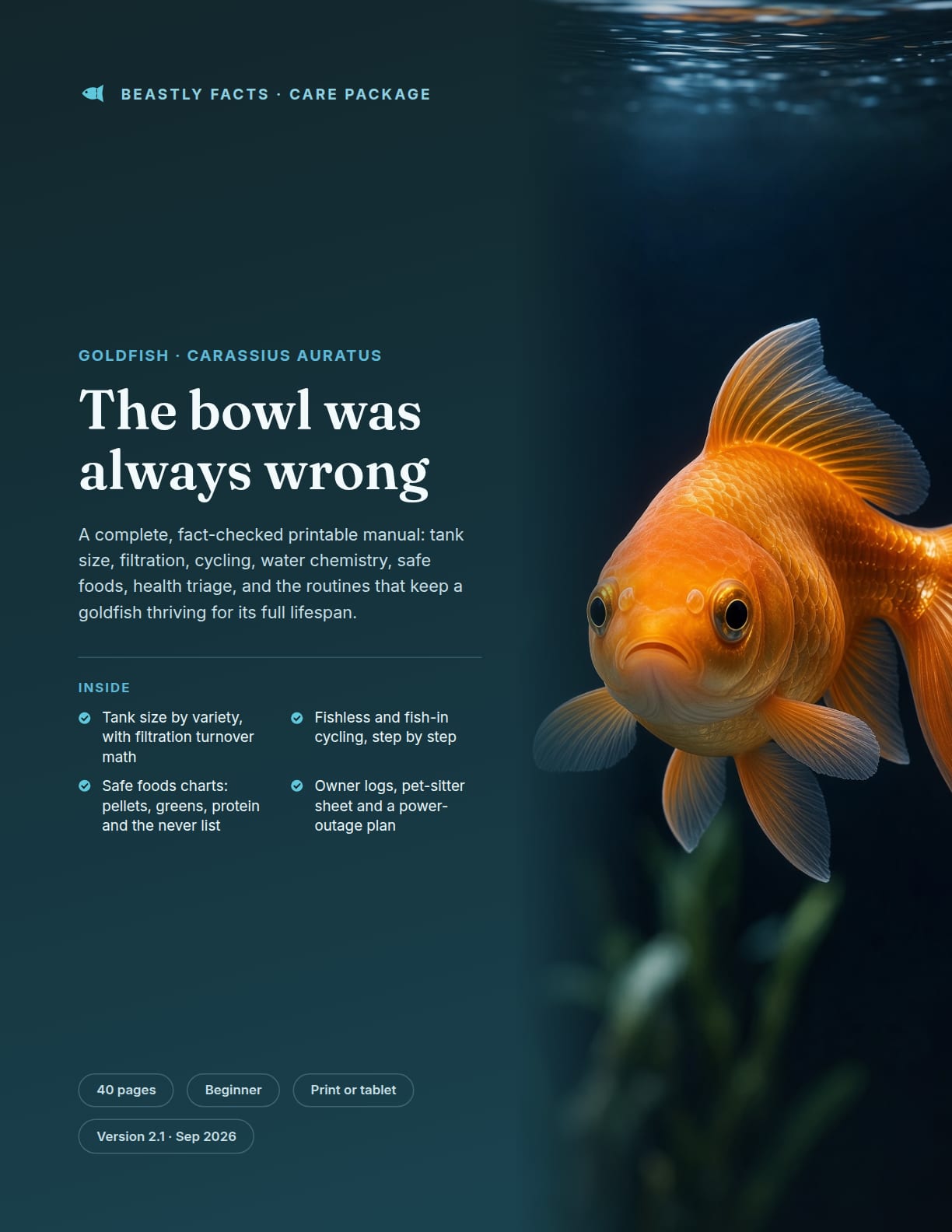
Goldfish Care Package
40 pages · PDF · $8.99
📰 Deep Dive
🐟 How Much Does a Goldfish Really Cost?
🐟 How to "Handle" a Goldfish (Net and Cup, Not Hands)
🐟 Common Goldfish Health Issues (And What Actually Prevents Them)
🐟 Goldfish Tank Setup: Bigger Than You Think, Filtered More Than You'd Guess
🐠 Goldfish Feeding: Schedule, Diet, and Why They Stop Eating
🐠 Goldfish Enrichment: Space, Plants, and Foraging Done Right
🩺 Health and More
🐠 Aquarium Power Outages, Transport, and Moving Your Fish: The Complete Plan
🦠 How to Cycle a Fish Tank, Start to Finish: Fishless and Fish-In
🧽 Aquarium Filtration: How It Actually Works and How to Maintain It
🪣 Aquarium Water Changes: How Much, How Often, and What the Number Is For
🐟 Aquarium Stocking and Tankmates: How Many Fish, and Which Ones Go Together
🧪 Freshwater pH, GH, and KH: Why Chasing a Number Backfires
🩺 Fish Quarantine and Treatment: The Hospital Tank Guide
🩹 Treating Ich: Heat, Salt or Medication, and the Temperature Ceiling That Decides
🩺 How to Tell If Your Fish Is Sick: Waste, Behavior, and Body Signs
🧊 Cooling an Aquarium Without a Chiller
🐾 Four Pets That Break the Usual Mold
🐠 Betta Fish vs. Goldfish: Which Beginner Fish Fits You Better
🐠 Koi vs. Goldfish: Which Pond Fish Actually Fits Your Space