Axolotl
Amphibians
The 'forever larva' with feathery gills and superhero-level regeneration!
On This Page▾
🤓 Did you know? Axolotls are neotenic, meaning they retain their larval (juvenile) features throughout their entire adult life and never undergo full metamorphosis. They keep their feathery external gills, tail fins, and aquatic lifestyle permanently. Scientists study them intensively because they can regenerate not just limbs but heart tissue, spinal cord sections, and parts of their brain with zero scarring.

🗓️ The first week
The numbers a new owner needs in the first week, each from the article it links to. Rows with no link come from the encyclopedia.
- Legal check
- Banned outright in California, Wyoming, and Alabama, effectively banned in New Jersey, permit-only and not issued for pets in Maine, and reported banned in Washington, D.C.; several other states restrict them in some way. Legal in Virginia since August 2021, despite widely repeated claims otherwise. Check your state before buying.Legal guide →
- Tank size
- A 20-gallon long tank is the minimum for one axolotl, with a 40-gallon breeder better if keeping two.Setup guide →
- Water temperature
- Between 60 and 68°F. Above 72°F starts to cause chronic stress, and it can become fatal in the mid-70s. Never use a heater, plan for an aquarium chiller.Setup guide →
- Water parameters
- Ammonia and nitrite at 0, nitrate ideally under 10 ppm, pH around 7.4 to 7.8.Setup guide →
- Cycling
- The tank needs to be fully cycled before an axolotl goes in, this isn't a species that tolerates an uncycled tank while it establishes itself.Setup guide →
- Substrate
- Fine sand with grains under 1mm, or bare-bottom. Never gravel or small rocks, axolotls gulp their food and swallow loose substrate along with it.Setup guide →
- Filtration
- Low flow only, a gentle sponge filter or a canister filter with the output diffused through a spray bar. Axolotls dislike current.Setup guide →
- Feeding schedule
- Hatchlings eat live food 2 to 3 times daily, juveniles about once a day, sub-adults every 1 to 3 days, adults every 2 to 3 days.Feeding guide →
- Diet
- Earthworms or nightcrawlers as the gold-standard staple, paired with a quality sinking pellet formulated for axolotls. Size each meal to roughly the axolotl's head, remove anything uneaten after 15 to 30 minutes.Feeding guide →
- Handling
- Minimal, reserved for genuine necessity. Guide it into a submerged container rather than lifting it out by hand or using a net, and keep it in water at all times.Handling guide →
- Not eating / floating
- See a vet promptly for fungal growth that hasn't improved within 48 hours of correcting water quality, suspected impaction, red streaking or open wounds, or appetite loss lasting 5 days or more.Health guide →
- Budget
- $30 to $100 for the axolotl itself, $200 to $500 for a basic setup or $450 to $900 with a chiller, and $15 to $45 a month after that.Cost guide →
- Adult size
- 9 to 12 inches.
- Lifespan
- 10 to 15 years typical in captivity.
- Quarantine
- 6 to 8 weeks per general veterinary guidance, landing closer to the 8-week end than the shortest end. The clock resets, not just pauses, if the animal shows illness partway through.Quarantine guide →
- Heat wave / power outage
- The emergency runs in reverse for axolotls: heat is the danger, not cold. Sustained water above about 75°F causes reduced appetite, ascites, and uncontrollable floating. Insulate against heat, float sealed frozen water bottles rather than loose ice, and as a stopgap move the axolotl to a dish in the refrigerator.Power outage guide →
🚨 Emergency card
Call the vet now if you see any of these.
- Fungal growth that hasn't improved within 48 hours of correcting water quality
- Suspected impaction
- Red streaking or open wounds
- Appetite loss lasting 5 days or more
An aquatic or exotic-amphibian vet, found before you need one. General small-animal clinics often aren't equipped for this species.
📰 Where to go next
How Much Does an Axolotl Really Cost?
The axolotl itself $30 to $100, why the chiller can double your setup cost, and the real monthly budget.
Axolotl Tank Setup: Cold Water and No Gravel
Cold water 60 to 68°F, no gravel ever, low-flow filtration, and the water parameters that matter.
Axolotl Feeding: Schedule, Diet, and the Substrate Mistake That Matters Most
Schedule by life stage, the gold-standard nightcrawler diet, and why gravel is the mistake that sends axolotls to surgery.
Should You Handle an Axolotl? Only When You Truly Have To
Why hands-off is the default, the submerged-container method, and drip-matching a new arrival in without touching it.
Common Axolotl Health Issues (Most Trace Back to Temperature)
Fungal infection, impaction, ammonia burns, heat stress, and the signs that mean a vet visit.
Axolotl Enrichment: Hides, Foraging, and Safe Novelty
Hides and structure, foraging that isn't a static food pile, and why every item in the tank has to be smooth.
Is It Legal to Own an Axolotl? State-by-State Guide (Virginia Myth Corrected)
Which states restrict axolotls, the Virginia myth corrected, and what the 2025 federal salamander rule actually changes.
🛒 What to buy
Prices and the reasoning behind each item are in How Much Does an Axolotl Really Cost?.
❓ Frequently Asked Questions
Is it legal to own an axolotl in Virginia?
Yes, and this corrects a widely repeated mistake. As of August 1, 2021, the Virginia Department of Wildlife Resources confirms it is legal to import, export, sell, and possess axolotls in Virginia, no permit required. Many hobbyist sites still incorrectly list Virginia as banned.
What is heat stress in axolotls and how serious is it?
It's the condition most axolotl health problems trace back to. Watch for curled or forward-facing gill tips, appetite loss, floating, and pale patches, extended exposure above roughly 72°F suppresses the immune system, and temperatures above about 75°F can be fatal, so dropping the water temperature immediately is the priority.
Why is gravel substrate dangerous for axolotls?
They gulp food instead of picking it out, so gravel goes down with the meal. That blockage in the intestine can require surgery and can be fatal. Use fine sand under about 1mm, or run the tank bare-bottom.
📚 Encyclopedia
Axolotl
Ambystoma mexicanum
Subscribe - it's free
New care guides straight to your inbox. No spam. 🐾
🖨️ Printable Guide
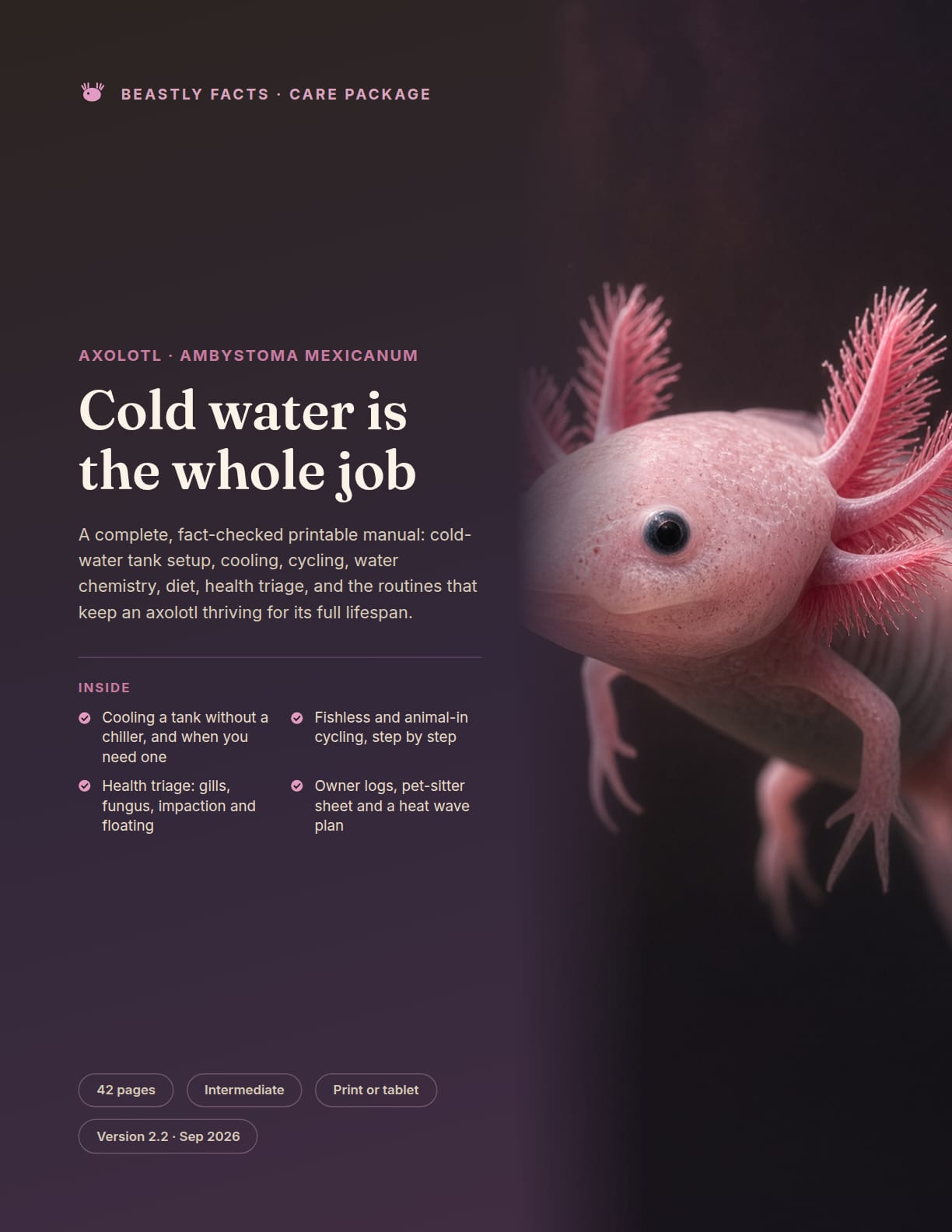
Axolotl Care Package
42 pages · PDF · $8.99
⚖️ Legal Guide
📰 Deep Dive
🦎 How Much Does an Axolotl Really Cost?
🦎 Should You Handle an Axolotl? Only When You Truly Have To
🦎 Common Axolotl Health Issues (Most Trace Back to Temperature)
🦎 Axolotl Tank Setup: Cold Water and No Gravel
🦎 Axolotl Feeding: Schedule, Diet, and the Substrate Mistake That Matters Most
🦎 Axolotl Enrichment: Hides, Foraging, and Safe Novelty
🩺 Health and More
🐠 Aquarium Power Outages, Transport, and Moving Your Fish: The Complete Plan
🦠 How to Cycle a Fish Tank, Start to Finish: Fishless and Fish-In
🧼 Salmonella and Reptile Hygiene: The Rules That Actually Matter
🧽 Aquarium Filtration: How It Actually Works and How to Maintain It
🪣 Aquarium Water Changes: How Much, How Often, and What the Number Is For
🧪 Freshwater pH, GH, and KH: Why Chasing a Number Backfires
🩺 Fish Quarantine and Treatment: The Hospital Tank Guide
🩺 How to Tell If Your Fish Is Sick: Waste, Behavior, and Body Signs
🛁 Tubbing, Cooling, and Salt Baths for Sick Axolotls
🧊 Cooling an Aquarium Without a Chiller
🧪 Amphibian Quarantine, Acclimation, and Water Hardness: The Full Guide
🐾 Four Pets That Break the Usual Mold
⚖️ Four Pets Whose Size Tells You the Wrong Thing
🦎 Tiger Salamander vs. Axolotl: Which Salamander Actually Fits Your Setup
🤩 Fun Facts
🦎 Axolotl Superpowers
Axolotls can regenerate entire limbs, their heart, spinal cord, and even parts of their brain with zero scarring! Scientists study them hoping to unlock regeneration secrets for humans.
🦎 Forever Young, Forever Underwater
Axolotls never grow up in the usual salamander sense. Thanks to a trait called neoteny, they keep their feathery gills and stay fully aquatic for their entire lives, reaching adulthood without ever setting foot on land. Sadly, the wild population now survives in just one place, a shrinking canal system near Mexico City.