Zebra Finch Enrichment: The Wild Flock Is Built from Pairs
On This Page▾

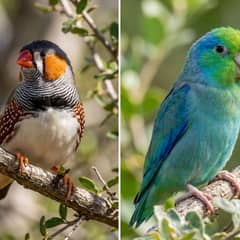
Zebra finches are sold as flock birds, and the wild flock, a few dozen birds to many hundreds, is real. Inside that flock, though, the birds spend the day in pairs and small groups.
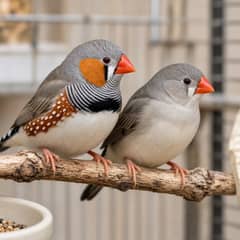
Wild zebra finches forage, drink and travel in pairs, nearly all a male and a female, or in small groups of three to ten. Keep pet birds the same way: two birds or a handful, never one and never a crowd.
A Day in the Australian Scrub
Zebra finches live across most of Australia, in dry savanna and open country with scattered shrubs and small trees, never far from a water hole. They are busy through the day. The flock, a few dozen birds to many hundreds, ranges widely for food and moves on quickly when an area dries out.
Their food is mostly dry grass seed, picked from the ground, with fruit, green plants and insects on top, and the insects matter most when there are chicks to feed. Inside the flock, a male and female pair stays together for life and keeps the bond up with mutual preening. The pair breeds whenever good rain comes, so the chicks hatch as the grass seed ripens, and defends only a small area around its nest. Outside the breeding season, the birds sleep in nests too: old breeding nests or ones built just for roosting, which keep them warm on cold nights.
Each part of that day points to something a pet zebra finch needs: a partner, seed to find on the ground, room to fly, a place to roost, and water to bathe in.
Pairs or Small Groups
Keep two birds, or a handful, not one and not a crowd. A zebra finch should never be housed alone without a compelling veterinary reason. A bigger group is not automatically kinder.
Mixed-sex pairs match the wild pattern most closely and will breed, so choose one only if you want chicks. Same-sex groups avoid that and need enough space, since the birds sort out a pecking order when they meet. Wild finches are seldom seen in single-sex groups, so a same-sex pair is a compromise for the keeper's sake, not the bird's. Going past a handful of birds turns this into colony and aviary keeping, which is a different set of problems.
To add a third bird to a pair, follow this order:
- Put the newcomer through quarantine first, 30 to 45 days in a separate room, because a finch hides illness well and the pair shares one airspace.
- Add a second food dish and water point, and spread the perches, so the dominant bird cannot hold the only station.
- Introduce the birds in a large cage instead of a small one, under close watch.
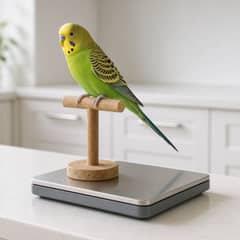
- Watch for a lighter bird being singled out and kept off food. It shows on a perch scale before it shows in the feathers.
- Separate birds that keep fighting.
Forage on the Floor
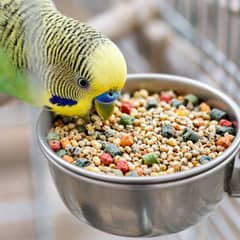
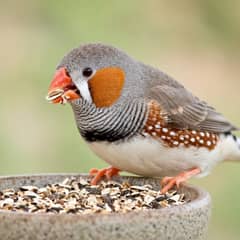
Wild zebra finches feed on the ground, so put some of the food there. Scatter part of the day's seed across a shallow tray set on top of the floor grate, where no perch hangs over it, and empty it daily. Lay a millet spray on the floor one day and hang it from the bars the next, a few times a week at most, so it has to be worked at. Clip washed greens to the bars. Keep the pellet dish full and the seed and treats small. Breeding adults can have a few live insects as well.
These small changes turn a thirty-second meal into an activity.
Flight Length and Perches
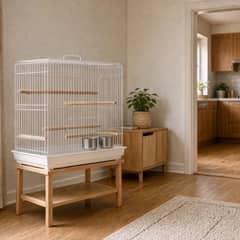
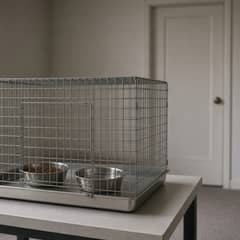
Zebra finches fly. They do not climb. A long flight cage gives them room to do it, and a tall, narrow cage gives them height with nowhere to fly. Keep the center clear so there is a flight path.
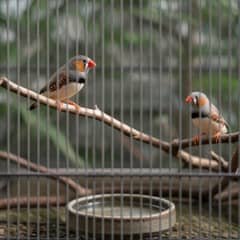
Perches make finches feel secure, but too many block flight. Set perches of varied diameter and natural branch at different heights toward the ends, so the birds can step down to a feeder or the floor. Fix one or two at one end only so they spring a little under the bird, which is exercise in itself. Put one high, about 6 inches below the roof, for roosting.
Nests Are for Breeding Pairs
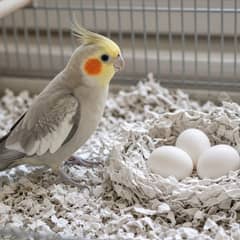
A pair you mean to breed needs a nest site and material to build with, and more nest sites than pairs, because zebra finches defend a nest box hard. Wicker or plastic baskets work. Give dried grass or coconut fiber from a wide-mesh wire basket, a little at a time: given too much, a pair can overfill the nest or even build a new layer on top of its own eggs or chicks. Never use loose fibrous nesting fluff, which wraps around legs and toes. Limit how many clutches, or sets of eggs, a hen raises, since zebra finches are prolific breeders and laying again and again wears her down.
A pair you do not want to breed gets no nest box and no pile of nesting material. They roost on the high perches instead, and a room kept at 65 to 80°F does the job a roosting nest does on a cold night in the wild.
Bathing
A wild zebra finch is never far from a water hole, and a pet pair bathes whenever water is there. Offer a shallow bath at least once a week, more often if they use it.
Toys
A swing, a ladder or a toy with a bell gives the birds something new, as long as it hangs at the edge and never across the flight path.
A Day in Practice
- Morning: fresh pellets and water, a little seed scattered on the floor tray, and the bath in on bath days.
- Midday: quiet. The pair preens, calls and flies the length of the cage.
- Afternoon: greens clipped to the bars and taken out within a couple of hours, or on millet days, a spray to work at.
- Evening: bath out, then lights out on a steady schedule.
How to Tell It Is Working
A pair with enough to do preens each other, calls back and forth, flies the length of the cage, and feeds from the floor as well as the dish. A male sings. The warning signs are feather pecking, a bird sitting fluffed apart from the others, and one bird losing condition. A fluffed bird, or one losing weight, needs an avian vet within about a day. Pecking usually means overcrowding, or a breeding pair short of nesting material, and a bird that keeps plucking the others may have to come out of the group.
Priority Order
- A pair or a small group, not one and not a crowd
- A long flight cage with a clear flight path
- Food on the floor as well as in the dish
- Perches at different heights, with a high roosting perch
- A bath at least once a week
- Nest sites and material, only for a pair you mean to breed
- Toys and new objects, last
Start With the Pair
If you change one thing this week, make sure no finch lives alone. Then put some of the food on the floor and clear the flight path.
Sources & Further Reading
Last reviewed 16 Sep 2026 · 4 sources
Frequently Asked Questions
How many zebra finches should I keep together?
A pair or a small group. Wild birds watched at water holes moved mostly in twos, nearly all male and female, or in small groups of up to ten.
Can a zebra finch live alone, or in a big flock?
Neither suits it. Pairs or small groups match the social life the birds have in the wild, which rules out both solitary housing and a crowded aviary.
Isn't a bigger group better for a social bird?
Not automatically. Wild birds spend the day in pairs and small groups, and a crowded cage means more birds sorting out a pecking order.
Do zebra finches fight?
They form pecking orders, and new birds often squabble until one settles out. Introduce them in a large cage with several feeding stations, and watch that no bird is kept off the food.
What shape of cage do they need?
Long. Zebra finches fly rather than climb, so horizontal distance is what gives them exercise. A tall narrow cage wastes most of its volume on this species.
Should I give them a nest?
Only for a pair you mean to breed. A nest box and nesting material encourage laying, so a pair you do not want to breed gets neither.
Recommended Gear
As an Amazon Associate I earn from qualifying purchases through the links above, at no extra cost to you.

Written by Michael Ryan
Mike keeps two rescued bearded dragons, Dex and Cera, and writes the care guides on BeastlyFacts from his own research and mistakes. He is not a veterinarian.
More about Michael Ryan →You May Also Like



Subscribe - it's free
An occasional email when something new is worth your time. No spam.
Health and More