Zebra Finches Aren't a Hands-On Pet, Either
On This Page▾

Zebra finches cannot be taught to talk, generally cannot be hand-tamed the way a parrot can, and shouldn't be forced into either. What they actually offer is a different, quieter kind of pet entirely.
Not a Hands-On Bird, and That's Normal for This Species
This isn't a training failure on the owner's part, it's how the species is. Lafeber's own zebra finch species profile is direct: these birds are "not really trainable as a parrot type bird is," and are, generally speaking, "hands-off" birds. PetMD's finch care sheet agrees, describing finches as independent birds that "do not enjoy being held" the way parrot species do. Avian veterinarian Susan Clubb's species profile is just as blunt: zebra finches "are not typically hand tamed and do not like handling."
Hand-raised individuals are the exception. With daily socialization from a young age, some hand-raised zebra finches will learn to perch on a finger and tolerate more contact, but breeders rarely raise them this way, and a bird bought from a typical pet store almost certainly hasn't had that early handling. Go in expecting a bird you'll watch and listen to, not one you'll be training to step up, similar in spirit to how our canary handling guide frames that species, though the underlying reason differs: a canary is often kept solo and prized for its song, while a zebra finch's whole social world is meant to be its flock mate, not you.
Why Forcing It Backfires
This matters enough to state plainly. Lafeber's guidance is direct: "Never try to force a finch to be 'friendly,' this will likely terrify and stress the bird." Zebra finches stress easily, and pushing for contact tends to produce a more fearful, harder-to-approach bird instead of a tamer one. Keep the cage out of a loud, high-traffic part of the house, let the birds get used to your presence and voice at their own pace, and treat any interest they show in approaching you as their choice, not something to coax out.
Chatty, Just Not Loud
Zebra finches are far from silent. Lafeber describes their vocalizations as "a lot of 'peeping' and 'beeping' sounds," adding that "they sound like tiny little car horns," not loud, but fairly persistent through the day. That constant, cheerful chatter is largely how a bonded pair or small group communicates with each other, not with you, which is part of why company matters so much more to this species than one-on-one handling does.
Only male zebra finches sing, and they learn their song from a tutor, usually their father, as juveniles. Researchers have leaned on that process heavily: a 2025 study in PLoS One describes the zebra finch as "a widely accepted avian laboratory model species" for vocal learning research, since songbirds and humans share real similarities in how they acquire complex, learned vocalizations. It's a genuine scientific parallel to speech development, just not one that results in an actual talking bird.
Catching a Zebra Finch Safely
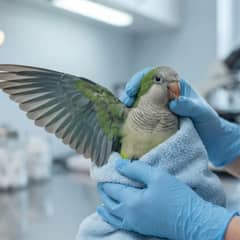
Handling still comes up occasionally, a vet visit, a cage move, an escaped bird. A small, fine-mesh finch net is the gentlest option: let the bird land on a perch, wall, or the cage floor, then carefully slide the net over it rather than chasing it around the cage. In an open room, a lightweight towel draped over the bird works well too and needs less precision than a net. Hold firmly enough to prevent escape but gently, too much pressure will make the bird gasp or squeal, a clear sign to ease up. Never grab or restrain a finch by the tail, it causes real, painful feather loss and won't actually stop the bird from struggling.
What Zebra Finches Want From You
Company of their own kind, a stable and predictable routine, and a keeper who mostly observes rather than handles. That's a genuinely different relationship than a budgie or cockatiel offers, but it's not a lesser one, and reading this species' wellbeing from the outside is largely how you'll be interacting with it day to day.
The Zebra Finch encyclopedia profile covers the wild behavior this all traces back to.
Sources & Further Reading
❓ Frequently Asked Questions
Can zebra finches be hand-tamed like a budgie or cockatiel?
Not reliably. Lafeber's species profile says plainly that a zebra finch isn't trainable the way a parrot type bird is, and PetMD describes finches as independent birds that 'do not enjoy being held.' A hand-raised bird socialized daily may perch on a finger, but that's the exception, not the pet-store norm.
Can zebra finches be taught to talk?
No. Zebra finches are genuine vocal learners, males learn their song from a tutor as juveniles in a process researchers actively compare to how human infants acquire speech, but that learning is limited to their own species-specific song, not mimicry of human words or arbitrary sounds the way some parrots can manage.
Why shouldn't I try to force my zebra finch to bond with me?
Because it backfires. Lafeber's guidance is blunt: 'Never try to force a finch to be friendly, this will likely terrify and stress the bird.' Zebra finches get stressed easily, and forced handling tends to produce a more fearful bird, not a tamer one.
How do I safely catch a zebra finch when I need to?
Use a small, fine-mesh finch net if you have one, letting the bird land before carefully sliding the net over it rather than chasing. A lightweight towel works too in an open room. Never grab or restrain a finch by the tail, it causes painful feather loss and doesn't stop the bird.
Are zebra finches loud?
Not in the piercing, parrot-screech sense, but they are chatty. Lafeber describes their calls as 'a lot of peeping and beeping' that 'sound like tiny little car horns,' not loud, but fairly persistent through the day.
Written by Michael Ryan
Mike keeps two rescued bearded dragons, Dex and Cera, and writes the care guides on BeastlyFacts from his own research and mistakes. He is not a veterinarian.
More about Michael Ryan →Comments
No comments yet - be the first!