Swordtail
Xiphophorus hellerii
On This Page▾
🌍 Overview
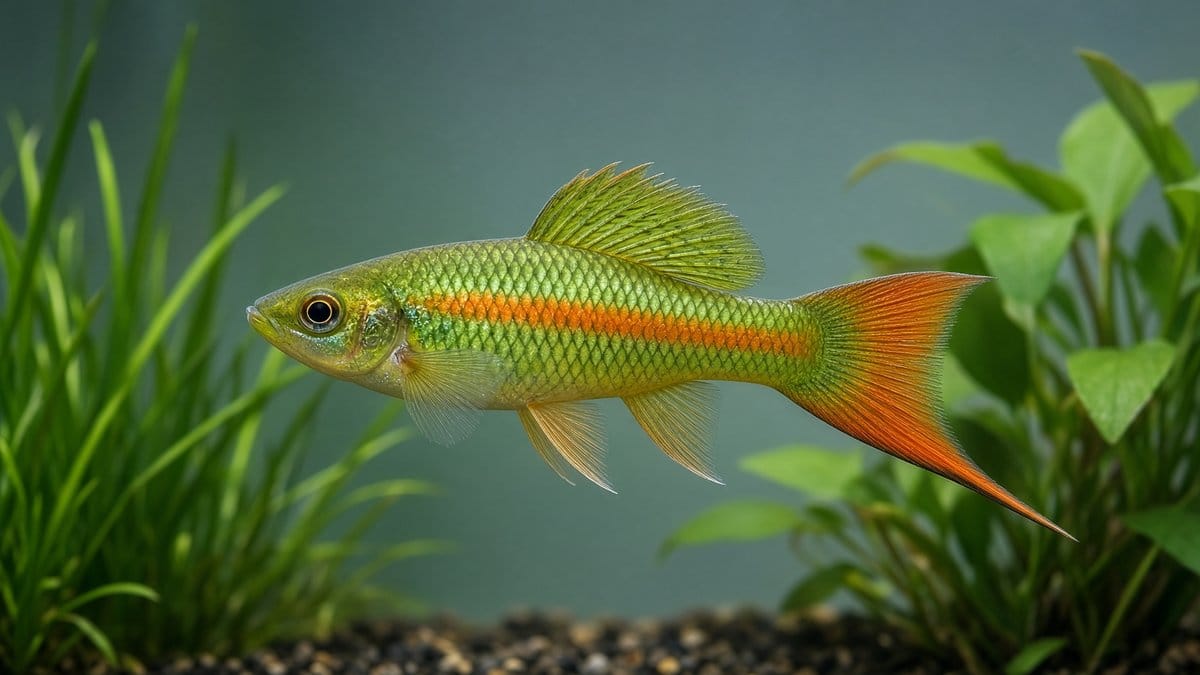
The swordtail is a livebearer native to the Atlantic-slope rivers of Mexico, Belize, Guatemala, and Honduras, and one of the platy's closest relatives, sharing the genus Xiphophorus, Greek for 'sword bearer.' Males grow a long, colorful lower extension of the tail fin, the namesake 'sword,' that plays no role in swimming but is a genuine target of female mate choice, with females showing measurable preferences for males with longer swords and bolder patterning. Swordtails are close enough to platies to interbreed, and the two species have been crossed intentionally for almost a century, so many swordtails and platies sold today already carry some hybrid ancestry. In the wild, swordtails favor faster-flowing streams than platies and are correspondingly more energetic, active swimmers in the aquarium.
📋 Quick Facts
Native Range
Atlantic slope of Mexico, Belize, Guatemala, and Honduras (Veracruz to the Río Usumacinta drainage)
Natural Habitat
Fast-flowing rocky streams, springs, ditches, ponds, and rivers from sea level to 1,500 m; adults favor stronger current than juveniles
Adult Size
Males up to 5.5 inches (14 cm) including the sword; females up to 6.2 inches (16 cm) and typically the larger sex overall
Wild Diet
Aquatic and terrestrial invertebrates, detritus, algae, and plant matter (a generalist omnivore)
Wild Lifespan
3-5 years
Conservation Status
Least Concern (IUCN)
📜 History
The species epithet records a collector. Karl Bartholomaeus Heller, an Austrian naturalist, traveled through Mexico between 1845 and 1848 and brought back the specimens from Orizaba that Johann Jakob Heckel used to describe Xiphophorus hellerii in 1848. Live stocks of the genus have been curated almost continuously since Myron Gordon, who had begun working on these fish at Cornell in 1924, mounted collecting expeditions to Mexico from 1930 onward and founded a dedicated Xiphophorus stock center in 1939, run out of the New York Aquarium and then the American Museum of Natural History. Klaus Kallman took the collection over after Gordon's death in 1959, and it moved to Texas in 1992, where it still maintains pedigreed lines.
⚖️ Compare
Swordtail
Human
Adult Size
Males up to 5.5 inches (14 cm) including the sword; females up to 6.2 inches (16 cm) and typically the larger sex overall
5-6 feet (150-185 cm); ~135-200 lbs
Wild Lifespan
3-5 years
~73 years (global average)
Wild Diet
Aquatic and terrestrial invertebrates, detritus, algae, and plant matter (a generalist omnivore)
Omnivorous - eats just about anything
Native Range
Atlantic slope of Mexico, Belize, Guatemala, and Honduras (Veracruz to the Río Usumacinta drainage)
Global - originated in Africa roughly 300,000 years ago
Natural Habitat
Fast-flowing rocky streams, springs, ditches, ponds, and rivers from sea level to 1,500 m; adults favor stronger current than juveniles
Everywhere from arctic tundra to tropical megacities
Conservation Status
Least Concern (IUCN)
Least Concern (8+ billion and counting)
🧠 Test Yourself
What's the Swordtail's native range?
🤩 Fun Facts
🐠 Females Choose the Longer Sword
A male swordtail's namesake tail extension plays no role in swimming, it's pure ornament. Females show a measurable, well-documented preference for males with longer swords, and a landmark 1990 study found the strength of that preference actually increases as the gap in sword length grows, a textbook case of sexual selection through female choice.
Subscribe - it's free
New animal facts and care guides straight to your inbox. No spam. 🐾
📰 Deep Dive
🐠 How Much Does Swordtail Fish Ownership Really Cost?
🐠 Swordtails Aren't Handled Either, But Ratio Is a Real Handling Decision
🐠 Common Swordtail Health Issues (Including the One That Isn't a Pathogen)
🐠 Swordtail Tank Setup: A Real 29 to 30 Gallons and a Lid That Actually Seals
🐠 Swordtail Feeding: Schedule, Diet, and Why They Stop Eating
🐠 Swordtail Enrichment: Two Males Is the Number That Causes Trouble
🩺 Health and More
🐠 Aquarium Power Outages, Transport, and Moving Your Fish: The Complete Plan
🦠 How to Cycle a Fish Tank, Start to Finish: Fishless and Fish-In
🧽 Aquarium Filtration: How It Actually Works and How to Maintain It
🪣 Aquarium Water Changes: How Much, How Often, and What the Number Is For
🐟 Aquarium Stocking and Tankmates: How Many Fish, and Which Ones Go Together
🧪 Freshwater pH, GH, and KH: Why Chasing a Number Backfires
🤓 Did You Know?
Female swordtails that have already given birth can sometimes go on to develop a sword, male coloring, and even father broods of their own later in life. Hobbyists have reported the switch for generations, and scientists have studied it since the 1930s, though researchers still debate whether it's a true sex reversal or male traits simply emerging late in a fish that was missexed as a juvenile.
Explore More