Rabbit Feeding: Schedule, Diet, and Why They Stop Eating
On This Page▾

A rabbit's gut needs food moving through it all the time, so a rabbit that eats less or passes fewer droppings needs watching from that moment.
Feeding Schedule by Life Stage
- Nursing kits (birth to about 6 weeks): Mother's milk first. A doe nurses only once or twice a day, and each feed lasts under 3 minutes, because her milk is rich enough to carry the kits between visits. Domestic kits are weaned at about 6 weeks.
- Babies (3 to 7 weeks): Unlimited alfalfa hay and alfalfa-based pellets alongside the milk.
- Juveniles (7 weeks to 7 months): Unlimited alfalfa hay and alfalfa-based pellets: the extra calories and calcium support growth. New greens start at about 12 weeks, in small amounts and one new item at a time.
- Young adults (7 months to 1 year): Unlimited grass hay takes over from alfalfa, and pellets come down over several weeks to a measured amount.
- Adults (1 to about 6 years): Unlimited grass hay as 80 to 85% of the diet. About 1/4 cup of high-fiber, timothy-based pellets per 5 to 6 pounds of body weight a day. At least 2 cups of chopped vegetables per 6 pounds, with at least 3 kinds of leafy greens. Fruit stays a small treat.
- Seniors (about 6 years and up): Unlimited grass hay continues. Alfalfa may come back if the rabbit is underweight, with a slightly higher treat allowance, and the vet sets the amounts.
Fresh water needs to be available at all times, by bottle or bowl, at every stage.
A Normal Day
- Morning: fresh hay in the rack and the litter box, enough that some is always left over; the measured pellets; the water bowl washed and refilled.
- Evening: the day's greens, a second top-up of hay, a look at the droppings in the box, and the soiled litter scooped out.
- Once a week: a weigh-in on the kitchen scale, written down.
Splitting the pellets and greens between morning and evening works just as well. What matters is that the hay never runs out.
Portions for Large and Giant Breeds
Pellets and vegetables are measured against body weight, which matters more than usual in a species that runs from about 2.5 pounds to over 20. At about 1/4 cup of pellets and at least 2 cups of chopped vegetables per 6 pounds a day, the numbers work out like this:
| Adult weight | Pellets per day | Vegetables per day |
|---|---|---|
| 3 lbs (dwarf) | About 1/8 cup | At least 1 cup |
| 6 lbs | About 1/4 cup | At least 2 cups |
| 12 lbs | About 1/2 cup | At least 4 cups |
| 18 lbs (giant) | About 3/4 cup | At least 6 cups |
Giants such as the Flemish are prone to obesity, so keep their pellets to the amount in the table, never more, and let hay make up the difference. Hay stays unlimited at every size, and a giant goes through it far faster, so buy it by the box. Water needs climb with body weight the same way, so a giant needs a big, heavy bowl that gets checked and refilled more than once a day.
What Rabbits Eat
Unlimited grass hay is the foundation of the diet at every stage, available around the clock. Alfalfa hay is richer and reserved for babies, juveniles, pregnant or nursing does, and underweight seniors: in a healthy adult its extra calcium and calories can lead to obesity and bladder sludge.
Pellets should be a fresh, high-fiber, plain timothy-based pellet. Colorful mixes with seeds, nuts or dried fruit are linked to obesity and dental disease. Adults get their pellets measured, never free-fed the way hay is.
Rabbits also eat cecotropes, soft, dark night droppings, straight from the body, usually overnight. That is normal and is how they get protein and B vitamins from food on its second pass through the gut.
Fresh leafy greens make up the bulk of the vegetables: romaine, cilantro, parsley, basil, mint, arugula, bok choy and carrot tops, with at least 3 varieties a day and new items introduced one at a time to watch for soft stool. Parsley, kale, spinach and dandelion greens are high in calcium, so rotate them in and out rather than feeding them every day. Bell pepper, cucumber and carrots count toward the same total in smaller amounts, about 1 tablespoon per 2 pounds of body weight a day, since they carry more sugar and starch than their reputation suggests. Fruit is a treat: no more than about 1 teaspoon per 2 pounds of body weight a day. Wash all vegetables for a couple of minutes in several changes of water, because the RHDV2 virus can travel on food.
Change the diet gradually. Keep a new rabbit on the food it was eating before it came home, then mix in the new food a little more each day, and add new vegetables one at a time. A sudden switch of hay, pellet brand or vegetables can upset the bacteria in the cecum and trigger soft stool or GI stasis.
Water
A rabbit drinks a little under 2 fluid ounces of water per pound of body weight a day, roughly twice what a dog or cat of the same size drinks, so a 6 pound rabbit takes about 11 ounces. Rabbits drink more from an open bowl than from a sipper bottle, so a heavy, flat-bottomed bowl is the better default. A rabbit whose chin stays sore and damp from a bowl, once the vet has ruled out a tooth problem, does better with a bottle, and since rabbits chew the valve of a bottle, one with a stainless steel valve lasts longest. Whichever you use, change the water every day, and wash a bowl rather than topping it up.
Safe Treats and Foods to Avoid
Safe as treats, within the fruit amount above: small pieces of apple (no seeds or stem), banana, strawberry or blueberry.
Toxic, never feed: avocado (can cause respiratory distress and fatal heart failure), chocolate, onions, garlic, and chives (can cause hemolytic anemia), and rhubarb (high oxalic acid, linked to kidney damage). Iceberg lettuce is not toxic but has little nutritional value and can upset the gut in quantity. Skip processed human foods too: bread, crackers, cereal, and yogurt drops, even the ones sold as rabbit treats.
Weight and Body Condition
Rabbits pick the richest parts of a meal and leave the fiber, which is why they gain weight easily on pellets, fruit, and treats.
Weigh a rabbit once a week on a kitchen scale that reads in grams, and write the number down. Set a box on the scale, zero it, and put the rabbit in. A rabbit too heavy for a kitchen scale goes on a bathroom scale: weigh yourself holding it, then alone, and subtract. A change in weight is often the first sign of illness, and a slow drift is easy to miss by eye. Once a month, feel the body as well, because a thick coat hides fat. Body condition is scored on a 9-point scale, and 4 to 5 is the usual ideal for an adult.
| Score | What the hands find |
|---|---|
| 1 to 3, thin | Ribs, spine, and hips feel sharp under little or no padding. The back is flat or sunken, and the belly is tucked up. |
| 4 to 5, ideal | Ribs and spine are easy to feel with gentle pressure under a light, even layer. The back is gently rounded, the rump feels firm and filled, and the belly has a slight tuck. |
| 6 to 7, overweight | Ribs and spine take firm pressure to find. The back is broad and rounded, the dewlap is noticeably padded, and the belly has lost its tuck. |
| 8 to 9, obese | Ribs and spine are very hard or impossible to feel. The rump bulges, the dewlap is large and folded, and the belly sags. |
A home score is an estimate. Anything outside 4 to 5, or any doubt, is a question for a rabbit-experienced vet before the diet changes, and weight alone cannot show whether a change is fat or muscle. Make any weight change gradual, and never cut food so far that a rabbit stops eating, because that is how GI stasis starts.
Why Rabbits Stop Eating
- GI stasis. The gut slows or stops, one of the most common life-threatening emergencies in pet rabbits. It usually follows low fiber, dehydration, pain or stress, and it feeds on itself once it starts.
- Dental disease. Rabbit teeth grow continuously, and they overgrow fast when hay runs short. Overgrown teeth or spurs can cut the mouth or make chewing painful. It is one of the most frequent causes of appetite loss, and it can build without obvious signs.
- Stress. New housing, a new pet in the household, loud noises or a change in handling can all set it off, even when the cause seems minor.
- An abrupt diet change. Switching hay, pellet brand or vegetables too quickly can put a rabbit off its food or cause soft stool.
- Pain from an unrelated illness. Urinary tract disease, gas, respiratory infection, or reproductive disease can all cause secondary appetite loss.
- Fur ingestion during a heavy molt. Swallowed fur combined with dehydrated gut contents can form a hard-to-pass mass. Regular brushing during molts helps prevent it.
- Certain medications. Some drugs used to treat other conditions can themselves slow gut motility as a side effect.
When to Worry
Rabbits eat around the clock, so any clear drop in eating or droppings is urgent, and the watching starts with the first meal left behind. A rabbit that has eaten nothing and passed no droppings for 8 hours needs a call to the vet, and at 12 hours it is an emergency. Past about 24 hours without food, fatty liver disease becomes a risk.
In a rabbit that is eating less, some signs mean calling the vet now rather than waiting out the 8 hours: droppings that have stopped since the last check, or droppings that are small, misshapen or strung together with mucus; a hunched or tense posture; audible tooth grinding; a bloated or tense abdomen; lethargy; drooling; drinking less; and ears that feel cold. About 70% of rabbits survive GI stasis, and most uncomplicated cases resolve with veterinary treatment over three to five days. Delayed cases can need days in the hospital, so early treatment matters.
Hay First, Every Day
A rabbit that always has hay in front of it and gets its pellets measured is one whose owner hears about trouble early. The hay rack and the litter box are the two places to look every day.
Sources & Further Reading
Last reviewed 3 Oct 2026 · 6 sources
- House Rabbit Society: Healthy Rabbit Diet, for the amounts by weight, the life stages and washing vegetables
- Rabbit.org: the food and diet, and GI stasis pages
- PetMD: the Flemish giant rabbit page, and the GI stasis page for the eight-hour figure, the roughly 70% survival rate, and the three to five day recovery
- Merck Veterinary Manual: the housing, nutrition, and management of rabbits pages, for pellet amounts, water intake, bowl versus bottle, and nursing and weaning
- NC State College of Veterinary Medicine: Caring for Your Pet Rabbit
- Association for Pet Obesity Prevention: Rabbit Body Condition Score Chart
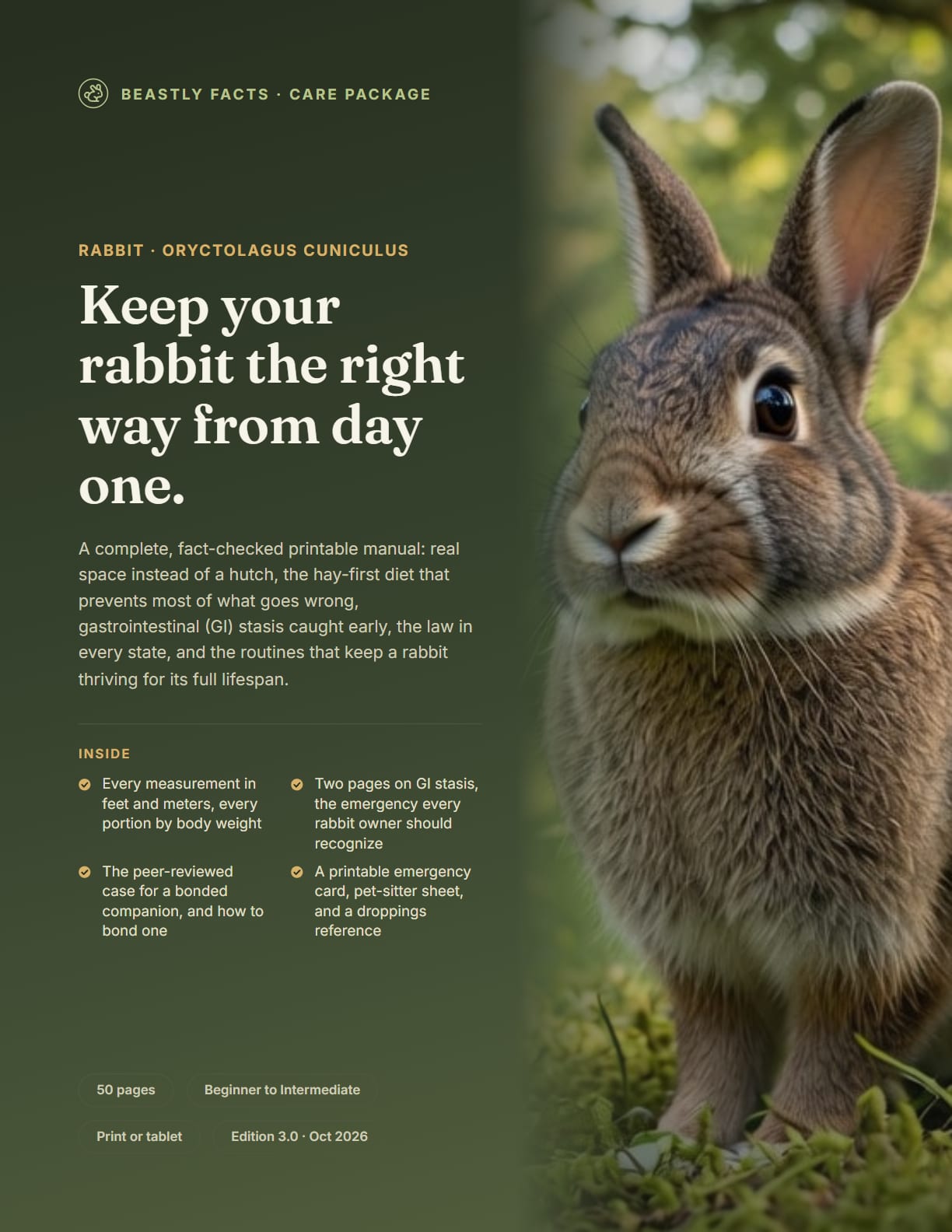
The Rabbit Care Package puts the feeding section, an owner log and a pet-sitter sheet on paper, in a 50-page PDF you can keep by the housing, $8.99. Includes the Universal Pet Kit free: a routine chart and feeding log you can fill in.
Frequently Asked Questions
How much hay does a rabbit need?
Unlimited, around the clock: grass hay makes up 80 to 85% of an adult's diet. It keeps the gut moving and wears down teeth that never stop growing.
How much pellet food and vegetables should I feed?
About 1/4 cup of plain timothy pellets and at least 2 cups of chopped vegetables a day for every 6 pounds the rabbit weighs. A 3 pound dwarf gets half that, and an 18 pound giant three times as much.
Can adult rabbits eat alfalfa hay?
Not as a staple. Alfalfa is for growing, breeding and underweight rabbits; a healthy adult eats a grass hay such as timothy, orchard, oat or brome, since alfalfa's extra calcium can lead to bladder sludge.
Why has my rabbit stopped eating?
Dental pain is one of the most common reasons, and it is easy to miss. Stress, a sudden diet change and pain from another illness are the others to rule out, and any of them can tip a rabbit into GI stasis.
How long can a rabbit safely go without eating?
Not long. Call the vet at 8 hours with no food or droppings; by 12 hours it is an emergency, and a fast of more than about a day risks fatty liver disease.
What foods are dangerous for rabbits?
Avocado, chocolate, onions, garlic, chives and rhubarb. Skip yogurt drops and other processed treats too, even the ones sold for rabbits.


Recommended Gear
As an Amazon Associate I earn from qualifying purchases through the links above, at no extra cost to you.

Written by Michael Ryan
Mike looks after his sister’s rabbit, Otis, for weeks at a time.
Mike keeps two rescued bearded dragons, Dex and Cera, and writes the care guides on BeastlyFacts from his own research and mistakes. He is not a veterinarian.
More about Michael Ryan →You May Also Like

Subscribe - it's free
An occasional email when something new is worth your time. No spam.
Health and More