Hamster
Small Mammals
The pouch-stuffing solo escape artist that needs way more space than the pet store box!
On This Page▾
🤓 Did you know? A hamster's cheek pouches can stretch back past its shoulders when fully packed with food, holding roughly a fifth of the hamster's own body weight.

🗓️ The first week
The numbers a new owner needs in the first week, each from the article it links to. Rows with no link come from the encyclopedia.
- Legal
- Legal in every US state except Hawaii, which bans hamsters outright with no permit route.Legal guide →
- Enclosure
- Roughly 700 to 775 square inches of unbroken floor for a Syrian, around 600 for dwarf species, more always better. Bar spacing no more than 1/2 inch for Syrians, 1/4 inch for smaller species.Setup guide →
- Temperature
- 65 to 75°F, held steady. Under 60°F risks torpor, a hibernation-like state; over 80°F risks heat stress.Setup guide →
- Bedding
- At least 6 inches of dust-free paper bedding or aspen shavings, a welfare requirement, not decoration. Never cedar or pine.Setup guide →
- Wheel
- Solid surface, no rungs. 8 to 11 inches for a Syrian, 6 to 8 for a dwarf. Too small forces an arched running posture that's hard on the spine.Setup guide →
- Sand bath
- A dust-free, non-clumping sand bath is a species essential, not an extra, for working coat and skin oils out.Setup guide →
- Company
- Syrian hamsters are strictly solitary, and housing two together leads to fighting. This is one of the most common and preventable hamster-owner mistakes there is.Handling guide →
- Diet
- A nutritionally complete hamster pellet or lab block as the staple, not a loose seed mix. Small daily fresh vegetables, under about 10% of the diet combined with fruit.Feeding guide →
- Not eating
- 6 to 12 hours without eating is worth watching, 12 to 24 hours warrants a vet call, 24+ hours is critical, 48+ life-threatening. A day of no visible eating can also just mean a hamster is working through a cheek-pouch hoard.Feeding guide →
- Handling
- Let it wake up and orient itself before reaching in, never grab from above. Scoop from below with both hands. Syrians are the easiest to handle; dwarfs and Roborovski are faster and more nip-prone.Handling guide →
- Budget
- $15 to $25 for a Syrian ($8 to $30 for dwarfs, $5 to $15 rescue). $150 to $350 to set up. $15 to $50 a month.Cost guide →
- Adult size
- 5 to 7 inches, 4 to 7 oz.
- Lifespan
- A large veterinary study found a median age at death of 1.75 years. Syrians tend toward 2 to 3 years, dwarf species often 1.5 to 2.5.Cost guide →
🚨 Emergency card
Call the vet now if you see any of these.
- Watery diarrhea or a wet, matted rear end (wet tail, fatal within 24 to 48 hours untreated)
- Dropped food or drooling
- Sudden weight loss
- A lump or growth
- Labored breathing
An exotic vet, found before you need one. Wet tail is a same-day emergency, not a wait-and-see situation; most of the rest of this list is prevented through clean, dust-free bedding and a stress-free setup.
📰 Where to go next
How Much Does a Hamster Really Cost?
$15 to $30 for the animal, $150 to $350 to set up, and what a median 1.75-year lifespan means for the budget.
Hamster Enclosure Setup: Bigger and Deeper Than the Starter Kit Suggests
The real floor space (bigger than any starter kit), bar spacing, bedding depth, wheel size, and the sand bath most kits skip.
Hamster Feeding: Schedule, Diet, and Why They Stop Eating
Free-choice versus scheduled feeding, safe and toxic foods, and how to tell cheek-pouch hoarding from real appetite loss.
How to Handle a Hamster (And Why the Species Matters More Than You'd Think)
Why species matters more than you'd think, the correct scoop-from-below technique, and why waking a sleeping hamster gets you bitten.
Common Hamster Health Issues (Wet Tail Is the One to Know)
Wet tail, overgrown incisors, tumors, respiratory infections, and diabetes in dwarf species.
Hamster Enrichment: The Bedding Depth Study Everyone Should Know
The bedding-depth study behind the numbers above, correct wheel sizing, and what wire-gnawing actually means.
🛒 What to buy
Prices and the reasoning behind each item are in How Much Does a Hamster Really Cost?.
❓ Frequently Asked Questions
What size enclosure does a hamster need?
Current welfare guidance puts a Syrian at roughly 700 to 775 square inches of unbroken floor, and dwarf species near 600, with more always better. A 40-gallon breeder suits dwarfs; a Syrian wants something closer to a 75-gallon.
What is wet tail and why is it so dangerous?
Wet tail (proliferative ileitis) is a bacterial condition tied to stress that a large veterinary study found to be both the most common diagnosed condition and the leading specific cause of death in pet hamsters, present in roughly 7 to 8% of hamsters studied. It hits young Syrians between 3 and 10 weeks old hardest and can be fatal within 24 to 48 hours without treatment, making it a same-day emergency, not a wait-and-see situation.
Can two Syrian hamsters be housed together so they have a friend?
No. Syrian hamsters are strictly solitary, and housing two together leads to fighting. This is one of the most common and preventable hamster-owner mistakes there is.
📚 Encyclopedia
Hamster
Mesocricetus auratus
Subscribe - it's free
New care guides straight to your inbox. No spam. 🐾
🖨️ Printable Guide
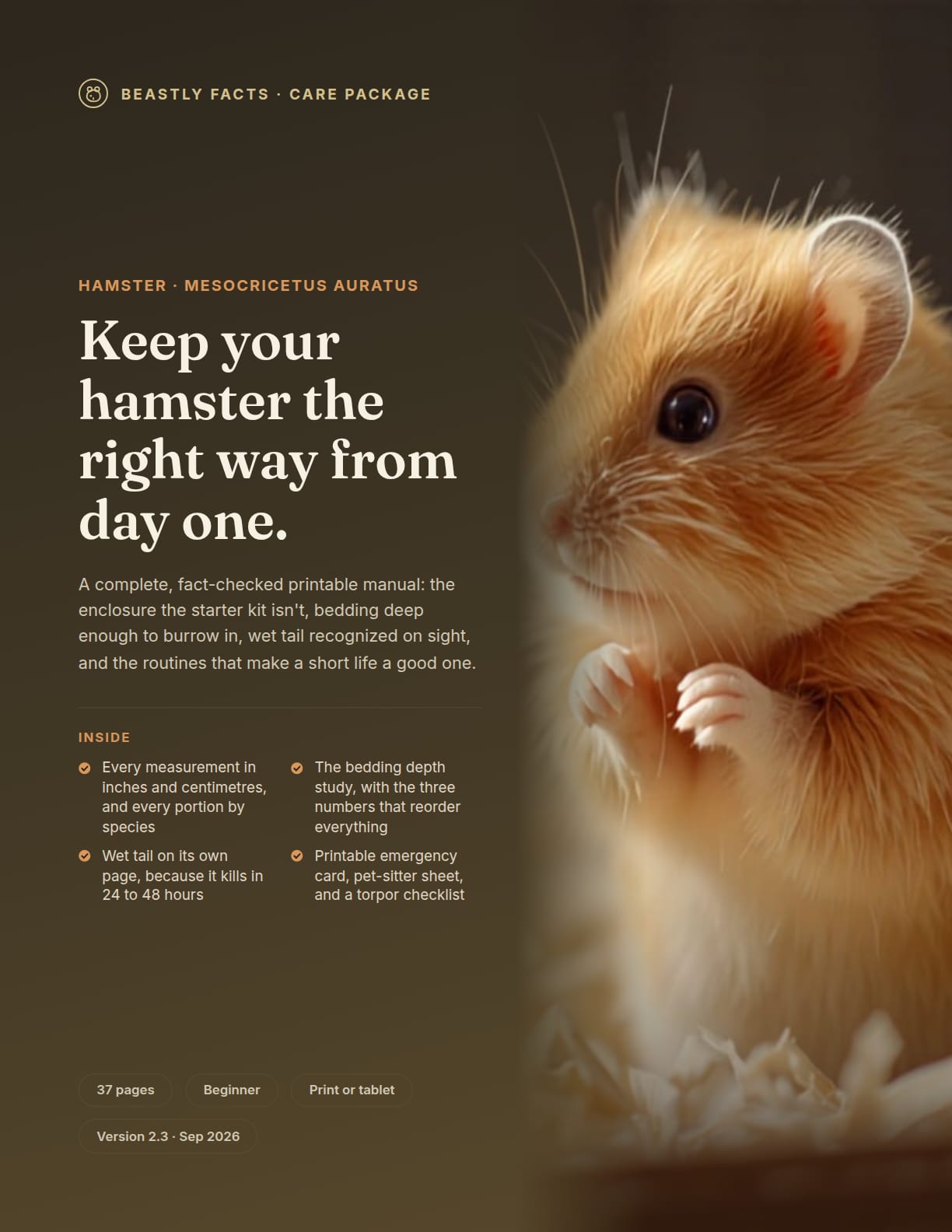
Hamster Care Package
37 pages · PDF · $8.99
⚖️ Legal Guide
📰 Deep Dive
🌰 How Much Does a Hamster Really Cost?
🌰 How to Handle a Hamster (And Why the Species Matters More Than You'd Think)
🌰 Common Hamster Health Issues (Wet Tail Is the One to Know)
🌰 Hamster Enclosure Setup: Bigger and Deeper Than the Starter Kit Suggests
🐹 Hamster Feeding: Schedule, Diet, and Why They Stop Eating
🐹 Hamster Enrichment: The Bedding Depth Study Everyone Should Know
🩺 Health and More
💊 Antibiotic-Associated Enterotoxemia: The Small Mammal Danger Most Vets Don't Warn You About
🌡️ Heat Stress and Cold in Small Mammals: Temperature Ranges and Emergency Signs
🩺 Getting a Small Mammal to the Vet: Carriers, Car Travel, and Anesthesia
✂️ Grooming, Nails, and Molting in Small Mammals
🎓 Four Pets, Four Different Lessons
🐹 Chinchilla vs. Hamster: Which Small Pet Fits Your Commitment Level