Betta Fish
Fish
The flowing-finned solo showoff that thrives in its own space and recognizes its keeper!
On This Page▾
🤓 Did you know? Wild betta fish live in shallow rice paddies and slow-moving water that can run low on oxygen, so they evolved a labyrinth organ that lets them gulp air directly from the surface. Males also build floating bubble nests out of saliva-coated air bubbles to hold their eggs - a behavior captive males will still perform even without a female present.

🗓️ The first week
The numbers a new owner needs in the first week, each from the article it links to. Rows with no link come from the encyclopedia.
- Tank size
- 5 gallons, heated and filtered, is the real minimum. Not the bowls or unheated cups bettas are often sold in.Setup guide →
- Heater and filter
- A 15 to 25 watt adjustable heater holding a stable 76 to 82°F, 78 to 80°F the sweet spot. A gentle, low-flow filter such as a sponge filter, since a betta's long fins can't handle strong current.Setup guide →
- Water parameters
- Ammonia and nitrite at 0 ppm with no safe nonzero reading for either, nitrate under 20 ppm, pH 6.5 to 7.5. Weekly water changes of 25 to 30%, always with a dechlorinator.Water guide →
- Cycling
- Cycle the tank before adding the fish. A fishless cycle typically takes 4 to 6 weeks at a stable warm temperature.Cycling guide →
- Feeding schedule
- 2 to 4 small, high-protein betta pellets, once or twice a day, no more than would fit in the size of the fish's eye. Fast one day a week.Feeding guide →
- Not eating
- A healthy adult can physically survive up to about two weeks, but that's an emergency ceiling, not a target. Start investigating around 5 to 7 days of refused food, sooner with a swollen belly, clamped fins, or lethargy.Feeding guide →
- Handling
- Never bare hands, it strips the protective slime coat on contact. Move the fish with a net or a cup. Float a new bag about 15 minutes before release so temperatures can equalize.Handling guide →
- Budget
- $5 to $30 for the fish, up to about $55 for rare varieties. $100 to $300 for a full setup. $10 to $25 a month after that.Cost guide →
- Adult size
- 2.5 to 3 inches.
- Lifespan
- 2 to 4 years typical, up to 5 years in captivity with excellent care.
- Tankmates
- One male, alone or with corydoras, mystery snails, ghost shrimp or small tetras. Never tiger barbs, any nipper, or a long-finned fish. A female sorority needs 10 gallons and cover.Aquarium Stocking and Tankmates →
- Ich
- White spots: raise the tank slowly to 86°F with an air stone, inside this species' range, and hold it two weeks. Or a tablespoon of aquarium salt per 5 gallons. Quarantine 30 days after.Treating Ich →
- Quarantine
- At least 30 days in a bare hospital tank before joining others. Thirty days is the floor, not the target.Quarantine guide →
- Power outage
- Oxygen loss is the fast danger, not the cold or the dark. Aerate right away with a battery air pump, or agitate the surface by hand roughly every 10 to 15 minutes in a small tank. A betta's transport bag needs far more air than a typical fish bag, since it breathes air directly through its labyrinth organ.Power outage guide →
🚨 Emergency card
Test the water and temperature first, then act on these the same day.
- Raised, pinecone-like scales (dropsy), a poor prognosis but worth same-day contact with an aquatic vet
- Pale or greyish saddle-shaped patches, ragged fin edges, or a cottony fuzz (columnaris)
- A fine gold or rust-colored dusty sheen (velvet), which moves fast and can kill quickly
- Buoyancy problems that do not clear after a 2 to 3 day fast
- Any illness that does not improve once water quality and temperature are corrected
An aquatic vet, found before you need one, for the serious or unclear cases. Most of this list is prevented by a heated, filtered, cycled tank.
📰 Where to go next
How Much Does a Betta Fish Really Cost?
$5 to $30 for the fish, a $100 to $300 setup, and $10 to $25 a month after that.
Betta Fish Tank Setup: Bigger, Warmer, and Cycled
The 5-gallon minimum, the heater and sponge filter that actually fit a betta's fins, and cycling before the fish goes in.
Betta Fish Water Parameters: The Numbers That Actually Matter
The target ranges for temperature, pH, ammonia, nitrite, and nitrate, and the testing schedule that actually catches trouble early.
Betta Fish Feeding: Schedule, Diet, and Why They Stop Eating
Portion size relative to the fish's own eye, safe treats and foods to avoid, and the honest range of reasons a betta stops eating.
How to Handle a Betta Fish (Hint: You Mostly Don't)
Why bare hands strip the slime coat, safe net and cup transfers, and how to read stress signs from a distance instead.
Common Betta Fish Health Issues (And Why Water Quality Comes First)
Fin rot, ich, velvet, columnaris, swim bladder disorder, dropsy, and why water quality is almost always the first fix.
Betta Enrichment: Three Studies, and a Mirror Is Not a Toy
What three published studies say about space and planting, and why a mirror is a stress test, not a toy.
🛒 What to buy
Prices and the reasoning behind each item are in How Much Does a Betta Fish Really Cost?.
❓ Frequently Asked Questions
What size tank does a betta fish need?
Five gallons is the current standard minimum, a genuine improvement over older bowl-based advice. Bettas can technically survive in smaller volumes, but bigger tanks are easier to keep stable since temperature and water chemistry swing less in more water. Always use a lid, bettas are surprisingly good jumpers.
Why won't my betta eat?
Most commonly it's stress from a recent move or tank change, pickiness about a new food, or water that's too cold or of poor quality. Bettas need water in the roughly 76 to 82°F range, cooler water slows their metabolism and appetite noticeably. Check water quality and temperature before assuming anything more serious.
What should I do before reaching for medication?
Test and correct water quality and temperature first. A heated, filtered tank on a consistent water-change schedule is what makes a huge share of betta illness resolve or never start. Most cases never need an aquatic vet, though one is worth finding for a serious or unclear illness.
📚 Encyclopedia
Betta Fish
Betta splendens
Subscribe - it's free
New care guides straight to your inbox. No spam. 🐾
🖨️ Printable Guide
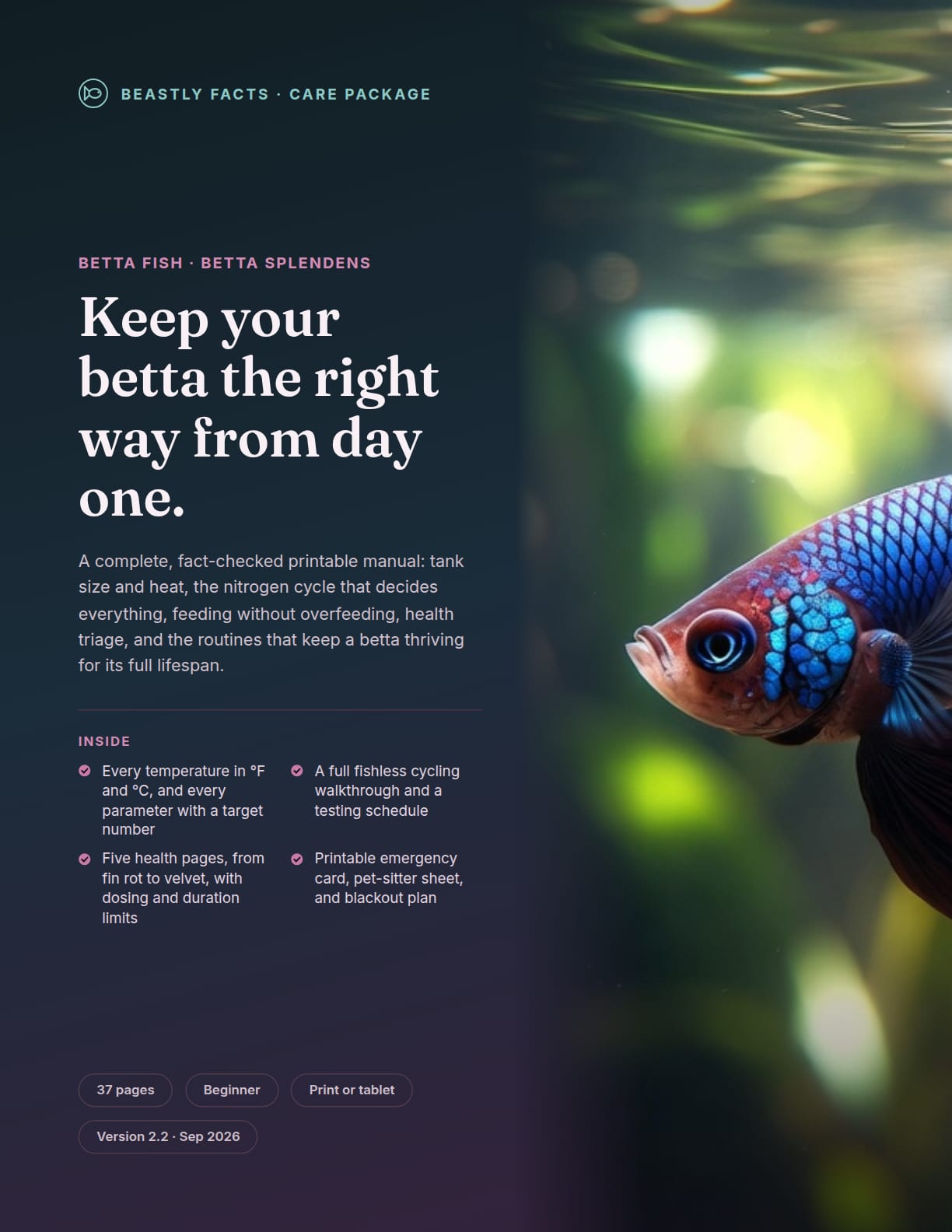
Betta Fish Care Package
37 pages · PDF · $8.99
📰 Deep Dive
🐠 How Much Does a Betta Fish Really Cost?
🐠 How to Handle a Betta Fish (Hint: You Mostly Don't)
🐠 Common Betta Fish Health Issues (And Why Water Quality Comes First)
🐠 Betta Fish Tank Setup: Bigger, Warmer, and Cycled
🐠 Betta Fish Feeding: Schedule, Diet, and Why They Stop Eating
🐠 Betta Enrichment: Three Studies, and a Mirror Is Not a Toy
🩺 Health and More
🐠 Aquarium Power Outages, Transport, and Moving Your Fish: The Complete Plan
🦠 How to Cycle a Fish Tank, Start to Finish: Fishless and Fish-In
🧽 Aquarium Filtration: How It Actually Works and How to Maintain It
🪣 Aquarium Water Changes: How Much, How Often, and What the Number Is For
🐟 Aquarium Stocking and Tankmates: How Many Fish, and Which Ones Go Together
🧪 Freshwater pH, GH, and KH: Why Chasing a Number Backfires
🩺 Fish Quarantine and Treatment: The Hospital Tank Guide
🩹 Treating Ich: Heat, Salt or Medication, and the Temperature Ceiling That Decides
🩺 How to Tell If Your Fish Is Sick: Waste, Behavior, and Body Signs
🧊 Cooling an Aquarium Without a Chiller
⚖️ Four Pets You Only Really Understand by Comparison
🔑 Four Pets With One Rule Each Worth Knowing First
🐠 Betta Fish vs. Goldfish: Which Beginner Fish Fits You Better