Guppy
Poecilia reticulata
On This Page▾
🌍 Overview
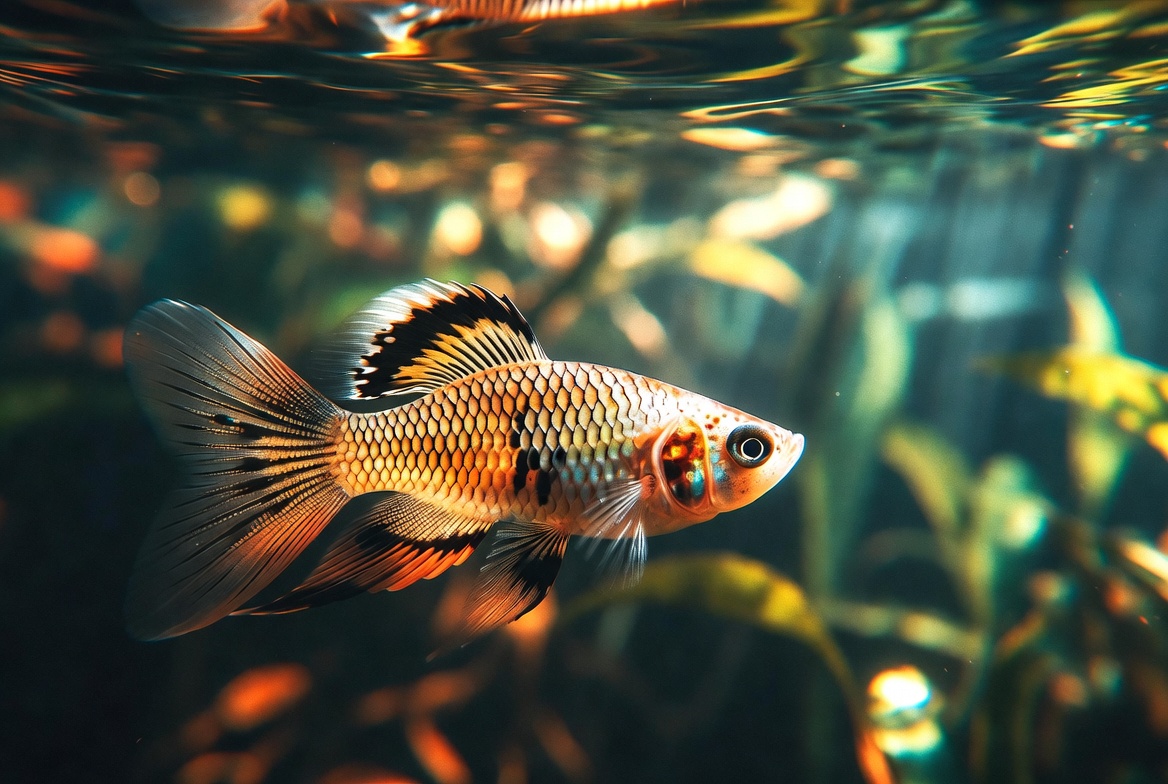
The guppy is a small, prolific livebearing fish native to the streams and rivers of northeastern South America and the Caribbean. Named after naturalist Robert John Lechmere Guppy, who submitted specimens to the British Museum in the 1860s, guppies have since become one of the most widely kept and selectively bred aquarium fish in the world, with countless color and finnage varieties developed by hobbyists. They have also been introduced globally as a natural mosquito-control agent, since they readily eat mosquito larvae.
📋 Quick Facts
Native Range
Northeastern South America and the Caribbean (Venezuela, Trinidad, Guyana, Brazil)
Natural Habitat
Freshwater streams, ditches, and slow-moving rivers
Adult Size
1-2.4 inches (2.5-6 cm); males smaller than females
Wild Diet
Mosquito larvae, algae, small invertebrates, and detritus
Wild Lifespan
2-3 years
Conservation Status
Least Concern (IUCN)
📜 History
The common name honors a man whose scientific name lost. Wilhelm Peters had already described the species from Venezuela as Poecilia reticulata in 1859, seven years before Albert Gunther coined Girardinus guppii, so the honorific was a junior synonym almost from the start. The fish also passed through Lebistes reticulatus, assigned by Charles Tate Regan in 1913, before Rosen and Bailey restored the original name in 1963. In the late 1970s John Endler moved guppies from a predator-heavy stretch of Trinidad's Aripo River to a site upstream that predators could not reach, and the color patterns of the transplanted population shifted measurably, giving field biology one of its standard demonstrations of selection at work.
⚖️ Compare
Guppy
Human
Adult Size
1-2.4 inches (2.5-6 cm); males smaller than females
5-6 feet (150-185 cm); ~135-200 lbs
Wild Lifespan
2-3 years
~73 years (global average)
Wild Diet
Mosquito larvae, algae, small invertebrates, and detritus
Omnivorous - eats just about anything
Native Range
Northeastern South America and the Caribbean (Venezuela, Trinidad, Guyana, Brazil)
Global - originated in Africa roughly 300,000 years ago
Natural Habitat
Freshwater streams, ditches, and slow-moving rivers
Everywhere from arctic tundra to tropical megacities
Conservation Status
Least Concern (IUCN)
Least Concern (8+ billion and counting)
🧠 Test Yourself
What's the Guppy's native range?
Subscribe - it's free
New animal facts and care guides straight to your inbox. No spam. 🐾
📰 Deep Dive
🐠 How Much Does Guppy Ownership Really Cost?
🐠 Guppies Aren't Handled, But They Do Need a Population Plan
🐠 Common Guppy Health Issues (Water Quality Is the Root of Almost Everything)
🐠 Guppy Tank Setup: Warm Water, Gentle Filtration, and a Plan for Fry
🐠 Guppy Feeding: Schedule, Diet, and Why They Stop Eating
🐠 Guppy Enrichment: The Sex Ratio Is a Welfare Decision
🩺 Health and More
🐠 Aquarium Power Outages, Transport, and Moving Your Fish: The Complete Plan
🦠 How to Cycle a Fish Tank, Start to Finish: Fishless and Fish-In
🧽 Aquarium Filtration: How It Actually Works and How to Maintain It
🪣 Aquarium Water Changes: How Much, How Often, and What the Number Is For
🐟 Aquarium Stocking and Tankmates: How Many Fish, and Which Ones Go Together
🧪 Freshwater pH, GH, and KH: Why Chasing a Number Backfires
🤓 Did You Know?
Guppies are livebearers, meaning females give birth to free-swimming fry rather than laying eggs, and a single female can store sperm from one mating to produce several broods of 20 to 50+ fry over the following months. The species is named after Robert John Lechmere Guppy, who submitted specimens from Trinidad to the British Museum in the 1860s.
Explore More