How to Handle a Hedgehog
On This Page▾

A hedgehog lives alone, sleeps through the day and meets a strange hand by rolling into a ball of spines. None of that makes it a bad pet to hold. It means handling is something you build up to, in the evening, a little at a time.
Can You Hold a Hedgehog With Bare Hands?
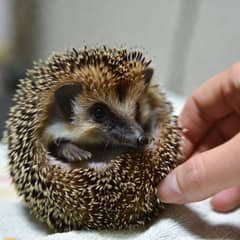
Yes. A hedgehog carries around 5,000 to 7,000 quills. They are smooth and have no barbs, so they do not stick in your skin the way a porcupine's would. What you feel depends on the hedgehog's mood. A balled-up hedgehog with its quills raised can poke hard enough to hurt bare hands, and a calm one that has unrolled is easy to hold.
Two reasons to cover your hands anyway:
- Comfort. A small towel or a piece of fleece under a nervous hedgehog takes the sting out while it learns you are safe.
- Skin fungus. Hedgehogs can carry ringworm fungi, which is why vets recommend gloves for handling one.
Hygiene Every Time
Hedgehogs often carry Salmonella while looking healthy.
- Wash your hands with soap and water right after every session, and after cleaning the cage.
- Do not kiss or snuggle a hedgehog against your face.
- Do not eat or drink while you handle it.
- Hedgehogs are not recommended for homes with children under 5.
How to Pick Up a Hedgehog
- Wait for evening. Hedgehogs are nocturnal, so night is the best time to interact. One woken at midday will be defensive.
- Let it smell your hand first.
- Slide both hands, flat or cupped, under its sides and belly, as if scooping with a shovel. Do not grip from above.
- Lift it and hold it low over your lap or a soft surface.
- Hold still and wait. A healthy hedgehog, even a shy one, unrolls and starts to explore when it feels safe.
Never force a ball open. It does not work, and it teaches the hedgehog that being held means being restrained, which makes the next session harder. A towel that carries your scent can help a nervous hedgehog settle.
What the Sounds and the Ball Mean
A hedgehog breathes silently. Hissing, huffing, and clicking or popping sounds are all defensive, and so is rolling up. They are reflexes, not aggression, and not a sign you are doing something wrong. They fade as the hedgehog gets used to your smell and your hands.
Building Trust
- Handle the hedgehog every evening. Short and regular beats long and rare.
- Start young where you can. Hedgehogs handled from an early age make the most interactive pets.
- Leave it alone in the daytime, when it needs to sleep.
- Let it walk across your lap and hands instead of holding it still.
A hedgehog tolerates handling more than it seeks it out. Its nighttime habits and its tendency to roll up limit how much play it will accept, and knowing that sets fairer expectations than the pet store shelf does.
Self-Anointing
When a hedgehog meets a new or interesting smell, it may froth at the mouth and twist around to spread the foamy saliva over its own quills. This is called self-anointing. It looks alarming the first time, and it is normal behavior, not a seizure or a sign of poisoning.
Wash your hands afterward before you touch your eyes or mouth.
Quilling
Baby quills, called nest spines, are shed at about a month old and replaced by permanent spines. Each permanent spine is later shed on its own, one at a time. A hedgehog that is quilling is often grumpier and balls up more. That passes, typically within about a month, and it is not a setback in training. Grumpiness is expected. Going off food is not, and 24 hours without eating is a vet call whatever else is going on.
Telling Males From Females
The hard part is getting the hedgehog to uncurl. Once it does, look at the belly.
- Male: the penis sits in a sheath on the middle of the belly, about 5 to 6 cm in front of the anus, where it looks like a large belly button.
- Female: a smooth belly with no "belly button." The vulva sits only about a centimeter from the anus.
House either sex alone. Hedgehogs are solitary, and males in particular will fight, sometimes to the death.
Check as You Handle
Handling time is also your health check.
- Weigh it once a week. Set a bowl on a kitchen scale that reads in grams, put the hedgehog in it and write down the number.
- Look at the toes. Hairs and threads wrap around them and can cut off the blood supply.
- Look at the nails. Trim overgrown ones with small-animal nail clippers. If the hedgehog will not uncurl for it, a vet can do the trim.
- Look at the skin. Heavy flaking, crusts, redness or quill loss in an adult need a vet. Mites and ringworm, which passes to people, are the two usual causes, so wear gloves until a vet has looked.
Bathing
A hedgehog does not need a bath unless it gets dirty, for example with droppings caked on its feet. Frequent washing dries out the skin. When one is needed:
- Fill a shallow basin with lukewarm water, low enough that the hedgehog's head stays well clear.
- Use a mild, unscented baby shampoo or a small-animal shampoo. Skip harsh soaps.
- Work a soft toothbrush between the quills, on the dirty areas.
- Rinse until no soap is left, because residue irritates and dries the skin.
- Pat dry with a soft towel. Do not use a hair dryer.
- Keep the hedgehog in a warm room, wrapped in a dry towel, until it is fully dry, so it does not get chilled.
Trips to the Vet
Carry a hedgehog in a small ventilated carrier lined with its own fleece or bedding. Warm the car before you set off, because a chilled hedgehog can slip into torpor on the drive.
First-Timer Mistakes
- Forcing a ball open instead of waiting
- Handling in the middle of the day
- Reading the grumpiness of quilling as the hedgehog's personality
- Skipping the scent step and the short early sessions
- Forgetting to wash hands
An Evening Habit
Handling a hedgehog well is mostly timing and patience. Pick it up in the evening with two flat hands, wait for it to unroll, and do the same again tomorrow. Over a few weeks the hissing fades, and the hedgehog that balled up on day one walks across your lap.
Sources & Further Reading
Last reviewed 16 Nov 2026 · 6 sources
- Merck Veterinary Manual: Management of Hedgehogs
- LafeberVet: Basic Information Sheet: African Pygmy Hedgehog
- VCA Animal Hospitals: Hedgehogs, Owning
- University of Florida Small Animal Hospital: How to Care for Your Pet Hedgehog
- University of Illinois College of Veterinary Medicine: How to Care for Your Hedgehog
- CDC: Salmonella Outbreak Linked to Pet Hedgehogs

A pet profile and a sitter sheet you can fill in, so anyone who helps knows the routine. The Universal Pet Kit has it, among 19 forms for any pet that you can type into or print.
Frequently Asked Questions
Can you hold a hedgehog with bare hands, and does it hurt?
You can. The quills have no barbs, and a relaxed hedgehog is comfortable to hold, though a frightened one with its spines up will prick. A towel helps at first, and vets suggest gloves because hedgehogs can carry ringworm.
Why does my hedgehog huff, click, or ball up when I pick it up?
It is defending itself, which is instinct and says nothing bad about you. Stay still and it will open up once it decides you are safe.
What's the correct way to pick up a hedgehog?
Scoop it from below with two flat hands in the evening, then let it uncurl in its own time. Prying it open backfires.
What is self-anointing, and should I be worried about it?
A hedgehog that finds an interesting smell foams at the mouth and licks the froth onto its spines. It is harmless, so just wash your hands afterward.
What is quilling, and does it change how my hedgehog behaves?
It is the swap from baby spines to adult ones, starting at about a month old. Expect a prickly mood for a few weeks, but not a lost appetite.
Are hedgehogs cuddly?
Not especially. Most learn to tolerate being held and to explore on you, but they are solitary night animals and rarely seek out contact.





Recommended Gear
As an Amazon Associate I earn from qualifying purchases through the links above, at no extra cost to you.

Written by Michael Ryan
Mike keeps two rescued bearded dragons, Dex and Cera, and writes the care guides on BeastlyFacts from his own research and mistakes. He is not a veterinarian.
More about Michael Ryan →You May Also Like



Subscribe - it's free
An occasional email when something new is worth your time. No spam.
Health and More