Hedgehog Enrichment: A Survey of Owners Found What Most Are Missing
On This Page▾

The most useful evidence on hedgehog enrichment is not an experiment. It is a survey of what hedgehog owners actually provide, and of what they leave out.
In a 2024 assessment of pygmy hedgehog owner practice, 84 percent of animals had no hiding house, 68 percent were housed in under half a square meter, and 17 percent had no wheel. Those three numbers are the enrichment priority list for this species, in reverse order of how often they get skipped.
What the Research Says
The relevant work is an assessment of owner investment in African pygmy hedgehog welfare across feeding, housing, enrichment, hygiene and health practice, published in the Journal of Veterinary Behavior in 2024. Owners were grouped by where they got their care information: a vet, other owners and breeders, or the internet.
The housing and enrichment findings are blunt. 84 percent lacked a hide. 68 percent were in enclosures under 0.5 square meters. 17 percent had no wheel. Owners who consulted a vet were more likely to clean the wheel daily, which matters more than it sounds for an animal that defecates while running.
The natural history sits alongside it: wild hedgehogs routinely travel five kilometers or more in a night foraging. No pet enclosure delivers that, which is why the wheel is not a toy.
The information-source split is the quietly damning part of that study. Where an owner got their advice predicted what the animal actually had.
The Wheel
The highest-value item and the one closest to a requirement. A large solid-surface wheel is the only realistic substitute for a night's foraging distance.

Solid running surface, not mesh or rungs, because hedgehog feet and legs are easily damaged by grid. Large enough that the animal runs with a straight back rather than an arched one. And clean it daily, since they run and defecate at the same time and the mess is not optional.
A hedgehog that uses its wheel heavily every night is doing the thing this species most needs to do.
A Hide, Which 84 Percent Do Not Have
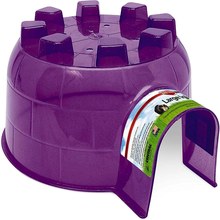
The most commonly missing item on the list and one of the cheapest to fix. Nocturnal animals that sleep through the day need somewhere dark and enclosed to do it.
A hideout plus fleece liners or a snuggle sack gives somewhere to burrow into. Hedgehogs push under fabric and sleep buried, and giving them nothing to burrow under leaves a nocturnal animal sleeping in the open.
Check fleece for loose threads, which can wrap around toes. That is a common and preventable injury.
Floor Space, Well Past Half a Square Meter
The second-most-missed item. Half a square meter is small for an animal built to cover kilometers, and floor area matters more than height here since hedgehogs are poor climbers and can be injured falling.
Long and wide rather than tall, with a solid floor.
Warmth, Which Is a Welfare Emergency If Missed
Not enrichment exactly, and it belongs on the list because everything else fails without it. African pygmy hedgehogs need consistent ambient warmth, and a cold hedgehog may attempt hibernation, which for this species in captivity is dangerous and often fatal.
A ceramic heat emitter on a thermostat holds the ambient temperature without adding light to a nocturnal animal's night.

Foraging
Insectivores that hunt across ground. Scatter feeding, insects released into a dig box of safe substrate, and food hidden inside cardboard or under objects all turn a bowl into a search.
Live insects are the strongest version. Watch the weight either way, since obesity is common in pet hedgehogs and a wheel plus scatter feeding addresses both halves of it.
Alone, Deliberately
Unlike the gerbils and degus that have to be kept in pairs, this species is solitary. Adults housed together fight. Solo housing is the correct answer, never a compromise.
Priority Order
- A large solid-surface wheel, cleaned daily
- A hide with something to burrow under
- Floor space well beyond half a square meter
- Consistent ambient warmth on a thermostat
- Scatter and dig-box foraging with live insects
- Solo housing
- Novel objects and rearrangement, last
What Not to Do
Do not skip the wheel, which 17 percent of owners in that survey did. Do not leave a nocturnal animal without a hide. Do not use a mesh or open-rung wheel. Do not use unsealed fleece with loose threads. Do not let the enclosure get cold enough to trigger hibernation attempts. Do not house two adults together. And do not assume a huffing, balled-up hedgehog is going to enjoy being socialized on your schedule: huffing and balling are defensive reflexes, and forcing a ball open teaches the animal that hands mean restraint.
Sources & Further Reading
❓ Frequently Asked Questions
Is there research on hedgehog welfare?
There is a 2024 study assessing owner investment in African pygmy hedgehog welfare across feeding, housing, enrichment, hygiene and health practice. It is a survey of what owners do rather than an enrichment experiment, and what it found is a useful list of common gaps.
What were the main gaps it found?
Three. 84 percent had no hide, 68 percent were in under half a square meter, and 17 percent had no wheel. Owners who consulted a vet were likelier to clean the wheel daily.
Is a wheel essential?
It is the closest thing to essential in this species. Wild hedgehogs routinely cover five kilometers or more in a night foraging, and no pet enclosure provides that distance. A wheel is the only realistic substitute for that much locomotion.
What kind of wheel?
Large, solid-surface and with a solid running track rather than mesh or rungs. Hedgehog feet and legs are easily injured by grid surfaces, and a wheel too small forces the spine into a curve. Expect to clean it daily, because they defecate while running.
Do hedgehogs need heat?
Yes, and it is the most commonly missed requirement. They need consistent ambient warmth, and if they get too cold they can attempt hibernation, which is dangerous for a captive African pygmy hedgehog and can be fatal.
Should hedgehogs be kept together?
No. African pygmy hedgehogs are solitary and adults kept together fight. Unlike most small mammals in this series, solo housing is the correct answer for this species rather than a compromise.
📰 More on the Hedgehog
📘 Hedgehog care guide
🦔 How Much Does a Hedgehog Really Cost?
🦔 How to Handle a Hedgehog
🦔 Common Hedgehog Health Issues (And Why Wobbly Hedgehog Syndrome Isn't as Common as You've Heard)
🦔 Hedgehog Enclosure Setup: Temperature Is the Non-Negotiable Part
🦔 Hedgehog Feeding: Schedule, Diet, and Why They Stop Eating
🛒 Recommended Gear
As an Amazon Associate, we earn from qualifying purchases through the links above - at no extra cost to you.
Written by Michael Ryan
Mike keeps two rescued bearded dragons, Dex and Cera, and writes the care guides on BeastlyFacts from his own research and mistakes. He is not a veterinarian.
More about Michael Ryan →Comments
No comments yet - be the first!