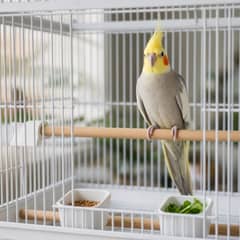
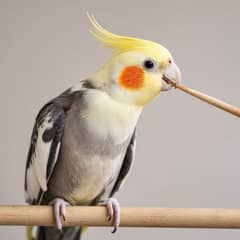
Conure Enrichment: A Big Parrot's Needs in a Small Parrot's Body
On This Page▾

Conures get bought as a manageable parrot. They are a manageable size, which is a different thing. A wild green cheek spends its day on the move with its flock, picking fruit, flowers and seeds, and a pet with a full bowl and nothing to do is finished in minutes.
The gap this species lives in is time. A green cheek with a full bowl has most of its waking day empty, and the behavior problems parrots are known for grow in that empty stretch. Fill it with food to find, things to shred and time with you.
A Day With the Flock
Wild green cheeks live in the dense forests of Paraguay, Bolivia, northwestern Argentina and parts of Brazil. They travel in flocks of 10 to 20 birds and are rarely seen alone or far from the flock. They eat fruit from the forest trees, including figs, mangoes and papaya, along with the seeds and pulp inside, flowers and their nectar, and seeds and nuts. They stay in the same forests year-round, nesting in tree holes.
Each part of that day points to something a pet green cheek needs: food to find and pick apart, company all day, and things to climb and chew.
Foraging, as the Default Way Food Arrives
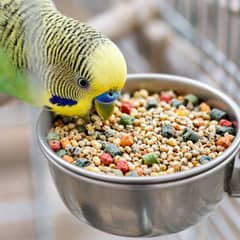
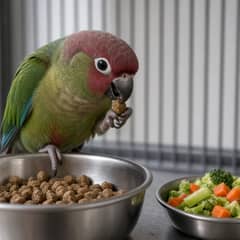
This is the highest-value change, and it costs almost nothing: stop using a bowl as the main way food arrives. Use a foraging box plus homemade versions: food wrapped in paper, pushed into cardboard tubes, threaded on skewers, and hidden in several places around the cage so the bird has to search for it. Rotate the method, because a conure solves a puzzle quickly and then it stops being one.
In young Amazon parrots, foraging work and a more complex cage both prevented and reduced feather picking, and reviews of feather damage in parrots list foraging, enrichment and training together as the interventions. Those are other parrots, but the problem has the same shape: an intelligent flock bird with a full bowl and nothing to do.
Destruction, Provided on Purpose
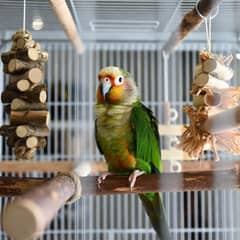
Conures chew and shred constantly. Supply it deliberately and they wreck the supply. Skip it and they wreck the cage, the furniture or their own feathers. Give them varied small parrot toys plus untreated soft wood, cardboard, paper and palm. Treat chew material as something you restock, not equipment. A destroyed toy is the good outcome.
Space and Time Out
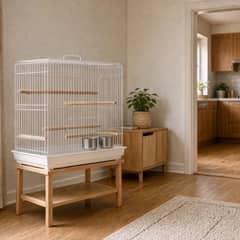
A large flight cage is the baseline, and the time outside it is what matters most. Plan on three to four hours of supervised time out of the cage every day. It does not have to be one block: a morning session and a longer evening one add up the same. Give the conure a stand, a bird-proofed room and things to climb and chew outside the bars.
Supervised means someone is in the room. The hazards a loose conure finds in an unwatched hour (ceiling fans, open water, metal with zinc or lead, nonstick fumes from the kitchen) are set out in the bird household hazards guide. A young conure that is short of stimulation tends to turn nippy, so a bird that bites more as its time out shrinks usually needs more time, not discipline.
Training
Build short daily positive reinforcement sessions into the routine: target training, step-up, recall (flying to you on cue) and simple problem solving. Use a clicker and target stick, run sessions of ten minutes twice a day, and end them while the bird is still engaged.
Sleep
Give the conure 10 to 12 hours of dark, quiet sleep under a plain cage cover, which heads off a lot of parrot behavior problems. Leave out tents, pouches and huts, because nest-like spaces are one of the triggers for hormonal behavior.
Calls and Screaming
Loud calls are how a parrot keeps in touch with its flock, and to a pet conure the household is the flock. Expect the most noise in the early morning and at dusk, when wild flocks gather, and whenever the house gets loud: a vacuum, music, a phone call or people talking over each other. A frightened, bored, lonely, stressed or sick bird calls more. Green cheeks sit at the quieter end of the conure family, but they still call, and enrichment will not make a conure silent.
What makes it worse is attention for the noise. Yelling back, rushing over, or covering the cage and turning off the light all teach the bird that screaming works.
- Ignore the scream whenever you safely can.
- Reward the quiet: when the bird is calm, give praise, a moment of attention, a bite of baby carrot, a pinch of seed or a foraging toy.
- Keep the household routine steady, so the bird is not calling for company it expects and does not get.
- Ask the avian vet for a referral to an avian behaviorist if the calling keeps climbing.
A sound you have never heard from the bird before is different: birds often call out during a seizure, so get it seen right away.
A Day in Practice
Put together, a good day for a pet conure looks like this:
- Morning: fresh pellets and chopped vegetables, and a bath offered early so the feathers dry by night.
- Through the day: part of the food inside foraging toys, safe wood and paper to destroy, and the bird where it can see and hear you.
- Evening: the longer part of the three to four hours of supervised time out of the cage, with a short training session in it, after a shorter session in the morning.
- Night: cage covered, room dark and quiet for 10 to 12 hours.
How to Tell It Is Working
A conure with enough to do plays, shreds, forages, chatters and moves around the whole cage. The warning signs are feather plucking, screaming beyond its normal calls, and biting that gets worse. The same signs can mean illness, so have an avian vet check a conure that shows them.
One Change at a Time
Keep the perches, dishes and cage where they are, and rotate the extras. Add one new toy at a time and watch how the bird takes it. Bring back a toy that has been out of rotation for a few weeks, because a conure often treats it as new.
Priority Order
- Deliver the food through foraging, across several sites.
- Keep destructible material in the cage at all times.
- Give it three to four supervised hours out of the cage in a bird-proofed room.
- Run short training sessions every day.
- Protect 10 to 12 hours of dark, quiet sleep, with no tent or pouch.
- Rotate new objects in and out instead of piling them up.
Start With the Food
If only one thing changes this week, take part of the day's food out of the bowl and hide it in a foraging toy. Add the shredding material next, and keep the daily time out going from there.
Sources & Further Reading
Last reviewed 24 Sep 2026 · 6 sources
- Animal Diversity Web: Pyrrhura molinae (green-cheeked parakeet), University of Michigan Museum of Zoology
- Meehan CL, Millam JR and Mench JA (2003). Foraging opportunity and increased physical complexity both prevent and reduce psychogenic feather picking by young Amazon parrots. Applied Animal Behaviour Science
- Feather damaging behaviour in parrots: a review with consideration of comparative aspects (PDF, downloads)
- Environmental enrichment for birds. Veterinary Partner (VIN)
- VCA Animal Hospitals: Biting and Screaming in Birds
- Conure Care. Tree of Life Exotic Pet Medical Center
Frequently Asked Questions
Is there enrichment research on conures?
Not on conures specifically. The evidence comes from other parrots: in young Amazon parrots, foraging opportunity and increased physical complexity both prevented and reduced feather picking with a behavioral cause, and foraging enrichment has repeatedly improved feather condition across parrot species.
How much time should a conure spend on food?
More than it does. Wild parrots spend a large share of the waking day searching for, selecting and manipulating food, while a captive bird with a full bowl finishes in minutes. Closing even part of that gap is the highest-value change most owners can make.
Are conures as demanding as bigger parrots?
Behaviorally, close to it. They are full parrots in a small body: intelligent, social and destructive, and they still call every day. Buying one expecting a budgie with more color is how conures end up rehomed.
Should a conure sleep in a tent or pouch?
No. Nest-like spaces such as tents, pouches and huts are one of the triggers for hormonal behavior in pet parrots. Give the bird a steady dark period of 10 to 12 hours under a plain cage cover instead.
Are conures loud?
They still call every day. Green cheeks are among the quieter conures, but no amount of enrichment makes one silent.
Can conures live alone?
With a very involved owner, yes, and they need real daily interaction rather than a cage in a busy room. A bonded pair covers the social side better, and a lone conure with an absent owner is the setup that produces screaming and plucking.
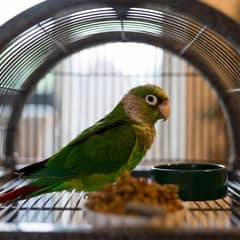
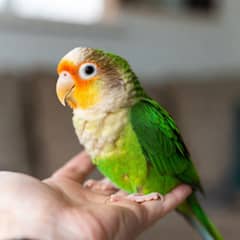

Recommended Gear
As an Amazon Associate I earn from qualifying purchases through the links above, at no extra cost to you.

Written by Michael Ryan
Mike keeps two rescued bearded dragons, Dex and Cera, and writes the care guides on BeastlyFacts from his own research and mistakes. He is not a veterinarian.
More about Michael Ryan →You May Also Like

Subscribe - it's free
An occasional email when something new is worth your time. No spam.
Health and More