Cardinal Tetra Care Guide
Fish
Beastly Facts · Updated
The neon tetra's flashier cousin, lit up red from nose to tail!
On This Page▾

Did you know? Many cardinal tetras are still wild-caught every year on Brazil's Rio Negro through community-based fisheries. The trade is often argued to be a conservation positive, since a living fishery gives river communities an economic reason to keep the forest standing, though the catch could fall if fishing pressure rises.
The first week
The numbers a new owner needs in the first week, each from the article it links to. Rows with no link come from the encyclopedia.
- Before any fish
- A 2008 study on this species found it sensitive to nitrite, so ammonia and nitrite both read zero and a finished cycle before stocking is the single most important step when the tank is first set up.Health guide →
- School size
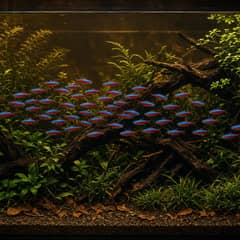
- Plan for ten, with eight the least to buy. Cardinals are obligate schooling fish and need the group to feel secure.Handling guide →
- Tank size
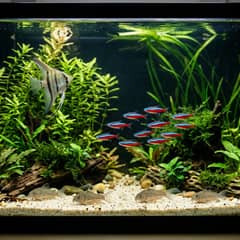
- A 20-gallon long, roughly 24x12 inches of base, for the school of 10. A standard 10-gallon does not meet that footprint.Setup guide →
- Temperature
- 73 to 81°F, held steady anywhere inside it. Keepers run them to 84°F, past the roughly 77°F neons are comfortable with, so they suit a warmer community tank.Setup guide →
- Water chemistry
- Soft and acidic, pH 5.0 to 7.0 and toward the low end. Test your source water first rather than assuming it fits, and ammonia and nitrite read zero before stocking.Setup guide →
- Filtration and substrate
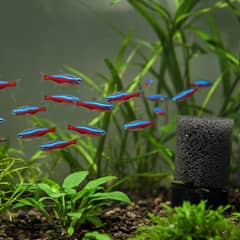
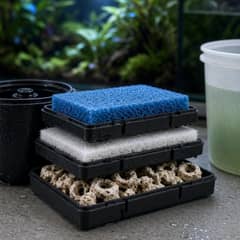
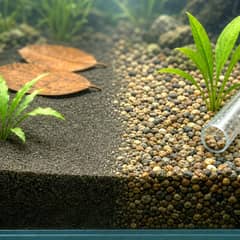
- Gentle flow, a sponge filter is the usual pick, over fine gravel or sand.Setup guide →
- Light and blackwater
- Dim light, driftwood and Indian almond leaves for tannins, dense planting. In a lab test, intense light faded the stripes, while fish kept at 250 lux or less looked more vivid.Setup guide →
- Often wild caught
- Many are still collected from the Rio Negro, and wild-caught fish cope worse with deteriorating water than bred ones, so the first weeks decide a lot. Buy from a shop that has held them a while, acclimate slowly, and keep the tank dim and quiet.Enrichment guide →
- Diet
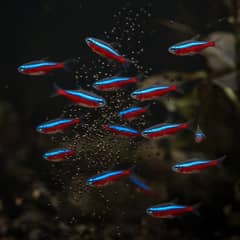
- A micro-pellet or crushed flake as the staple, with live or frozen bloodworms, mosquito larvae, daphnia or moina. Whole flakes and standard pellets are too big for the mouth and get spat out, which starves the fish.Feeding guide →
- Feeding schedule
- Twice a day, what the school finishes in a couple of minutes, or split into three or four smaller feeds. Food still visible after that means cut back, since cardinals are sensitive to nitrite.Feeding guide →
- Water changes
- 25 to 30% weekly from the substrate, with conditioned water at tank temperature. Test nitrate first: under 20 ppm the routine is right, past 40 ppm the next change is 50%.Aquarium Water Changes →
- A dead fish
- Never leave one in the tank or let the others scavenge it. There is no cure for neon tetra disease, and fish that eat an infected body contract it.Feeding guide →
- Quarantine
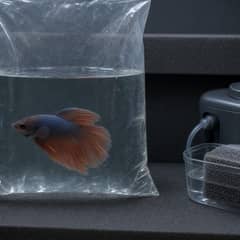
- A full 30 days for any new fish, the most effective way to keep ich out of an established tank.Health guide →
- Budget
- $3.30 to $8 a fish, about $35 to $80 for a school of 10. Setup roughly $165 to $335. Vet care is rarely needed; water quality and over-the-counter treatment cover most of it, and a fish vet is worth paying when losses have no clear cause.Cost guide →
- Lifespan
- About five years in a well-kept tank. In the wild it lives about a year.Cost guide →
- Adult size
- 2 inches (5 cm).
- Water chemistry, the wider picture
- KH holds pH in place, and dosing pH-up or pH-down against it is how keepers crash a tank. Work with what the source water gives you.Freshwater pH, GH, and KH →
- Power outage
- Oxygen is the threat, not darkness. Unplug the filter rather than letting it sit dead in the water, and keep the surface moving.Power outage guide →
Emergency card
Test the water first, then act on these today. Aquatic vets are rare, so nearly all of this is handled at home.
- Small white spots like grains of salt, flashing against decor, rapid breathing: ich, treated with medication and daily partial water changes, warming slowly to 81°F with strong aeration; heat alone is not a treatment for cardinals
- Discoloration on the fin edges, then fraying: fin rot, treatable
- Floating at the surface unable to swim down, or struggling to rise: poor water quality first, then overfeeding
- Restless or erratic swimming at night, fading or patchy color, lumps under the skin, a curved spine: neon tetra disease, no cure, and the fish is separated so the others cannot eat it
Everything treatable here traces back to water quality and stability. The untreatable one is prevented by quarantine.
Where to go next
How Much Does Cardinal Tetra Ownership Cost?
$3.30 to $8 a fish, the $165 to $335 setup, and the Rio Negro fishery behind why this one prices above a neon.
Cardinal Tetra Tank Setup: A 20-Gallon Long, Warm Soft Water, and Dim Light
The 20-gallon long, 73 to 81°F, soft acidic water, gentle flow, and the blackwater tannins that change the fish.
Cardinal Tetra Feeding: Schedule, Diet, and the Rule That Prevents an Outbreak
Micro-pellet portions, the two-minute rule, and why removing a dead fish immediately is the real defense against an incurable disease.
Cardinal Tetras Aren't Handled Either, and School Size Is the Rule That Counts
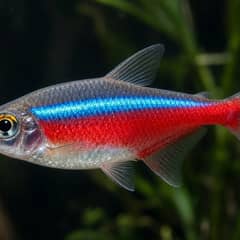
Why this is an observation fish, the ten-fish minimum, acclimation after long shipping, and the stripe that tells it from a neon.
Common Cardinal Tetra Health Issues (Including a Disease Named After a Different Fish)
Neon tetra disease, ich, fin rot, swim bladder trouble, and the 2008 study that found this species sensitive to nitrite.
Cardinal Tetra Enrichment: Many Are Still Wild
Many are still wild caught, what that means for the first weeks, and the borrowed neon tetra finding that says ten.
What to buy
As an Amazon Associate I earn from qualifying purchases. Underlined items are paid Amazon links, at no extra cost to you.
Prices and the reasoning behind each item are in How Much Does Cardinal Tetra Ownership Cost?.
Full Cardinal Tetra gear listFrequently Asked Questions
How many cardinal tetras should I keep together?
Ten is the number to plan for, and eight is the least to buy. Cardinals are schooling fish that do best in a large group. Smaller groups turn pale, hide, and get sick more often from the stress.
Can cardinal tetras get neon tetra disease?
Yes. It is named for the neon, but the microsporidian parasite behind it, Pleistophora hyphessobryconis, affects tetras broadly, along with angelfish, rasboras, barbs, and zebrafish. Watch for restless or erratic swimming, fading or patchy color, visible lumps under the skin, and a curved spine in advanced cases.
What's the non-obvious detail that makes the biggest difference in a cardinal tetra tank?
Blackwater conditions. As driftwood and Indian almond leaves release tannins, the water tints and the pH eases down, which copies the shaded, leaf-strewn streams the fish comes from. Add dense planting and dim light, and color and confidence both improve noticeably.
Subscribe - it's free
New care guides straight to your inbox. No spam.
Deep Dive

Health and More





Fun Facts
🐠 Stripes on a Dimmer Switch
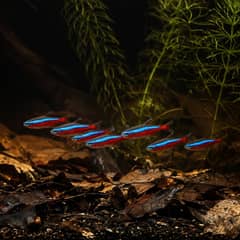
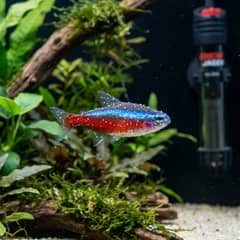
A cardinal tetra's famous stripes come with a dimmer switch. In low light its dark and neon blue stripes grow more vibrant, but under intense light they fade pale while the red stripe deepens. Researchers suggest that fading may be camouflage during the brightest hours in the Rio Negro's black water, helping the fish confuse predators.
Explore More