Cardinal Tetra
Paracheirodon axelrodi
On This Page▾
🌍 Overview
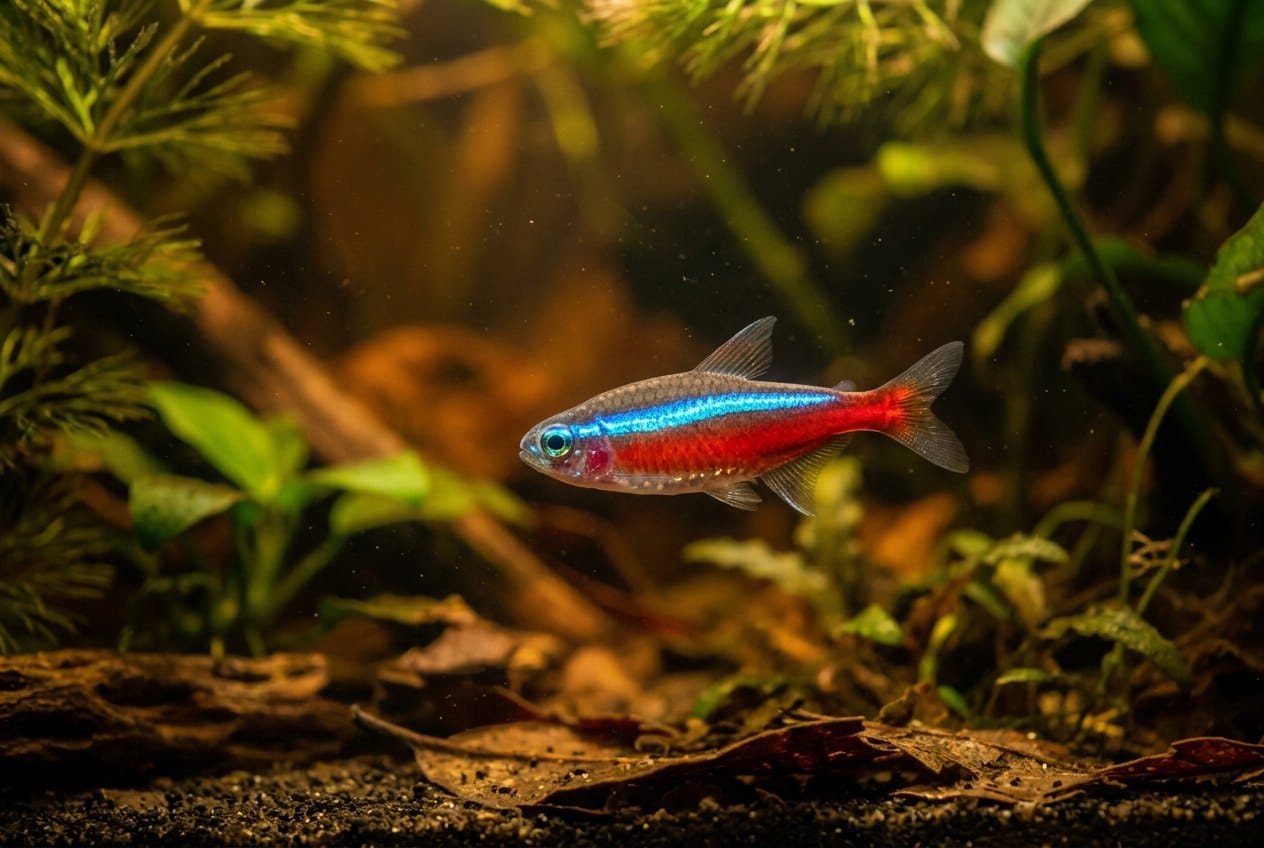
The cardinal tetra is a small schooling fish from the blackwater tributaries of the Amazon and Orinoco basins, closely resembling the neon tetra but with its iridescent red stripe running the full length of the body rather than just the rear half. Enormous numbers are still sustainably wild-harvested from the Rio Negro each year through community-based fisheries, a rare case where the aquarium trade directly funds rainforest conservation by giving local communities an economic reason to keep the forest, and the river, intact.
📋 Quick Facts
Native Range
Amazon and Orinoco Basins (Brazil, Colombia, Venezuela)
Natural Habitat
Blackwater forest streams and tributaries
Adult Size
2 inches (5 cm)
Wild Diet
Small insects, worms, crustaceans, and zooplankton
Wild Lifespan
Often under 1 year (seasonal pools frequently strand and dry out); commonly 4-5 years, up to 10, in a stable aquarium
Conservation Status
Not evaluated (widespread; sustainable wild-harvest fishery supports conservation in parts of its range)
📜 History
Its scientific name comes out of one of the odder priority races in ichthyology. In 1956 George Myers and Stanley Weitzman were preparing to describe the fish as Hyphessobrycon cardinalis, but Leonard Schultz published his own description first, in the hobbyist magazine Tropical Fish Hobbyist, and named it Cheirodon axelrodi after the magazine's founder Herbert R. Axelrod. Schultz won on priority, and the species is now Paracheirodon axelrodi. Myers and Weitzman lost the binomial and kept everything else, because their proposed epithet survives, in English, as the common name every shop uses.
⚖️ Compare
Cardinal Tetra
Human
Adult Size
2 inches (5 cm)
5-6 feet (150-185 cm); ~135-200 lbs
Wild Lifespan
Often under 1 year (seasonal pools frequently strand and dry out); commonly 4-5 years, up to 10, in a stable aquarium
~73 years (global average)
Wild Diet
Small insects, worms, crustaceans, and zooplankton
Omnivorous - eats just about anything
Native Range
Amazon and Orinoco Basins (Brazil, Colombia, Venezuela)
Global - originated in Africa roughly 300,000 years ago
Natural Habitat
Blackwater forest streams and tributaries
Everywhere from arctic tundra to tropical megacities
Conservation Status
Not evaluated (widespread; sustainable wild-harvest fishery supports conservation in parts of its range)
Least Concern (8+ billion and counting)
🧠 Test Yourself
What's the Cardinal Tetra's native range?
🤩 Fun Facts
🐠 A Stripe That Hides You
That vivid red-and-blue stripe isn't just decoration. In the dim, tannin-stained water this species evolved in, the metallic stripe actually functions as camouflage, reflecting available light in a way that creates false or confusing targets for predators. What looks like the showiest feature in a home aquarium is doing real defensive work in a blackwater stream.
📖 Care Guide
Cardinal Tetra Care Guide
The neon tetra's flashier cousin, lit up red from nose to tail!
Subscribe - it's free
New animal facts and care guides straight to your inbox. No spam. 🐾
📰 Deep Dive
🐠 How Much Does Cardinal Tetra Ownership Really Cost?
🐠 Cardinal Tetras Aren't Handled Either, But the School Size Rule Is Even Stricter
🐠 Common Cardinal Tetra Health Issues (Including a Disease Named After a Different Fish)
🐠 Cardinal Tetra Tank Setup: Soft Water, Warmer Temps, and a Blackwater Feel
🐠 Cardinal Tetra Feeding: Schedule, Diet, and the Rule That Prevents an Outbreak
🐠 Cardinal Tetra Enrichment: Most of Them Are Still Wild
🩺 Health and More
🐠 Aquarium Power Outages, Transport, and Moving Your Fish: The Complete Plan
🦠 How to Cycle a Fish Tank, Start to Finish: Fishless and Fish-In
🧽 Aquarium Filtration: How It Actually Works and How to Maintain It
🪣 Aquarium Water Changes: How Much, How Often, and What the Number Is For
🐟 Aquarium Stocking and Tankmates: How Many Fish, and Which Ones Go Together
🧪 Freshwater pH, GH, and KH: Why Chasing a Number Backfires
🤓 Did You Know?
Huge numbers of cardinal tetras are still sustainably wild-harvested from Brazil's Rio Negro every year through community-based fisheries, a rare case where the aquarium trade directly funds rainforest conservation by giving local communities a real economic reason to keep the river intact.
Explore More