Pacman Frog
Ceratophrys ornata
On This Page▾
🌍 Overview
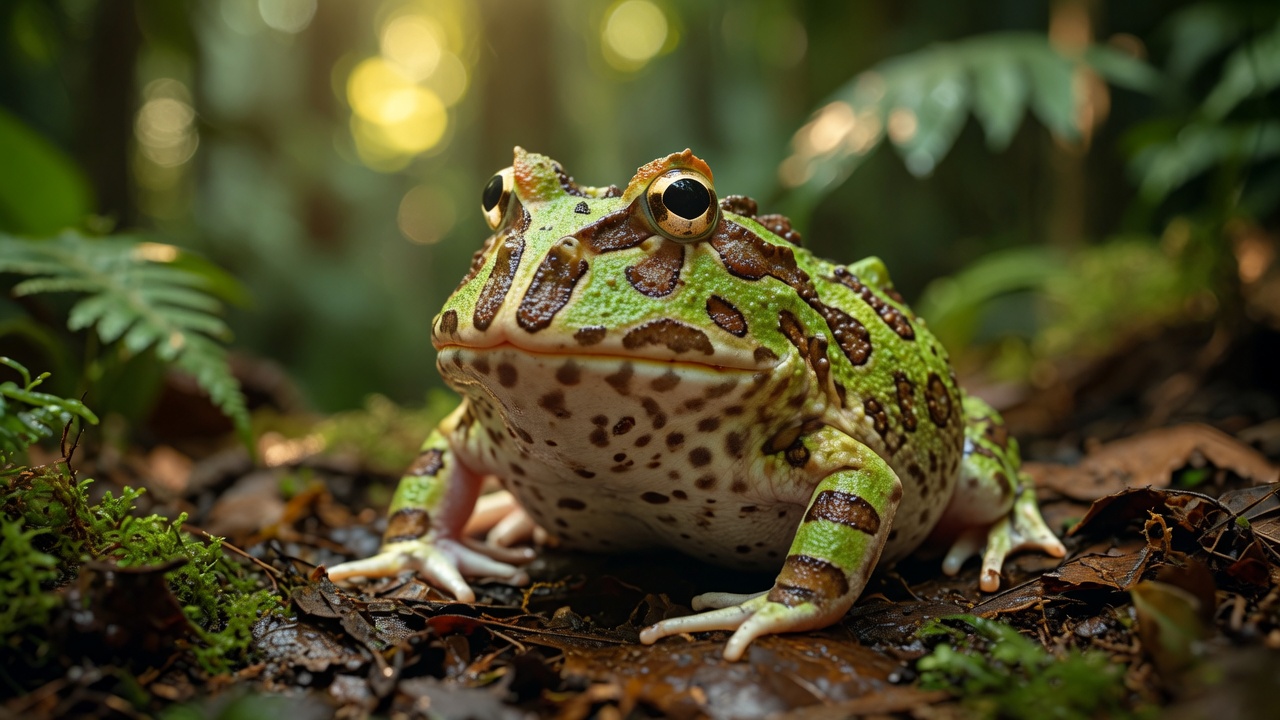
The ornate horned frog - nicknamed the Pacman frog for its enormous, round, gaping mouth - is native to the grasslands and rainforests of South America. They are ambush predators that bury themselves in soil or leaf litter and wait, motionless, for prey to enter range of their enormous mouth. Despite their sluggish lifestyle, Pacman frogs will attempt to consume prey nearly as large as themselves - including other frogs, rodents, and small snakes.
📋 Quick Facts
Native Range
South America (Argentina, Brazil, Uruguay)
Natural Habitat
Grassland, tropical rainforest, and humid meadows
Adult Size
4-7 inches (10-18 cm) body; 0.5-1.5 lbs
Wild Diet
Insects, worms, mice, other frogs, and small vertebrates
Wild Lifespan
Not well documented in the wild; about 6 years is the usual figure given, with captive records reaching 14.7 years
Conservation Status
Least Concern (IUCN)
📜 History
The species entered science through Darwin's voyage. Thomas Bell described it in 1843 as Uperodon ornatum, in the reptiles volume of the Zoology of the Voyage of H.M.S. Beagle, from a specimen labeled Buenos Ayres, with syntypes catalogued at the British Museum; the genus Ceratophrys, where it eventually landed, had been erected by Wied-Neuwied in 1824. Modern keeping rests on two species rather than one, since Cranwell's horned frog, Ceratophrys cranwelli, is bred and sold alongside the ornate. Breeders also cross Ceratophrys cranwelli with the Surinam horned frog to produce the captive hybrid marketed as the fantasy frog.
⚖️ Compare
Pacman Frog
Human
Adult Size
4-7 inches (10-18 cm) body; 0.5-1.5 lbs
5-6 feet (150-185 cm); ~135-200 lbs
Wild Lifespan
Not well documented in the wild; about 6 years is the usual figure given, with captive records reaching 14.7 years
~73 years (global average)
Wild Diet
Insects, worms, mice, other frogs, and small vertebrates
Omnivorous - eats just about anything
Native Range
South America (Argentina, Brazil, Uruguay)
Global - originated in Africa roughly 300,000 years ago
Natural Habitat
Grassland, tropical rainforest, and humid meadows
Everywhere from arctic tundra to tropical megacities
Conservation Status
Least Concern (IUCN)
Least Concern (8+ billion and counting)
🧠 Test Yourself
What's the Pacman Frog's native range?
📖 Care Guide
Pacman Frog Care Guide
The round, grumpy ambush predator that is essentially all mouth!
Subscribe - it's free
New animal facts and care guides straight to your inbox. No spam. 🐾
📰 Deep Dive
🐸 How Much Does a Pacman Frog Really Cost?
🐸 Should You Handle a Pacman Frog? Rarely, and Carefully
🐸 Common Pacman Frog Health Issues and What Causes Them
🐸 Pacman Frog Tank Setup: Small Footprint, One Big Rule About Substrate
🐸 Pacman Frog Feeding: Schedule, Diet, and Why They Stop Eating
🐸 Pacman Frog Enrichment: An Animal Built to Do Nothing
🩺 Health and More
🤓 Did You Know?
Pacman frogs (horned frogs, genus Ceratophrys) have an extraordinarily powerful bite for an amphibian. Their bite force relative to body size is comparable to some predatory dinosaurs. They will attempt to eat anything that moves near them, including other frogs, small mice, and keepers' fingers.
Explore More